
Billy Joel’s vocal range spans approximately A2 to A5, giving him close to three octaves across his studio recordings and live performances. Considered a lyric baritone, Joel is known for his warm lower register, expressive midrange, and bright, gritty upper tone that has become central to his sound.
This 2025 vocal profile covers his range, voice type classification, signature vocal traits, song-by-song examples, and how his voice has evolved over time.
Billy Joel’s vocal range is approximately A2–A5, about three octaves.
His primary voice type is a lyric baritone, known for warmth, resonance, and expressive grit in the upper midrange.
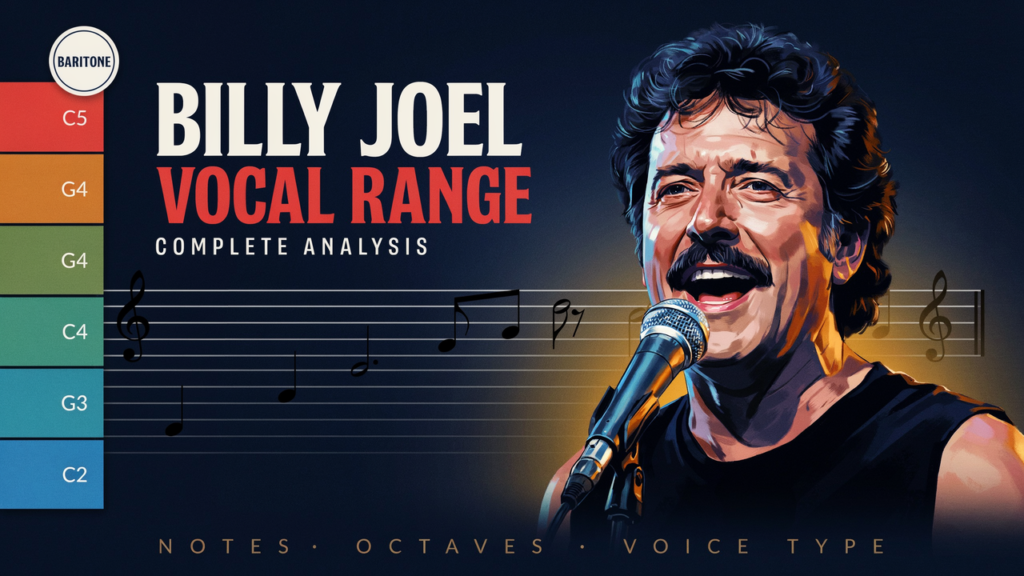
Billy Joel’s Exact Vocal Range Explained
Low Notes: A2
Joel consistently reaches solid A2 notes, especially in slower ballads and jazz-influenced tracks.
Comfortable Register: B2 – E4
Most of his vocals sit in this baritone-friendly range, where he delivers his clearest phrasing and strongest emotional expression.
Upper Notes: G4 – A4 (Chest/Mix)
He frequently hits G4 and A4 using a supported mix, yielding strong, bright tones without forcing.
Extended High Notes: up to A5 (Falsetto/Head Voice)
While uncommon, Joel has reached A5 in layered harmonies or expressive head-voice moments.
Is Billy Joel a Tenor or Baritone?
Billy Joel is a lyric baritone, though he sometimes sounds like a tenor. The confusion comes from:
- His bright resonance
- Skillful vowel modifications
- Mixed voice technique
- Crisp rock phrasing
- The brightness of songs like “Uptown Girl”
Baritone Characteristics in His Voice
- Strong resonance in the C3–E4 area
- Warm, weighty timbre
- Controlled breath support
- Expressive vibrato
While he can reach some tenor-like highs, his vocal comfort zone places him firmly in the baritone category.
Billy Joel Vocal Range in His Most Famous Songs
| Song | Approximate Range | Vocal Notes |
|---|---|---|
| Piano Man | B3 – E4 | Classic baritone phrasing |
| Uptown Girl | C4 – A4 | Bright, energetic upper register |
| New York State of Mind | A2 – D4 | Warm jazz expression |
| The Longest Time | F2 – F4 | Smooth doo-wop clarity |
| Honesty | B3 – G4 | Strong emotional belting |
| Scenes from an Italian Restaurant | A2 – F4 | Wide dynamic variation |
These examples show Joel’s range flexibility across genres.
A strong vocal foundation starts with controlled airflow, which you can build using the methods in breathing techniques for singing. Understanding how your registers interact through chest voice vs head voice helps eliminate strain. To evaluate improvements in stability and range, retake the vocal range test as your technique develops.
How Billy Joel’s Voice Has Changed Over Time
Early Career (1970s)
His tone was smoother, lighter, and more agile, allowing him to hit upper notes like G4 and A4 with less strain.
Middle Career (1980s–1990s)
Joel developed more power, resonance, and the trademark grit that many fans associate with his peak sound.
Later Career (2000s–2025)
His upper extension has slightly lowered, but his interpretive phrasing and emotional expression have strengthened.
Billy Joel’s voice today prioritizes storytelling and connection rather than high-note athleticism.
What Makes Billy Joel’s Voice Unique?
Grit and Controlled Distortion
Joel uses rasp with precision, adding emotional weight without damaging tone.
Emotional Phrasing
He shapes words and timing to tell a story, similar to classic jazz and Broadway vocalists.
Dynamic Versatility
He moves effortlessly from soft ballads to powerful rock belting.
Resonant Midrange Strength
His most identifiable tone lies between C3 and E4, where his voice carries warmth and presence.
Genre Adaptability
Joel comfortably transitions between pop, rock, jazz, doo-wop, and even classical influences.
How Billy Joel Compares to Other Legendary Singers
| Singer | Range | Voice Type | Comparison Notes |
|---|---|---|---|
| Elton John | F2 – C6 | Tenor | Wider high range, lighter tone |
| Freddie Mercury | F2 – F#6 | Tenor | Exceptional flexibility and power |
| Bruce Springsteen | B2 – A4 | Baritone | Similar grit but darker tone |
| Paul McCartney | A2 – A5 | Tenor/Baritone mix | Similar range but brighter timbre |
Billy Joel’s appeal comes not from extreme range but from emotional authenticity and expressive control.
Can You Sing in Billy Joel’s Range?
You may be able to sing Joel’s catalog comfortably if you:
- Are a baritone or high baritone
- Have a strong midrange between C3 and E4
- Can access mild grit or brightness in your upper notes
To compare your range with his:
- Use a vocal range tester
- Try singing passages from his songs
- Identify where your tone feels natural versus strained
Frequently Asked Questions
What is Billy Joel’s vocal range?
His range is approximately A2–A5, close to three octaves.
What is Billy Joel’s voice type?
He is a lyric baritone.
Does Billy Joel still sing well live today?
Yes. Although keys may be lowered, he remains expressive and highly musical.
Why does Billy Joel sometimes sound like a tenor?
His bright mix, vowel shaping, and rock phrasing can make his tone seem higher than his true classification.
What is Billy Joel’s best vocal song?
“New York State of Mind” highlights depth, “Honesty” highlights power, and “Uptown Girl” highlights brightness.
What is his hardest song to sing?
“Uptown Girl,” due to its sustained A4 lines.
Which vocal genre does he perform best in?
Pop-rock ballads and jazz-infused storytelling pieces.
Erika Parker is a vocal analysis and singing education writer at Vocal Range Test. She focuses on vocal range testing, voice type analysis, pitch recognition, and singing tools for vocalists, musicians, choir singers, and beginners.