
Ella Fitzgerald is widely considered the greatest jazz vocalist of all time—celebrated for her perfect pitch, pure tone, unmatched vocal agility, and the most sophisticated scat technique in recorded music. Her voice combined instrument-level precision, classical clarity, and jazz improvisational brilliance, producing a sound that remains the gold standard for vocalists worldwide.
This authoritative guide analyzes Ella Fitzgerald’s vocal range, voice type, highest and lowest notes, scat technique, and how her voice evolved across five decades.
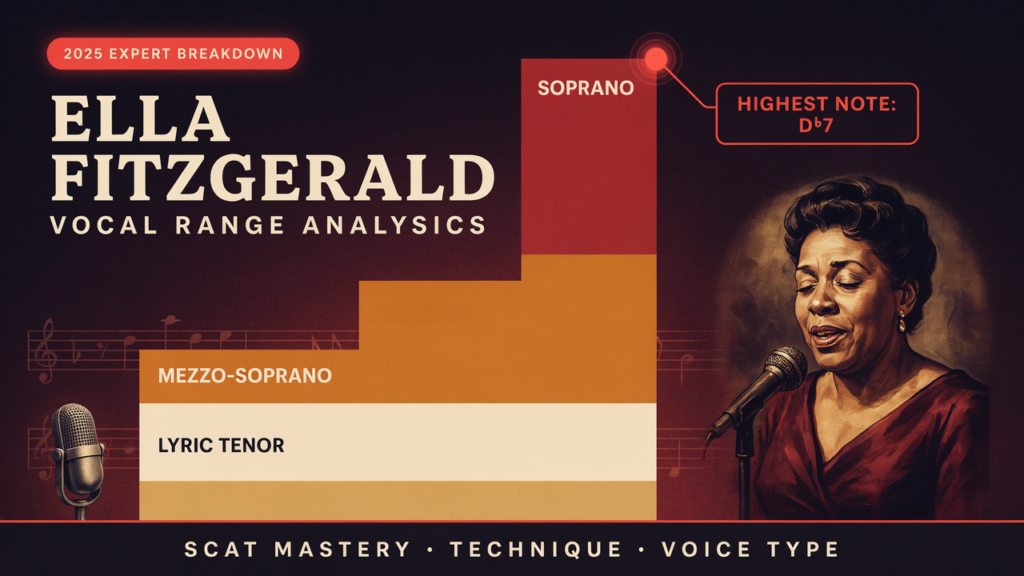
Ella Fitzgerald’s Vocal Range: D3 – C6 (Approx. 3 Octaves)
Ella Fitzgerald’s documented range sits around: D3 – C6
(approximately three octaves, with occasional higher extensions during improvisation)
While many singers demonstrate wide ranges, Ella’s distinction lies not merely in range but in absolute control across every register.
Lower Register (D3–E3)
Ella’s low notes are warm, smooth, and unforced.
- Heard in: “Cry Me a River,” “Angel Eyes,” “Misty”
- She rarely showcased lows for effect; instead, she used them to shape phrasing with elegance.
Middle Register (G3–B4): Her Primary Tessitura
This is where Ella’s voice becomes unmistakable:
- Crystal clarity
- Effortless resonance
- Masterful legato and rhythmic precision
- Perfect placement and intonation
Most of her jazz standards, including the Great American Songbook recordings, sit here.
Upper Register (C5–C6)
Ella’s upper range demonstrates her coloratura-like agility:
- Clean, ringing head voice
- Exceptional pitch accuracy
- No strain or tonal distortion
- Rapid interval leaps in scat passages
Her most precise upper-range work appears in “How High the Moon,” “Airmail Special,” and her live versions of “Mack the Knife.”
Ella Fitzgerald’s Voice Type: Light Lyric Soprano
Ella Fitzgerald is best classified as a light lyric soprano—a voice type known for clarity, flexibility, and upper-register ease.
Why “Light Lyric Soprano” Fits Perfectly
- Bright, bell-like tonal quality
- Rapid agility across all registers
- Head voice with a clean, shimmering timbre
- Straight, natural vibrato
- Absence of weight or huskiness typical of mezzos
Notable Technical Traits of Ella’s Soprano Voice
- Ability to execute coloratura-like passages—rare in jazz
- Seamless blending of chest, middle, and head registers
- Tonal consistency from softest pianissimo to full-voiced phrases
- Intonation so precise it bordered on perfect pitch
Her voice was not powerful in a dramatic sense—it was pure, elastic, and instrumentally precise, making her a unique figure in both jazz and vocal history.
Why Ella Fitzgerald’s Tone Was Unmatched
Ella’s tone is considered one of the purest in recorded music. Key reasons include:
1. Nearly Perfect Intonation
Her pitch was so precise that instrumentalists often took reference from her.
No scoop. No slide. No pitch drift. Just clean, centered tone.
2. Seamless Register Transitions
She shifted between chest, middle, and head voice with no audible break—something even classical sopranos struggle with.
3. Breath Mastery
Ella could sustain long legato lines without any audible tension, using diaphragmatic support that remained stable over decades.
4. Articulation & Diction
Her consonant clarity was unmatched. Even during ultra-fast scat passages, every syllable remained crisp and audible.
5. Vibrato Control
Ella used a light, even vibrato, adding warmth without overpowering rhythm or melody.
This combination created the signature “Ella sound”—warm, effortless, and impeccably precise.
Gaining control over your registers starts by understanding the fundamentals explained in chest voice vs head voice. Once you’re familiar with how your voice shifts, you can safely work upward using the methods in how to sing high notes. Throughout your training, track your progress with updated measurements from the vocal range test.
Highest and Lowest Notes (With Song Evidence)
Highest Notes (C6 and above in scat)
Ella occasionally touched C6 and slightly beyond during live scat sequences.
Most notable examples:
- “How High the Moon” — rapid-fire leaps approaching C6
- “Airmail Special” — virtuosic fifth-octave lines
- “Mack the Knife” (Live in Berlin, 1960) — improvisations reaching the upper fifth octave
These high notes were clean and pitch-secure—never screamed, strained, or pushed.
Lowest Notes (D3–E3)
Ella’s lower register is showcased in:
- “Cry Me a River”
- “Misty”
- “Prelude to a Kiss”
While she was not a contralto, her lows retained warmth and clarity.
The Technique Behind Ella Fitzgerald’s Scat Singing
Ella is the undisputed master of scat singing, and her technique remains unmatched even today.
1. Instrumental-Level Improvisation
Ella didn’t just sing scat—she imitated horns, drum hits, and bebop lines with uncanny accuracy.
2. Bebop Harmonic Intelligence
She improvised with harmonic awareness equal to top jazz instrumentalists, anticipating chord changes and outlining arpeggios with precision.
3. Incredible Interval Accuracy
Ella could navigate huge jumps (octave, ninth, eleventh) with laser-focused pitch.
4. Syllabic Vocabulary
Her scat syllables (“bap,” “dit,” “doo-wah,” “zoop,” etc.) were rhythmically and tonally intentional, never random.
5. Rhythmic Sophistication
She understood swing and syncopation at a fundamental level—her timing was flawless.
Repeatedly, Ella proved that scat singing is not “nonsense syllables”—it is instrumental improvisation executed through the voice.
How Ella Fitzgerald’s Voice Evolved Across Her Career
1930s–1940s (Youthful Soprano)
- Light, girlish timbre
- Early glimpses of scat ability
- Clean, agile phrasing
- Crystal-clear intonation
1950s–1960s (Golden Era)
- Peak technical mastery
- Best examples of tone, agility, and pitch
- Perfect control across three octaves
- Landmark Songbook recordings
- Legendary scat performances
1970s–1980s (Mature Warmth)
- Slightly darker tone
- Reduced but still impressive agility
- Increased interpretive depth
- Continued tonal purity despite age-related decline
Ella maintained exceptional vocal health across decades—extremely rare for a singer with such complex technical demands.
Ella Fitzgerald Compared to Other Iconic Jazz Vocalists
| Singer | Vocal Range | Voice Type | Signature Qualities |
|---|---|---|---|
| Ella Fitzgerald | D3–C6 | Light Lyric Soprano | Perfect pitch, unmatched scat agility, crystal clarity |
| Sarah Vaughan | F2–B5 | Contralto/Mezzo | Dark, operatic richness, wide vibrato |
| Billie Holiday | D3–B5 | Light Mezzo | Emotional nuance, unique timbre |
| Dinah Washington | F3–D6 | Soprano | Bright tone, gospel-influenced attack |
| Carmen McRae | E3–C6 | Alto/Mezzo | Conversational phrasing, rhythmic sophistication |
Ella stands singular for her precision + purity + agility—a rare triple combination.
Frequently Asked Questions
What is Ella Fitzgerald’s vocal range?
Approximately D3–C6, covering around three octaves.
What voice type was Ella Fitzgerald?
A light lyric soprano with exceptional flexibility.
What was her highest note?
Around C6, often hit during scat improvisations.
What was her lowest note?
Approximately D3, used sparingly but clearly.
How was she able to scat so accurately?
She combined perfect pitch, harmonic knowledge, rhythmic mastery, and vocal agility.
Did her voice change over time?
Yes—slightly darker tone and reduced agility later, but unmatched purity remained.
- To understand where Ella Fitzgerald fits among classical and jazz voices, start with difference between soprano alto tenor and bass.
- Her legendary agility becomes clearer when viewed through the lens of what is a good vocal range.
- You can compare your own span to hers by using how to find your vocal range on piano.
- The control behind her flawless pitch runs is explained in how do the vocal cords work.
- Many of her floating highs sit in registers detailed in does head voice count in vocal range.
- To see how her note span compares to modern vocal extremes, is 4 octaves a good vocal range puts it in perspective.
Erika Parker is a vocal analysis and singing education writer at Vocal Range Test. She focuses on vocal range testing, voice type analysis, pitch recognition, and singing tools for vocalists, musicians, choir singers, and beginners.