
Whispering is often assumed to be gentle on the voice because it’s quiet.
In reality, whispering does use the vocal cords—and it does so in a way that can create more tension than speaking normally.
This guide provides a scientifically accurate, clinically aligned, and singer-friendly explanation of how whispering works, what it does to the vocal cords, whether it is safe, and what to do instead.
Does Whispering Actually Use Your Vocal Cords?
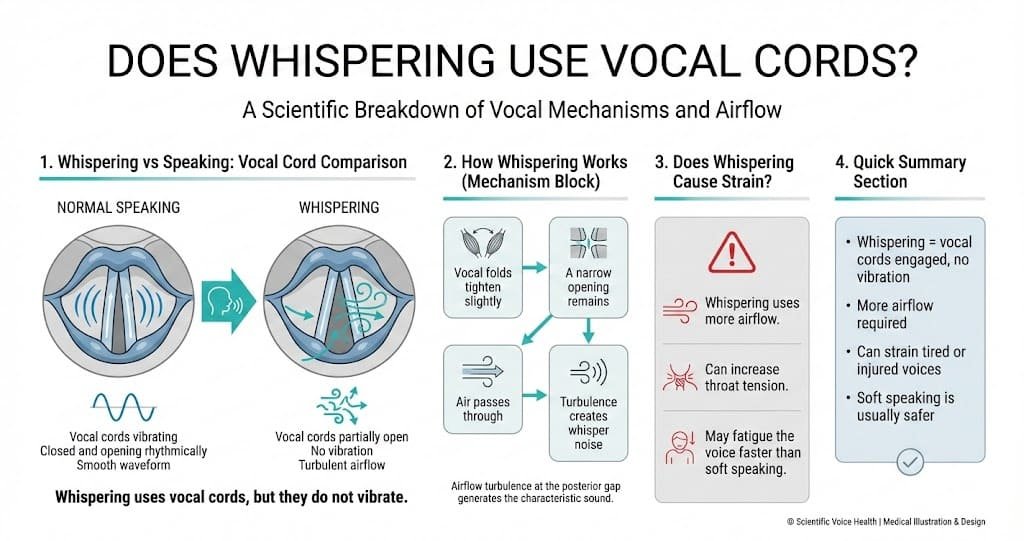
Yes. Whispering engages the vocal cords, but without vibrating them.
During whispering:
- The vocal cords are pulled together tightly at the front
- A small opening called the “whisper triangle” forms at the back
- Air passes through this gap, causing turbulent airflow
- No pitch is produced because the folds do not vibrate
In short:
- Whispering does not vibrate the vocal cords
- But whispering does require muscular effort from the vocal cords and surrounding laryngeal structures
- This posture is more taxing than soft speech
How Whispering Works Inside the Larynx (Anatomy + Physiology)
When whispering, the body uses a special configuration:
1. Vocal Folds Partially Adduct (Come Together)
They approximate firmly at the front to block vibration.
2. A Back Opening Forms (Whisper Triangle)
A triangular gap near the arytenoid cartilages allows airflow to escape.
3. Turbulent Airflow Produces Sound
Sound is created by air friction, not vocal fold vibration.
4. Increased Laryngeal Tension Is Required
Maintaining this configuration requires more muscular engagement than gentle phonation.
This combination explains why whispering is not a vocal rest strategy and can aggravate vocal fatigue.
Is Whispering Bad for Your Voice?
Whispering can be harmful because it:
- Increases tension in the intrinsic laryngeal muscles
- Dehydrates the vocal folds
- Causes irritation due to turbulent airflow
- Forces the folds into a “held” posture
- Overworks the arytenoid muscles
Whispering is especially harmful when:
- You are sick
- You are hoarse
- You are recovering from vocal strain
- You whisper for long periods
- You whisper loudly (a common mistake)
As a result, whispering often delays healing instead of helping.
Speech therapists, ENTs, and vocal coaches consistently warn against whispering during vocal injury or fatigue.
Whispering vs. Speaking Softly (Important Difference)
| Behavior | Do Vocal Cords Vibrate? | Muscle Tension | Airflow Type | Vocal Safety |
|---|---|---|---|---|
| Whispering | No | High | Turbulent | Low |
| Soft speaking | Yes | Low | Laminar (smooth) | High |
| Silent rest | None | None | None | Highest |
Key takeaway:
Soft talking is safer than whispering.
True vocal rest is best for healing.
Why Whispering Feels Scratchy or Tiring
Whispering produces sound by air turbulence, which:
- Dries the vocal fold tissue
- Removes protective mucus
- Causes a scratchy sensation
- Leads to vocal fatigue quickly
- Increases friction against the glottal surface
This explains why prolonged whispering feels harsher than speaking.
Why Whispering Is a Bad Idea for Singers
Singers are particularly affected because whispering:
- Disrupts breath–resonance coordination
- Creates unnecessary tension in the larynx
- Reduces flexibility in the upper registers
- Interferes with warm-up efficiency
- Makes recovery slower after heavy vocal use
Professional voice educators universally discourage whispering before rehearsals, performances, or recording sessions.
When Is Whispering Safe?
Whispering is safe only when:
- Used briefly
- Your voice is healthy
- You are not recovering from strain
- You do not rely on it as your primary communication
It becomes unsafe when used:
- Repetitively
- During illness
- During hoarseness
- When tired
- When forced to be loud
Even healthy whispering should be minimized.
Healthier Alternatives to Whispering
1. Gentle, Quiet Speech
Speak softly at your normal pitch without breathiness or strain.
2. Resonant Voice (Therapeutic Technique)
Forward, buzzy, easy tone with reduced vocal fold impact.
3. SOVT (Semi-Occluded Vocal Tract) Exercises
Such as:
- Straw phonation
- Lip trills
- Light humming
These reduce pressure on the folds.
4. Full Vocal Rest
The safest option for recovery.
Common Myths About Whispering
Myth 1: Whispering protects your voice.
False — it increases strain.
Myth 2: Whispering uses fewer muscles.
False — it uses more laryngeal tension.
Myth 3: Whispering avoids irritating vocal cords.
False — turbulent airflow is more irritating.
Myth 4: Whispering is necessary when you are hoarse.
False — speech therapists recommend soft speech instead.
Frequently Asked Questions
Does whispering use your vocal cords?
Yes, whispering uses them in a tense, non-vibratory configuration.
Is whispering safer than talking quietly?
No—soft speaking is safer.
Can whispering damage the vocal cords?
It can worsen inflammation and delay recovery, especially during hoarseness or illness.
Why does whispering feel scratchy?
Because turbulent airflow dries and irritates the vocal folds.
Should singers whisper?
No. Whispering introduces tension that interferes with vocal balance.
Can whispering cause nodules?
Not directly, but chronic strain can contribute to irritation that leads to injury.
How long can I whisper safely?
Short periods only, and not when your voice is fatigued or sick.
- To understand what really happens when you whisper, start with this breakdown of how your vocal cords work.
- Many singers are surprised that poor technique is often addressed in beginner singing lessons that teach gentle phonation.
- If you’re worried about damage, this guide on does vocal coaching work explains how professionals prevent vocal strain.
- Whisper-related tension can be reduced by practicing these Alexander Method exercises for neck and throat release.
- Posture and airflow corrections taught in the Alexander Technique for musicians also protect the vocal folds.
- Long-term vocal health is easier to maintain with structured adult singing lessons that reinforce safe speaking and singing habits.
- For a complete technical foundation, the best online singing lessons hub reviews programs focused on vocal health and control.
Erika Parker is a vocal analysis and singing education writer at Vocal Range Test. She focuses on vocal range testing, voice type analysis, pitch recognition, and singing tools for vocalists, musicians, choir singers, and beginners.