
Josh Groban remains one of the most technically consistent and expressively refined vocalists in contemporary music. With a foundation rooted in classical training and an ability to interpret repertoire across pop, classical crossover, and musical theater, Groban demonstrates exceptional vocal control and artistic versatility. Understanding Josh Groban’s vocal range and voice type requires both technical accuracy and a clear understanding of classical vocal pedagogy.
This expert analysis evaluates Groban’s range, registration strategies, resonance profile, technical strengths, and the repertoire that demonstrates his capabilities.
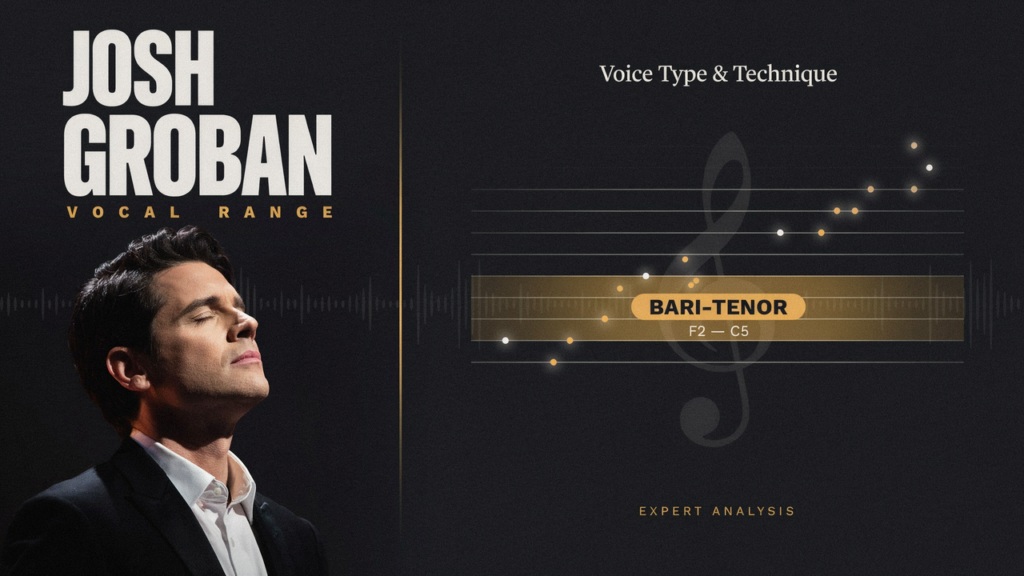
Josh Groban Vocal Range
Josh Groban’s functional vocal range can be classified as: B2 – G5
(Approximately 2.5 octaves)
- Lowest phonated pitch: B2
- Highest supported chest/mix tone: B4
- Upper head voice access: F5–G5
- Primary fach: Lyric Baritone (with baritenor characteristics)
- Optimal tessitura: D3 – G4
In vocal pedagogy terms, Groban demonstrates a balanced laryngeal position, a well-coordinated breath management system, and consistent resonance strategies across his primary registers.
What Voice Type Is Josh Groban?
Although occasionally referred to as a tenor due to his ability to access strong upper-register notes, Josh Groban is most accurately classified as a lyric baritone.
Characteristics aligning him with this fach include:
- Baritone-derived resonance structure
His timbre features a warm, rounded core with a pronounced lower harmonic series, creating fullness even at moderate dynamic levels. - Natural baritone speech placement
His speaking voice falls comfortably within the baritone range, indicating inherent laryngeal weight. - Tessitura positioning
Much of his repertoire centers between D3 and G4, consistent with a lyric baritone’s usable range. - Vibrato characteristics
Groban’s vibrato is narrow, even, and classically aligned—further supporting a lyric baritone classification.
What differentiates Groban is his high-functioning mixed register, which allows him to sing repertoire often written for lighter tenors without compromising vocal health or tonal integrity.
Josh Groban’s Registration Strategy
Groban exhibits an exemplary relationship between his registers:
Chest Voice (Modal Register) – B2 to E4
His chest voice is resonant, balanced, and produced with a stable laryngeal position. The tone remains consistent without excessive vocal weight—an important characteristic for baritones transitioning into upper ranges.
Mix Voice – F4 to B4
Groban’s mix demonstrates:
- Efficient blending of chest and head mechanisms
- Minimal strain due to strong breath anchoring
- Excellent vowel modification (especially on [a], [ɛ], and [o] vowels)
- High frontal resonance, reducing pressure at the glottis
This mix allows him to perform high, sustained phrases with clarity and ease.
Head Voice – C5 to G5
Groban’s head voice is:
- Well-coordinated
- Clear rather than breathy
- Used selectively for expressive purposes rather than dominance
His head voice aligns more with classical baritone function rather than a pure tenor’s extended head register.
Resonance, Timbre, and Acoustic Profile
Josh Groban’s resonance strategy is one of the defining components of his sound. Key characteristics include:
1. Balanced Pharyngeal Space
Groban maintains an open, stable pharyngeal tract, producing a round, full sound across dynamics.
2. Forward Placement
A balanced mask resonance enhances clarity and projection, allowing his tone to carry effectively in orchestral environments.
3. Controlled Laryngeal Stability
He avoids elevated laryngeal tension in upper passages, maintaining tonal uniformity even near the top of his mix register.
4. Consistent Vibrato Mechanism
His vibrato speed and oscillation width demonstrate technical maturity and controlled appoggio.
Repertoire That Demonstrates Josh Groban’s Vocal Range
Lower Range (B2 – D3)
- “February Song”
- “You Are Loved (Don’t Give Up)”
These selections highlight his ability to maintain warmth and clarity without excessive darkness or breathiness.
Midrange / Tessitura (D3 – G4)
- “You Raise Me Up”
- “To Where You Are”
- “Believe”
This is where Groban’s voice is most resonant and technically aligned, showcasing his hallmark baritone timbre and refined legato.
Upper Register / Mix (A4 – B4)
- “The Prayer”
- “Bring Him Home” (Live)
- “Evermore”
These performances demonstrate his advanced technical coordination and mix efficiency.
Head Voice (C5 – G5)
- “Pure Imagination”
- Live acoustic improvisations
This register is used tastefully and never as a primary technical driver.
Why Josh Groban’s Voice Is Considered Exceptional
From a vocal pedagogy standpoint, Josh Groban excels because of:
1. Efficient Breath Management
His appoggio technique supports long, sustained lines without fatigue.
2. Register Coordination
Transitions between chest, mix, and head are seamless and technically sound.
3. Resonance Balance
He maintains a consistent resonance strategy, avoiding tonal imbalance.
4. Stylistic Versatility
Groban adjusts vowel modification, vibrato rate, and tonal shading depending on genre.
5. Technical Consistency
Across decades of performances, he demonstrates stable technique and vocal health.
Compare Your Vocal Range to Josh Groban
Use our Free Vocal Range Test to find out:
- Your highest and lowest notes
- Your vocal type
- How your range and register align with Josh Groban’s
- A personalized range chart comparing you to famous singers
Start your vocal range test now.
- To see where Josh Groban fits among singers, you can compare your voice using the singer comparison tool.
- Understanding your voice type can help improve technique, so check out our voice-type test.
- Warm-ups are essential for maintaining range, and our daily vocal warm-up is a great routine to follow.
- If you want to analyze pitch and notes, try the vocal range calculator for precise measurements.
- For practical ear training, the ear training game helps sharpen musical perception.
- Learn how to safely expand your vocal range without strain or injury.
- For a detailed look at different voice classifications, explore our voice types guide.
Erika Parker is a vocal analysis and singing education writer at Vocal Range Test. She focuses on vocal range testing, voice type analysis, pitch recognition, and singing tools for vocalists, musicians, choir singers, and beginners.