
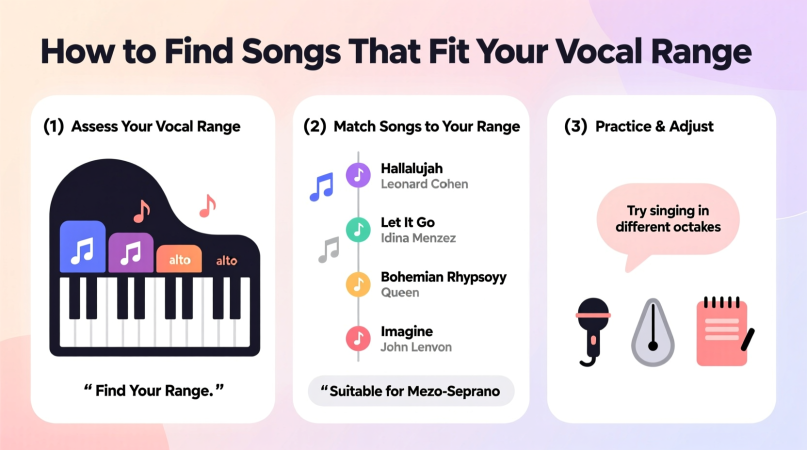
The fastest way to find songs that fit your vocal range is to compare three things: your lowest comfortable note, your highest comfortable note, and the part of the song where most of the melody sits. A song can technically fit your range but still feel terrible if every chorus lives near your top note. The best song for your voice sits mostly in your easy middle, uses high notes only for musical impact, and can be transposed without losing its character.
How to Find Songs That Fit Your Vocal Range
Start by measuring your voice, then test the song in real singing conditions. Your goal is not to find songs that prove how high or low you can go. Your goal is to find songs you can sing clearly, repeatably, and expressively from the first verse to the final chorus.
| Step | What to Check |
| 1 | Your comfortable low note and high note |
| 2 | The song’s lowest and highest important notes |
| 3 | The tessitura, or where most of the melody sits |
| 4 | Whether the chorus feels repeatable |
| 5 | Whether a key change makes the song easier |
Step 1: Measure Your Comfortable Range
Your useful singing range is not every sound you can make once. It is the span of notes you can sing with stable pitch, clear tone, and no throat squeezing. Use a basic vocal range guide to understand the terms, then check your own notes with a vocal range finder.
Write down two versions of your range: your total range and your performance range. Your total range may include edge notes that work only on a good day. Your performance range is the safer zone you could use in front of people without worrying about cracking, shouting, or fading halfway through the song.
Step 2: Find the Song’s Real Vocal Demands
Do not judge a song only by the highest note. Look at the full melody. A song with one quick high note may be easier than a song that stays near your upper limit for an entire chorus. This is where tessitura matters. Tessitura means the part of the range where the melody spends most of its time.
For example, if your top comfortable note is G4, a song that touches G4 once may be fine. A song that repeats F4 and G4 every line may feel exhausting. If you are unsure how big the song feels, test it with an octave range test and listen for where your voice starts working too hard.
Step 3: Use the 80 Percent Rule
A good song choice should spend about 80 percent of its melody in your comfortable middle. The remaining 20 percent can stretch you a little with emotional high notes, low moments, or stylistic color. If the song feels like a fight from the first chorus, it is probably not the right key yet.
This rule is especially useful for auditions, karaoke, live sets, and recording. A song that is barely possible at home may become much harder with nerves, bad monitoring, loud instruments, or a long performance day.
Step 4: Warm Up Before Testing Songs
Never judge your range cold. A song may feel too high simply because your voice is not ready yet. Do a short voice warm-up before testing keys. Then sing the verse and chorus at medium volume, not full performance energy.
If the song still feels tight after warming up, do not keep forcing it. Health sources such as the NHS warn that loud talking or whispering can strain an already irritated voice during laryngitis, and the same general principle applies to singing: if your voice feels irritated or hoarse, rest instead of pushing harder (NHS).
Step 5: Check Register Changes
Some songs feel difficult because they cross your register break again and again. A melody may not be extremely high, but if it sits right where your chest voice wants to shift into head voice, it can feel unstable. Learning chest voice vs head voice helps you understand why certain songs feel awkward even when the notes look normal.
If the song jumps between registers too often, try a different key. Moving the song down one or two semitones can place the chorus in a more natural coordination. Moving it up can sometimes help lower voices avoid muddy low verses.
Step 6: Transpose Instead of Forcing
Transposing means changing the key of the song while keeping the melody the same shape. This is one of the most practical ways to make a song fit your voice. If the chorus is too high, move the song down. If the verses are too low and dull, move it up.
Try this simple process:
- Sing the chorus in the original key.
- Move it down one semitone and sing again.
- Repeat until the top notes feel strong but not squeezed.
- Then check the verse to make sure it did not become too low.
- Choose the key where both verse and chorus feel usable.
Step 7: Use the Comfort Test
A song fits your vocal range if you can answer yes to these questions:
- Can I sing the chorus three times without strain?
- Can I keep the lyrics clear on the highest notes?
- Can I sing the low notes without disappearing?
- Can I stay on pitch when I lower the volume?
- Does my voice still feel normal after the song?
If the answer is no, the song may still be usable, but it probably needs a key change, a simplified melody, or more technique work. The guide on how to sing high notes without straining can help if the issue is the chorus peak.
Common Mistakes When Choosing Songs
The biggest mistake is choosing a song because you love the artist instead of because the song fits your voice. Another mistake is copying the original key even when it was written for a completely different voice type. Professional singers change keys all the time. It is not cheating; it is musicianship.
Also avoid choosing songs that require your best note every few seconds. A good performance needs dynamics, phrasing, and emotional control. If every line feels like a vocal test, the audience will hear the effort more than the music.
How to Build a Song List That Fits You
Keep a simple song list with four columns: song title, original key, your best key, and difficulty level. Mark each song as easy, medium, or stretch. Easy songs are good for warm-ups and relaxed gigs. Medium songs are your best performance choices. Stretch songs are for practice, not high-pressure moments.
As your technique improves, update the list. Your range and stamina can change with consistent practice. If you want to expand the number of songs you can handle, work gradually with how to improve vocal range and protect your voice with the basics in vocal health for singers.
FAQs About Finding Songs for Your Vocal Range
How do I know if a song fits my vocal range?
A song fits if most of the melody sits in your comfortable middle and the highest or lowest notes do not cause squeezing, cracking, disappearing tone, or lasting hoarseness.
Is vocal range or tessitura more important?
Tessitura is often more important. A song can fit your total range but still feel too hard if most of the chorus sits near your limit.
Should I change the key of a song?
Yes, if the original key does not suit your voice. Transposing a song is normal and often makes the performance sound more confident.
Can I sing songs outside my range?
You can adapt them by changing the key, simplifying a phrase, or switching octaves. Forcing notes outside your comfortable range is not a good long-term habit.
What should I do if every song feels too high?
Try lowering the key by one to three semitones, choose artists with a similar voice type, and build your upper range gradually instead of pushing harder.
Final Thoughts
The best songs for your vocal range are not always the songs with the most impressive notes. They are the songs that let your tone, pitch, lyrics, and emotion work together. Measure your range, check tessitura, test the chorus repeatedly, and transpose when needed. When the key fits your voice, singing feels less like survival and more like music.
Erika Parker is a vocal analysis and singing education writer at Vocal Range Test. She focuses on vocal range testing, voice type analysis, pitch recognition, and singing tools for vocalists, musicians, choir singers, and beginners.