
Eddie Vedder is usually described as a deep, chest-heavy rock baritone whose voice helped define Pearl Jam’s grunge-era sound. His exact vocal range has not been officially published, so note spans such as A1-E4 should be treated as listener-based estimates, not verified measurements. The more useful way to understand Vedder is by his vocal identity: dark resonance, spoken phrasing, emotional weight, and a gritty tone that makes even a modest range feel huge.
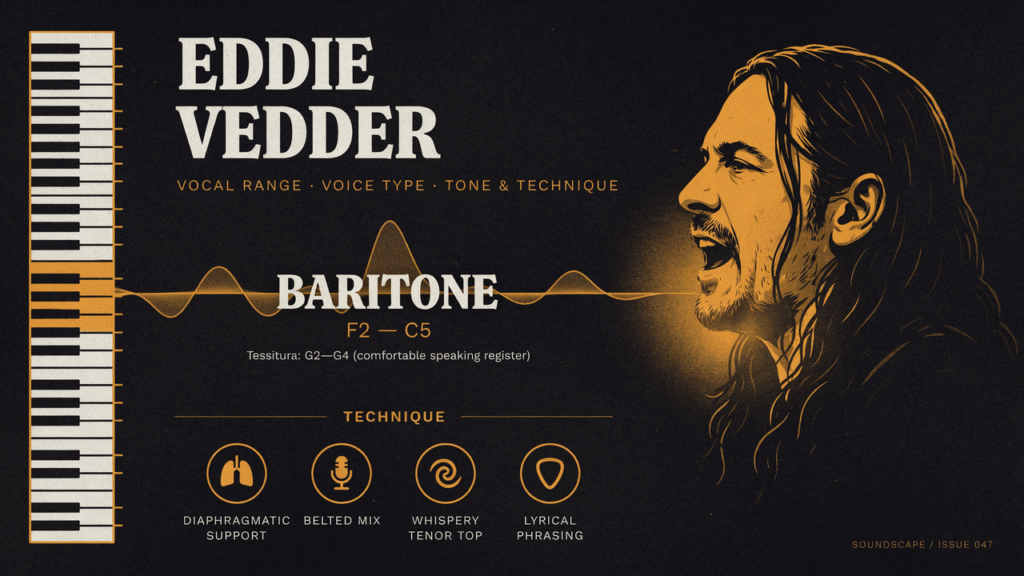
Eddie Vedder Vocal Range at a Glance
| Estimated voice type | Rock baritone / low-centered baritone |
| Commonly cited range | A1-E4, but not officially verified |
| Core tessitura | Low-to-mid baritone area |
| Signature traits | Dark tone, chest weight, grit, narrative phrasing |
| Best-known vocal setting | Pearl Jam and solo acoustic performances |
If you want to compare your own range with Vedder’s, start with the basics of vocal range and then use a vocal range finder to check your comfortable notes. Vedder’s voice is a good reminder that a singer does not need extreme high notes to be instantly recognizable.
What Voice Type Is Eddie Vedder?
Eddie Vedder is best understood as a baritone in a rock context. His tone sits low, rounded, and speech-like, with a strong center in the lower and middle part of the male range. Compared with many classic rock tenors, he does not build his identity around high belts. Instead, his sound comes from weight, vowel color, and emotional pressure.
That is why a standard baritone vocal range description is a better starting point than a tenor comparison. Vedder’s upper notes can still cut through a band, but they usually carry chest-dominant intensity rather than a bright, high-tenor ring.
Why Exact Note Claims Need Caution
Many vocal-range pages list Vedder around A1-E4. That estimate may be useful as a rough fan reference, but it should not be presented as a confirmed professional measurement. A low note in a live performance can be affected by microphone proximity, pitch interpretation, audience noise, or relaxed speech-like delivery. A high note can change depending on key, era, live arrangement, and how much grit is being used.
For this reason, the safest wording is that Vedder is commonly estimated to have a baritone-centered range with notable low resonance and a practical upper area around the lower fourth octave. That gives readers a clearer picture without turning uncertain note labels into facts.
The Sound of Pearl Jam’s Baritone Frontman
Vedder became widely known as Pearl Jam’s frontman, and the Rock & Roll Hall of Fame’s Pearl Jam page recognizes the band’s place in rock history. Vocally, his role in Pearl Jam is different from the soaring-tenor model often associated with arena rock. He brings gravity to the music. The tone feels close to speech, then expands into a bigger emotional shape when the song demands it.
In songs like “Alive,” “Black,” “Jeremy,” and “Elderly Woman Behind the Counter in a Small Town,” the impact comes from phrasing as much as pitch. Vedder often sounds like he is telling the lyric before he is singing it. That narrative quality is one of the reasons his voice connects so strongly with listeners.
Chest Voice, Grit, and Resonance
Vedder’s singing is heavily chest-centered. Understanding chest voice vs head voice helps explain why his tone feels grounded and physical. He rarely sounds like he is floating above the band; he sounds anchored inside the lyric.
That chest weight also shapes his grit. His rasp works because it is connected to a strong tonal center, not because he simply forces the throat. Singers who want a similar rock texture should first develop stable support and clean tone, then add style carefully. The guide to mixed voice is useful for learning how singers blend weight and release instead of pushing every note with the same pressure.
Lowest Notes and Dark Tone
Vedder’s lowest notes are part of his signature, but the darkness of his voice is not only about pitch. It also comes from rounded vowels, a low-centered speaking quality, and a relaxed but intense delivery. Some singers can hit a low note without sounding deep. Vedder often sounds deep even in the middle of his range because the whole vocal color leans dark.
This is why range alone does not explain his voice. A singer could match a note estimate and still sound nothing like him. The shape of the vowel, the weight of the consonants, the breath pressure, and the emotional intent all matter.
Upper Range and Intensity
Vedder’s upper notes are not usually about vocal acrobatics. They work because they arrive with urgency. When he pushes higher, the tone often keeps a chest-like bite rather than switching into a clean, light head voice. That can sound powerful, but it also means singers should be careful when imitating him.
If you want to build that kind of upper intensity, start with safe technique. Work through how to sing high notes without straining before trying to add Pearl Jam-style rasp. For long-term singing, vocal health for singers matters more than copying one dramatic moment.
How His Voice Changed Over Time
Like many rock singers, Vedder’s voice has changed with age, touring, and repertoire. Early Pearl Jam recordings have a raw, explosive quality, while later performances often lean more into warmth, storytelling, and acoustic phrasing. The core identity remains the same: dark tone, direct emotional delivery, and strong rhythmic speech-singing.
That evolution is normal. A baritone singer may gain even more depth over time while losing some ease in the upper register. The important part is how the singer adapts. Vedder’s later performances often use interpretation and phrasing rather than trying to recreate every early-career texture exactly.
Can You Sing Like Eddie Vedder?
You can study his phrasing, vowel color, and emotional directness, but copying the rasp too aggressively is not a good plan. Start with your natural voice type, warm up carefully, and learn where your comfortable range actually sits. A practical voice warm-up will help more than trying to force a low, dark tone you do not naturally have.
If your goal is range growth, use gradual training rather than imitation. A gradual range-building plan explains a safer path than pushing your voice into someone else’s signature sound.
FAQs About Eddie Vedder’s Vocal Range
What is Eddie Vedder’s vocal range?
His exact vocal range has not been officially verified. Many fan estimates place him around A1-E4, but it is more accurate to describe him as a baritone-centered rock singer with a dark lower range and a practical upper area near the lower fourth octave.
Is Eddie Vedder a baritone?
Yes, baritone is the most useful description for his rock voice. His sound is low-centered, warm, chest-heavy, and darker than many classic rock tenors.
Why does Eddie Vedder’s voice sound so deep?
His depth comes from more than low notes. Rounded vowels, chest-dominant resonance, relaxed speech-like phrasing, and dark tonal color all contribute to the sound.
Does Eddie Vedder use falsetto?
Falsetto is not a major part of his signature style. His best-known performances rely more on chest voice, grit, and narrative phrasing.
Is Eddie Vedder’s range wide?
Not compared with extreme-range rock singers. His impact comes from tone, expression, phrasing, and emotional force more than a huge octave count.
Final Thoughts
Eddie Vedder’s vocal range is best described cautiously: an estimated baritone-centered rock range, not a fixed official note chart. His real strength is the sound he builds inside that range. Dark resonance, chest-heavy grit, and deeply human phrasing make his voice one of rock’s most recognizable baritone signatures.
Erika Parker is a vocal analysis and singing education writer at Vocal Range Test. She focuses on vocal range testing, voice type analysis, pitch recognition, and singing tools for vocalists, musicians, choir singers, and beginners.