
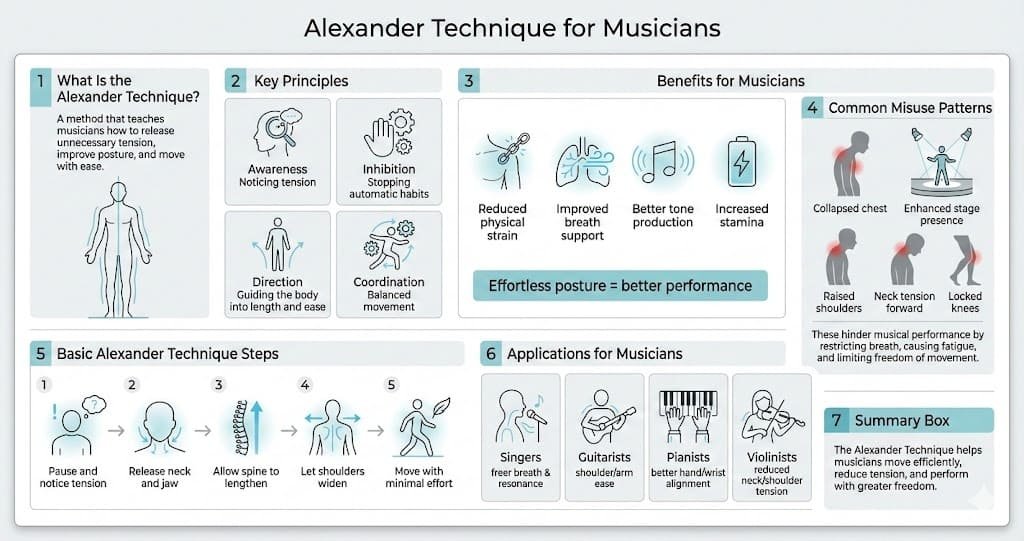
Musicians are physical performers. Whether you play violin, piano, guitar, drums, or sing, your sound is shaped by how efficiently your body moves, breathes, and responds to pressure. Over years of practice, most musicians develop harmful movement habits — excess tension, collapsed posture, shallow breathing, repetitive strain — without knowing it.
The Alexander Technique (AT) is one of the most respected, science-supported somatic methods for improving the way musicians use their bodies. Taught in world-leading conservatories such as Juilliard, Royal Academy of Music, and Berklee, it helps musicians move with ease, reduce tension, enhance tone, and prevent injury.
This master-level guide explains exactly how the Alexander Technique works, how it benefits your playing or singing, and how to apply it onstage, in the practice room, and in daily life.
What is the Alexander Technique?
The Alexander Technique is a method of neuromuscular re-education that teaches you how to stop unnecessary tension and restore natural coordination.
Key principles:
- Awareness of habitual tension
- Inhibition — pausing automatic reactions
- Direction — sending gentle internal cues to organize the body
- Primary control — head, neck, and spine alignment leading the whole body
Originally developed by actor F. M. Alexander to solve chronic vocal strain, it is now used by musicians, dancers, athletes, public speakers, and clinical rehabilitation teams.
It is not stretching, yoga, or physical therapy.
It is a mind-body learning method that changes how you move.
Why Musicians Need the Alexander Technique
Musicians often face:
- Shoulder, neck, and back pain
- Wrist, finger, or forearm strain
- Breath restriction
- Performance anxiety
- Technical inconsistency
- Fatigue during long rehearsals
- Long-term overuse injuries
These come from maladaptive habits, not “bad technique.”
AT addresses the root causes by retraining your entire movement system.
Core benefits for musicians
- Frees unnecessary muscular tension
- Improves posture and alignment naturally
- Enhances tone, articulation, and dynamic control
- Improves breath support and resonance
- Reduces injury risk and pain
- Increases body awareness and stamina
- Improves focus and performance confidence
This makes it one of the most essential holistic tools for musicians.
The Science Behind the Alexander Technique
Modern neuroscience supports AT principles through:
Neuroplasticity
Habit patterns can be unlearned and replaced with healthier coordination.
Sensorimotor Integration
Musicians often misjudge their own tension.
AT recalibrates proprioception — how you sense movement.
Muscle Synergy Optimization
Less tension allows muscles to work together more efficiently, improving speed and accuracy.
Autonomic Nervous System Regulation
AT reduces sympathetic arousal (fight-or-flight), helping musicians:
- Manage performance anxiety
- Stay calm while performing
- Maintain breath flow and control
The Core Concepts of the Alexander Technique (Clear & Practical)
1. Habit Awareness
Most musicians don’t notice tension patterns such as:
- Lifting shoulders unnecessarily
- Tightening the jaw or throat
- Locking knees
- Collapsing the pelvis
- Stiffening fingers
- Over-squeezing bow or keys
Awareness is the first step toward change.
2. Inhibition
This does not mean “stop playing.”
It means pausing the automatic tension response before movement.
Example:
Before lifting your violin bow, pause → release neck → allow breath → move freely.
3. Direction
These are mental cues that reorganize movement:
- “Let my neck be free.”
- “Let my head release forward and up.”
- “Let my back widen and lengthen.”
- “Allow my breath to move naturally.”
Direction is subtle but powerful.
4. Primary Control
When the head, neck, and spine work in natural relationship, the entire body gains:
- Stability
- Balance
- Freedom
- Efficiency
Musical technique becomes easier and more expressive.
To build a strong foundation, start by identifying your natural limits with the vocal range test. Once you know your highest and lowest notes, explore techniques in expand vocal range safely to push your boundaries without strain. You can also refine note accuracy using the ear training game, and track long-term progress through the vocal range calculator.
Benefits of the Alexander Technique for Specific Musicians
For Violinists / Violists
- Reduces shoulder and neck compression
- Improves bowing mechanics
- Prevents over-gripping the instrument
- Enhances left-hand agility
For Pianists
- Improves sitting posture and spine alignment
- Reduces wrist and forearm strain
- Refines arm weight technique
- Enhances tone production
For Guitarists
- Stops forward head posture
- Frees picking and fretting hand tension
- Improves rib and torso mobility
For Singers
- Enhances resonance and vocal freedom
- Improves breath coordination
- Reduces jaw, tongue, and throat tension
- Supports consistent tone and power
For Wind & Brass Players
- Increases lung capacity and breath efficiency
- Improves embouchure stability without stiffness
- Prevents upper-body rigidity
For Drummers
- Improves whole-body movement
- Reduces back strain
- Enhances timing and endurance
Alexander Technique Exercises for Musicians
Here are the most useful AT practices musicians can apply immediately:
1. Constructive Rest (10–15 minutes)
Lie on your back with knees bent, feet flat, books under head.
Benefits:
- Decompresses spine
- Reduces overall tension
- Calms nervous system
- Resets coordination
2. The “Neck Free” Direction
Silently think: “I allow my neck to be free, my head to release forward and up.”
This reduces pulled-down posture and opens the throat and rib cage.
3. The Zipper Line
Imagine lengthening upward from pelvis to crown of head — without stiffening.
4. Controlled Chair Work
Practice sitting and standing:
- Without collapsing
- Without pushing or tightening
- Using natural balance
5. Breath Release
Let breath enter instead of “pulling” it in.
This is transformative for vocalists and wind players.
6. Instrument Awareness Drills
Pick up your instrument slowly.
Notice when tension appears.
Release neck, shoulders, and ribs before playing.
These micro-adjustments compound into major improvements.
Integrating Alexander Technique Into Music Practice
Before Practice
- 5 minutes constructive rest
- Gentle directions (neck free, spine long)
- Breathing release
During Practice
- Pause often to inhibit automatic tension
- Notice when technical difficulty creates stiffness
- Focus on ease, not force
- Use mindful movement
Before Performances
- Release jaw, neck, and shoulders
- Let breath expand naturally
- Use grounding through feet
- Remind yourself of primary control
During Performance
- Avoid “trying hard”
- Allow movement instead of restricting it
- Stay present through body awareness
After Practice
- Brief constructive rest
- Let the nervous system reset
How Alexander Technique Reduces Performance Anxiety
AT helps recondition your stress response.
Benefits include:
- Better diaphragmatic movement
- Lower physical tension under pressure
- Clearer mental focus
- Reduced adrenaline overreaction
- Increased confidence through posture
- More grounded stage presence
Performance anxiety often lives in:
- Tight jaw
- Raised shoulders
- Shallow breathing
AT directly addresses all of these.
Research & Evidence Supporting AT for Musicians
Studies show AT benefits musicians by:
- Improving posture and muscle coordination
- Reducing chronic pain
- Improving breath efficiency
- Increasing movement control
- Improving tone quality
- Reducing performance anxiety
- Enhancing playing endurance
Institutions using AT include:
- Juilliard School
- Royal Academy of Music
- Royal College of Music
- New England Conservatory
- Many university performance programs
This widespread adoption demonstrates strong real-world results.
Working With a Certified Alexander Technique Teacher
AT is best learned with a certified teacher trained in 3-year programs.
Recognized Certification Bodies
- STAT — Society of Teachers of the Alexander Technique
- AMSAT — American Society for the Alexander Technique
- CANSTAT — Canada
- APATA — Australia
What Happens in a Lesson
- Posture and movement assessment
- Hands-on guidance for easier coordination
- Breathing improvement
- Instrument-specific adjustments
- Rewiring of habitual patterns
- Personalized home exercises
Lessons typically last 30–45 minutes.
Frequently Asked Questions
Can I learn the Alexander Technique on my own?
You can learn principles, but in-person lessons provide the most profound changes.
How long does it take to see results?
Some changes occur immediately; deeper rewiring takes weeks to months.
Is it safe for injured musicians?
Yes — it is gentle and non-invasive.
Does it improve tone and sound quality?
Yes. Free movement improves resonance, breathing, and technical clarity.
Is AT only for classical musicians?
No — it benefits musicians of every genre.
- Musicians who want hands-on posture training often start with these practical Alexander Method exercises.
- Breath efficiency improves when paired with structured adult singing lessons that emphasize body alignment.
- Beginners build safer movement habits through guided beginner singing lessons.
- Understanding how alignment affects phonation becomes clearer when you study how the vocal cords work.
- Many performers use targeted vocal exercises to increase range to reinforce relaxed coordination.
- You can test posture-based learning through a risk-free free singing course.
- For long-term training options, the best online singing lessons hub compares programs that integrate body awareness.
Erika Parker is a vocal analysis and singing education writer at Vocal Range Test. She focuses on vocal range testing, voice type analysis, pitch recognition, and singing tools for vocalists, musicians, choir singers, and beginners.