
Tenors usually sing comfortably from about C3 to C5 (131–523 Hz), making tenor the highest common male voice type. The checker below tells you whether your voice fits. Sing your lowest and highest comfortable notes into the microphone, or pick them from the list. It shows how much of the tenor range you cover, which notes you’re missing at the top or bottom, and the voice type your range is closest to.
Tenor Range Checker
Find your lowest and highest comfortable singing notes, then see how much of the tenor range (C3–C5) your voice covers.
No result yet. Sing or choose your lowest and highest comfortable notes.
- Your range
- –
- Tenor range
- C3–C5
- Range covered
- –
- Closest type by range
- –
Range is one part of voice type. Tone colour, tessitura (where your voice feels most comfortable) and register changes matter too. Sing gently and stop if anything feels strained.
Related Tools
- Voice Type Test
Compare your range with all six voice types, from bass to soprano, in one test.
- Voice Frequency Test
Check the pitch of your speaking or singing voice in Hz.
- Vocal Range Test
Find your full singing range, from your lowest to your highest note.
- Singer Comparison Tool
See which well-known singers have a range like yours.
- Octave Range Test
Measure how many octaves you can sing.
- Song Key Finder
Find the key of a song before you decide whether it suits your voice.
How to Read Your Tenor Range Result
Your result compares your comfortable notes with the tenor range of C3–C5. Use the verdict and the missing notes together:
| What you see | What it usually means |
|---|---|
| Yes: 90% or more covered | Your comfortable notes span the tenor range. By range, tenor fits. |
| The top notes (around A4–C5) are missing | Your voice may sit a little lower, closer to a baritone (A2–A4). |
| The bottom notes (C3–E3) are missing | Common for lighter, higher voices. Tenor may still fit if your top is easy and ringing. |
| Closest type is baritone or bass | Your range sits mostly below the tenor range. Compare with those voice types. |
Comfortable high notes only
Many tenors carry their voice up toward the top of the range by blending into a lighter, head-voice-dominant sound. For this check, count only high notes you can sing freely and repeat. A note you can reach only by shouting or squeezing isn’t part of your comfortable range, and including it will make your result look higher than your voice really sits.
Tenor or baritone?
Tenor and baritone ranges overlap by almost two octaves, so many men sit near the border. Tone and comfort decide it: tenors tend to sound bright and feel at home higher up, while baritones sound warmer and tire sooner on sustained high notes. If your result is close, read the tenor vs baritone comparison and take the Voice Type Test.
Get a reliable reading
- Warm up for a few minutes, starting in the middle of your voice.
- Sing a steady vowel such as “ah” and hold it until the checker offers to save the note.
- Keep the microphone about an arm’s length away. If the reading says “too loud”, move back.
- Retest on a different day before deciding; range grows and shrinks with practice and rest.
What Is the Tenor Vocal Range?
Most tenors sing comfortably between C3 and C5, though some advanced singers extend higher toward B4 or even C5 with proper technique.
| Voice Type | Typical Range (Notes) | Approx. Frequency Range (Hz) |
|---|---|---|
| Bass | E2–E4 | 82–330 Hz |
| Baritone | A2–A4 | 110–440 Hz |
| Tenor | C3–C5 | 130–523 Hz |
Tenors bring clarity and brilliance to the male vocal spectrum, with the upper register shining in solos, choral works, and contemporary music.
Key Characteristics of the Tenor Voice
- Tone Quality: Bright, clear, and expressive
- Tessitura (Comfort Zone): Mid-to-high register with agile high notes
- Projection: Naturally carries over ensembles without strain
- Versatility: Works in opera, pop, rock, jazz, and musical theater
Compared to baritones or basses, tenors often sing melody lines and leading roles due to their expressive upper range.
Types of Tenor Voices
Classical singing and opera classify tenors into subtypes based on range, timbre, and agility:
- Lyric Tenor
- Smooth, warm tone with romantic qualities
- Roles: Rodolfo in La Bohème (Puccini)
- Dramatic Tenor
- More powerful, darker tone
- Roles: Otello in Verdi’s Otello
- Heldentenor (Heroic Tenor)
- Used in Wagnerian operas for heroic, demanding roles
- Strong projection and stamina
- Countertenor
- Male singers using falsetto or high register to sing alto/mezzo ranges
- Found in early music, Baroque repertoire
- Tenore di Grazia
- Agile, light voice capable of fast ornamentation
- Common in bel canto operas
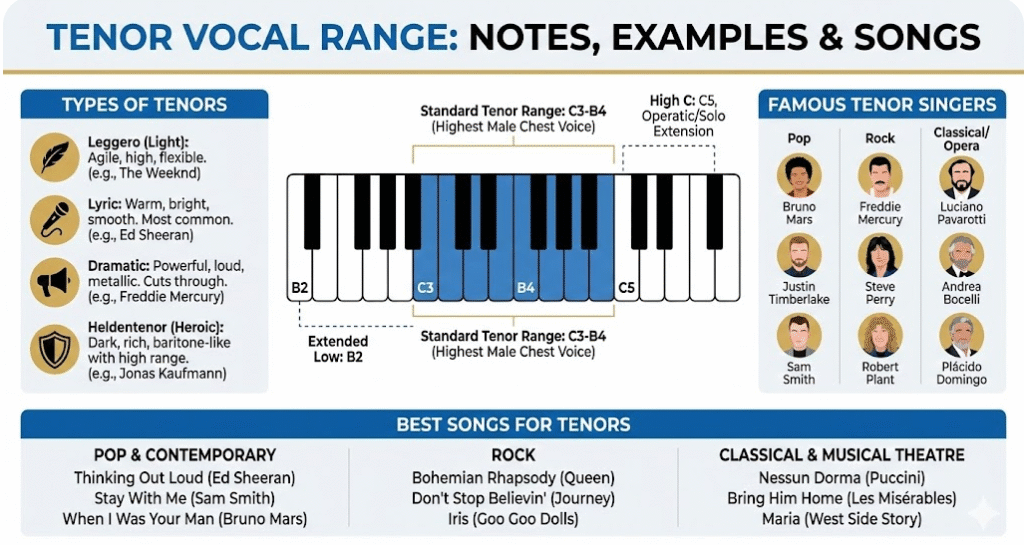
Famous Tenor Singers
Tenors dominate many genres. Some iconic names include:
- Luciano Pavarotti – Legendary operatic tenor with unmatched high notes
- Andrea Bocelli – Classical crossover tenor with global appeal
- Freddie Mercury – Queen’s frontman with powerful tenor range
- Michael Jackson – Pop icon with bright, flexible tenor voice
- Josh Groban – Contemporary tenor known for rich, expressive vocals
Listening to these singers helps you hear the tenor voice across styles and languages.
Songs for Tenor Voices
Choosing the right repertoire showcases your tenor range and tone safely.
Beginner-Friendly Songs:
- Can’t Help Falling in Love – Elvis Presley
- You Raise Me Up – Josh Groban
- Imagine – John Lennon
Intermediate & Advanced Songs:
- Nessun Dorma – Puccini (Opera aria)
- Bring Him Home – Les Misérables (Musical Theater)
- Bohemian Rhapsody – Queen (Rock/Pop)
Before singing, warm up using our Daily Vocal Warm-Up Exercises to protect your voice.
Tenor vs Baritone vs Bass
| Feature | Tenor | Baritone | Bass |
|---|---|---|---|
| Range | C3–C5 | A2–A4 | E2–E4 |
| Tone | Bright, expressive | Warm, versatile | Deep, powerful |
| Roles | Leading melodies | Romantic, secondary leads | Authority, mature characters |
Training Tips for Tenor Singers
1. Strengthen High Notes Safely
Tenors often struggle with strain on high notes. Our High Notes Singing Training guide covers exercises to build power and control without pushing.
2. Improve Breath Support
Steady airflow prevents cracks and supports sustained phrases. Learn Breathing Techniques for Singing for better stamina.
3. Work on Register Transitions
Smooth blending between chest and head voice prevents breaks. See Chest Voice vs Head Voice for practical tips.
4. Practice Daily, Even Briefly
Consistency matters more than long sessions. A 15-minute focused routine builds strength safely over time.
Daily 15-Minute Routine for Tenors
| Exercise | Duration | Focus |
|---|---|---|
| Diaphragmatic Breathing | 2 min | Breath control & stamina |
| Lip Trills & Humming | 3 min | Relaxation & resonance |
| 5-Note Scales on “ah” | 3 min | Pitch accuracy & tone clarity |
| Siren Glides Low → High → Low | 3 min | Range extension & flexibility |
| Song Practice | 4 min | Apply techniques in context |
Common Mistakes to Avoid:
- Pushing high notes with excess air pressure
- Singing at full volume before proper warm-up
- Ignoring vocal fatigue or hoarseness
- Neglecting posture and breath support during phrases
How to Know If You’re a Tenor?
You might be a tenor if:
- Your lowest note is around C3
- Your highest comfortable note reaches C5 or above
- The mid-to-high range feels easiest and most resonant
Confirm with the Vocal Range Calculator for accuracy.
Our Interactive Tools
- Vocal Range Calculator – measure and record your range accurately using your microphone.
- Singer Comparison Tool – compare your vocal range with famous singers and see where you align.
- AI Voice Analysis – get instant feedback on your tone, pitch stability, and clarity through advanced AI.
- Song Key Finder – discover songs that naturally fit your vocal range and tessitura.
FAQs About Tenor Vocal Range
Q1: What is the standard tenor vocal range?
Most tenors sing between C3 and C5, with some extending higher through training.
Q2: Are tenors rare?
Yes, tenors are less common than baritones or basses, especially in classical music.
Q3: What songs fit tenor voices best?
Pop ballads, opera arias, and musical theater solos often highlight tenor voices.
Q4: Can tenors sing low notes too?
Yes, but baritones and basses handle lower registers more naturally.
Q5: How can I improve my tenor high notes?
With proper warm-ups, breathing techniques, and safe range expansion exercises over time.
- To confirm where your highest comfortable notes sit, a quick check with the highest vocal range adds useful context.
- Tenors often compare themselves to lighter voices by reviewing the soprano vocal range.
- To see how male voices are grouped overall, this guide to the male vocal ranges is helpful.
- Many singers track their progress using a detailed vocal range chart.
- For smoother high notes, learning how to sing without straining makes a big difference.
- To understand how your voice compares to similar types, this breakdown of tenor vs baritone explains the key differences.
- When choosing repertoire, this guide on finding songs that fit your range keeps things comfortable.