
Mezzo-sopranos usually sing comfortably from about A3 to A5 (220–880 Hz), the range between the soprano and the contralto. Use the checker below to see whether your voice fits. Sing your lowest and highest comfortable notes into your microphone, or choose them from the list. You’ll see how much of the mezzo-soprano range you cover, which notes are missing, and which voice type your range is closest to.
Mezzo-Soprano Range Checker
Find your lowest and highest comfortable singing notes, then see how much of the mezzo-soprano range (A3–A5) your voice covers.
No result yet. Sing or choose your lowest and highest comfortable notes.
- Your range
- –
- Mezzo-soprano range
- A3–A5
- Range covered
- –
- Closest type by range
- –
Range is one part of voice type. Tone colour, tessitura (where your voice feels most comfortable) and register changes matter too. Sing gently and stop if anything feels strained.
Related Tools
- Voice Type Test
Get a full voice-type result from your lowest and highest notes, across all six voice types.
- Vocal Range Test
Measure your complete singing range, from your lowest to your highest note.
- Octave Range Test
Find out how many octaves your voice spans.
- Singer Comparison Tool
Compare your range with famous singers.
- Vocal Range Calculator
Count the notes, semitones and octaves between any two notes.
- Voice Frequency Test
See the pitch of your voice in hertz (Hz).
How to Read Your Mezzo-Soprano Range Result
The checker compares your comfortable range with the mezzo-soprano range of A3–A5, a span of two octaves. It reports how much of that span your voice covers:
| Result | What it means | What to do next |
|---|---|---|
| Yes (90% or more) | Your comfortable notes cover the whole mezzo range, or all but a note or two. | Mezzo-soprano is a strong fit by range. Confirm it with tone and comfort (see below). |
| Partly (60–89%) | Most of the range fits, but some notes at the bottom or top are missing. | Check which end is missing. It points to the neighbouring voice type. |
| Only part (under 60%) | Only a small part of the mezzo range matches your notes. | Look at the “closest type by range” line, and compare with that voice type. |
| Outside | Your notes sit entirely above or below A3–A5. | Retest after a gentle warm-up, then try the full Voice Type Test. |
What the missing notes tell you
If the top of the range (around F5–A5) is missing, your voice may sit lower, closer to a contralto (F3–F5). If the bottom (A3–B3) is missing but you reach above A5 with ease, you may be closer to a soprano (C4–C6). Mezzos and sopranos share most of their notes, so the lowest and highest notes alone rarely settle the question.
Range is only part of your voice type
Two singers with the same range can be different voice types. Tone colour (a darker, fuller sound is typical of mezzos), tessitura (where your voice feels most comfortable for long stretches) and where your voice changes register all matter. Use the result as a first check, then confirm it with the Voice Type Test or a voice teacher.
Tips for an accurate result
- Warm up gently first; a cold voice usually tests narrower.
- Count only notes you can sing comfortably. Skip strained, shouted or breathy notes.
- Use a quiet room and hold each note steadily until the checker offers to save it.
- Test again on another day. Comfortable range varies with rest, health and practice.
What Is the Mezzo-Soprano Vocal Range?
Most mezzo-sopranos sing comfortably between A3 and A5, though some singers can stretch slightly beyond this range with training.
| Voice Type | Typical Range (Notes) | Approx. Frequency Range (Hz) |
|---|---|---|
| Contralto | F3–F5 | 175–698 Hz |
| Mezzo-Soprano | A3–A5 | 220–880 Hz |
| Soprano | C4–C6 | 261–1046 Hz |
The mezzo-soprano combines warmth from the lower female registers with brightness in the upper range, making it extremely flexible across musical genres.
Mezzo-Soprano Characteristics
- Tone Quality: Richer than sopranos but lighter than contraltos
- Tessitura (Comfort Zone): Middle range with some high note capability
- Vocal Roles: Often play mothers, heroines, and dramatic characters in opera and musical theater
- Versatility: Works well in pop, jazz, gospel, and choral music
Unlike sopranos, who typically carry the main melody, mezzo-sopranos often sing harmony lines or character roles in classical settings while thriving as soloists in contemporary music.
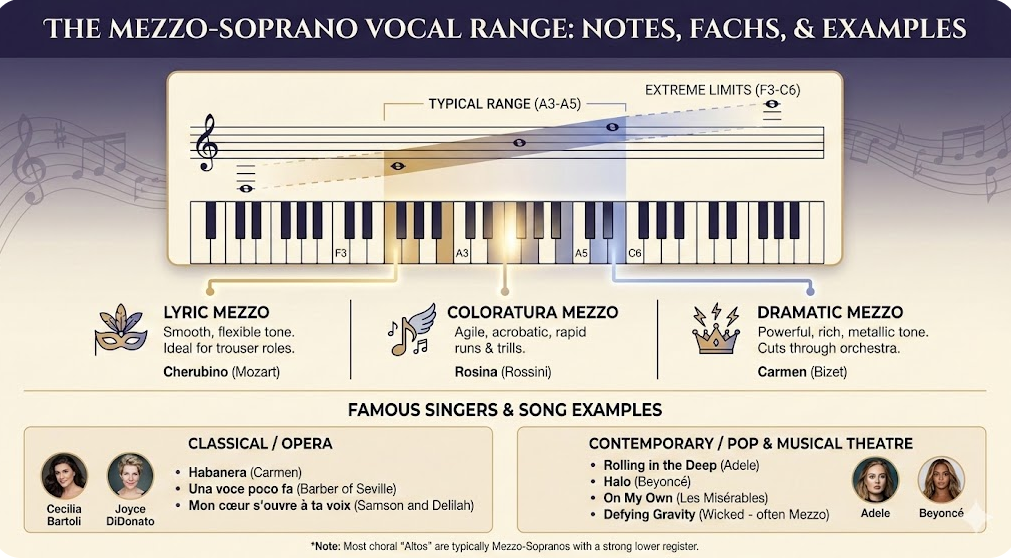
Types of Mezzo-Sopranos
- Lyric Mezzo-Soprano
- Warm, smooth tone
- Perfect for romantic roles and lyrical melodies
- Dramatic Mezzo-Soprano
- Powerful, darker timbre
- Suited for intense operatic and theatrical roles
- Coloratura Mezzo-Soprano
- Light, agile voice
- Capable of singing fast, ornamented passages
Famous Mezzo-Soprano Singers
Some iconic mezzo-sopranos across genres include:
- Cecilia Bartoli – Opera mezzo-soprano known for agility and power
- Meghan Trainor – Pop singer with warm mid-range vocals
- Adele – Often classified as a lyric mezzo-soprano in pop and soul
- Annie Lennox – Rich, expressive mezzo voice in rock and pop
- Beyoncé – Wide-ranging mezzo-soprano with powerful vocal control
Listening to these singers can help you understand the mezzo-soprano sound in different musical contexts.
Songs for Mezzo-Soprano Voices
Choosing songs that fit your range helps showcase vocal tone and control.
Beginner-Friendly Songs:
- Rolling in the Deep – Adele
- Halo – Beyoncé
- Someone Like You – Adele
Intermediate & Advanced Songs:
- Habanera – Carmen (Georges Bizet)
- Memory – Cats (Andrew Lloyd Webber)
- Defying Gravity – Wicked (Stephen Schwartz)
Before singing, warm up using our daily vocal warm-up exercises to protect your voice.
Mezzo-Soprano vs Soprano vs Contralto
| Feature | Mezzo-Soprano | Soprano | Contralto |
|---|---|---|---|
| Range | A3–A5 | C4–C6 | F3–F5 |
| Tone | Warm, rich, flexible | Bright, light, agile | Deep, dark, powerful |
| Opera Roles | Heroines, mothers | Leading characters | Mature or dramatic roles |
If you’re unsure where you fit, use the Vocal Range Calculator to confirm your voice type.
Training Tips for Mezzo-Soprano Singers
1. Strengthen Your Middle Register
The mid-range is your vocal home. Practice scales and sustained tones here daily.
2. Work on High Note Control
Many mezzo-sopranos want a stronger top register. Check out our High Notes Singing Training guide for safe methods.
3. Improve Breath Support
Diaphragmatic breathing keeps tone steady across the entire range. See Breathing Techniques for Singing for exercises.
4. Balance Chest and Head Voice
A smooth blend prevents breaks and adds consistency. Our Chest Voice vs Head Voice article explains how to develop this skill.
Main Interactive Tools:
- Singer Comparison Tool – compare your vocal range with famous singers and see where you align.
- AI Voice Analysis – get instant feedback on your tone, pitch stability, and clarity through advanced AI.
- Song Key Finder – discover songs that naturally fit your vocal range and tessitura.
Daily 15-Minute Routine for Mezzo-Sopranos
| Exercise | Duration | Focus |
|---|---|---|
| Diaphragmatic Breathing | 2 min | Breath support |
| Lip Trills & Humming | 3 min | Warm-up, resonance |
| 5-Note Scales on Vowels | 4 min | Pitch accuracy, tone control |
| Siren Glides (Low → High → Low) | 3 min | Range expansion, smoothness |
| Song Application | 3 min | Technique in real music |
Common Mistakes to Avoid:
- Skipping warm-ups before singing high or low passages
- Pushing chest voice too high without blending registers
- Ignoring vocal health habits like hydration and rest
- Singing outside your comfortable tessitura for long periods
For vocal care tips, read Vocal Health Tips for Singers.
How to Know If You’re a Mezzo-Soprano?
- Lowest comfortable note ≈ A3
- Highest comfortable note ≈ A5
- Middle range feels easiest and most resonant
FAQs About Mezzo-Soprano Vocal Range
Q1: What is the standard mezzo-soprano range?
Most mezzo-sopranos sing comfortably between A3 and A5.
Q2: Can mezzo-sopranos sing high notes like sopranos?
Yes, but sopranos generally sing higher with more ease; mezzos focus on warmth and versatility.
Q3: What songs fit mezzo-soprano voices best?
Pop ballads by Adele, musical theater songs, and classical arias like Habanera suit mezzos well.
Q4: Are mezzo-sopranos rare?
They are less common than sopranos but more common than true contraltos.
Q5: Can I expand my mezzo-soprano range?
Yes, with consistent training, warm-ups, and range expansion exercises, many mezzos gain extra notes safely.
- Many singers also explore the darker end of the spectrum by reviewing the contralto vocal range.
- To understand where mezzo notes fall, a detailed vocal range chart provides a clear visual.
- If you’re unsure about your placement, a quick how to test vocal range for women can confirm it.
- Building control across registers is easier when you practice the chest voice vs head voice balance.
- Many mezzo singers strengthen their mix using targeted vocal exercises to increase range.
- To choose music that fits comfortably, this guide on finding songs that fit your range is especially useful.