
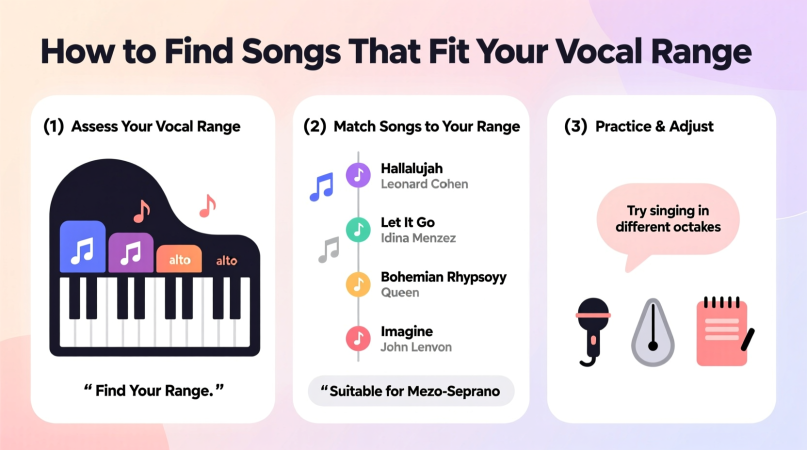
Singing a song that’s too high or too low can leave your voice feeling strained and your confidence shaken. The secret to choosing the right music is simple: pick songs that sit comfortably inside your vocal range. Here’s a step-by-step guide to help you match your voice to the songs that truly fit.
How to Find Songs That Fit Your Vocal Range: A Singer’s Guide
Step 1: Measure Your Vocal Range
Your vocal range is the distance between the lowest and highest notes you can sing clearly.
- Start by warming up with scales.
- Slide down to your lowest note and up to your highest.
- Write down the note names (for example, C3–G5).
👉 Not sure how to test accurately? Use our free Vocal Range Checker to find your exact notes and voice type.
Step 2: Identify Your Voice Type
Most singers fall into one of six common categories:
| Voice Type | Typical Range | Examples |
|---|---|---|
| Soprano | C4–C6 | Ariana Grande, Mariah Carey |
| Mezzo-Soprano | A3–A5 | Adele, Lady Gaga |
| Alto/Contralto | F3–F5 | Amy Winehouse |
| Tenor | C3–B4 | Bruno Mars, Freddie Mercury |
| Baritone | G2–G4 | Elvis Presley, Ed Sheeran |
| Bass | E2–E4 | Johnny Cash |
Knowing your voice type helps you filter songs written for singers like you.
Step 3: Match Songs to Your Range
Now that you know your range and type, it’s time to find songs that fit.
- Check song range charts: Some sites and tools list the lowest and highest notes for popular songs.
- Search by vocal type: Try queries like “best pop songs for altos” or “tenor Broadway songs.”
- Use online tools: Input your range into tools that match songs to your notes.
Tip: Even if a song fits your range, pay attention to tessitura—the area where most of the song sits. A piece that hovers near your highest note will feel harder than one that stays mid-range.
Step 4: Adjust Songs to Fit Better
Don’t skip a favorite song just because the key feels too high or low.
- Transpose: Shift the key down or up to match your comfort zone.
- Try acoustic or live versions: Artists often perform in easier keys on stage.
- Switch octaves: Singing certain phrases an octave lower or higher keeps the song accessible without losing its impact.
Step 5: Example Songs by Range
Here are a few songs with known ranges to get you started:
- “Someone Like You” (Adele) – A3–E5 (mezzo-soprano friendly)
- “Just the Way You Are” (Bruno Mars) – Bb2–D5 (good for tenors)
- “Hallelujah” (Leonard Cohen/Jeff Buckley) – C3–C5 (baritone/tenor adaptable)
- “Halo” (Beyoncé) – A3–F#5 (suits sopranos and mezzo-sopranos)
FAQs
How do I know if a song is too high or low for me?
If you feel tension in your throat or can’t sustain the notes clearly, it’s outside your comfortable range.
Can I sing songs outside my range?
Yes—if you transpose or adjust. But forcing your voice can cause strain.
What’s more important: range or tessitura?
Tessitura often matters more. A song that sits in your sweet spot will feel effortless, even if the extremes look easy on paper.
Do I need music theory knowledge to figure this out?
Not at all. Tools like our Vocal Range Calculator make it simple.
- Exploring Christina Aguilera’s vocal range helps identify songs that suit strong soprano belts.
- Observing John Legend’s vocal range shows how mid-range male songs can match your voice.
- Learning from Miley Cyrus’ vocal range highlights practical ways to select pop songs within your comfort zone.
- Comparing with Jennifer Hudson’s vocal range illustrates choosing songs that safely reach high notes.
- Examining Adam Levine’s vocal range provides insight into matching falsetto passages to your range.
- Insights from Kelly Clarkson’s vocal range help select repertoire that strengthens mid- and upper-register control.
- Observing Luther Vandross’ vocal range demonstrates how soulful songs fit comfortably within your natural span.
Erika Parker is a vocal analysis and singing education writer at Vocal Range Test. She focuses on vocal range testing, voice type analysis, pitch recognition, and singing tools for vocalists, musicians, choir singers, and beginners.