
The average vocal range for an untrained adult is approximately 1.5 to 2 octaves. For trained singers, the average rises to 2 to 2.5 octaves. Professional vocalists typically work within 2.5 to 3.5 octaves, with exceptional singers extending beyond 4 octaves.
These numbers vary by gender, voice type, training level and age — all of which are covered in detail below. If you want to know where your own range sits right now, the fastest way is the free vocal range test.
→ Test your vocal range free →
Average Vocal Range by Training Level
| Singer Type | Average Range | Notes |
|---|---|---|
| Untrained adult | 1–1.5 octaves | Comfortable singing range only |
| Casual singer | 1.5–2 octaves | Some training or regular singing |
| Trained singer | 2–2.5 octaves | Formal lessons or consistent practice |
| Professional vocalist | 2.5–3.5 octaves | Career-level training and performance |
| Exceptional vocalist | 4+ octaves | Rare — Mariah Carey, Dimash etc. |
Most people who think they have a small range have simply never explored the full extent of their voice. The majority of untrained adults can access more than 1.5 octaves — they just have not had reason to push to the edges.
Average Vocal Range for a Female
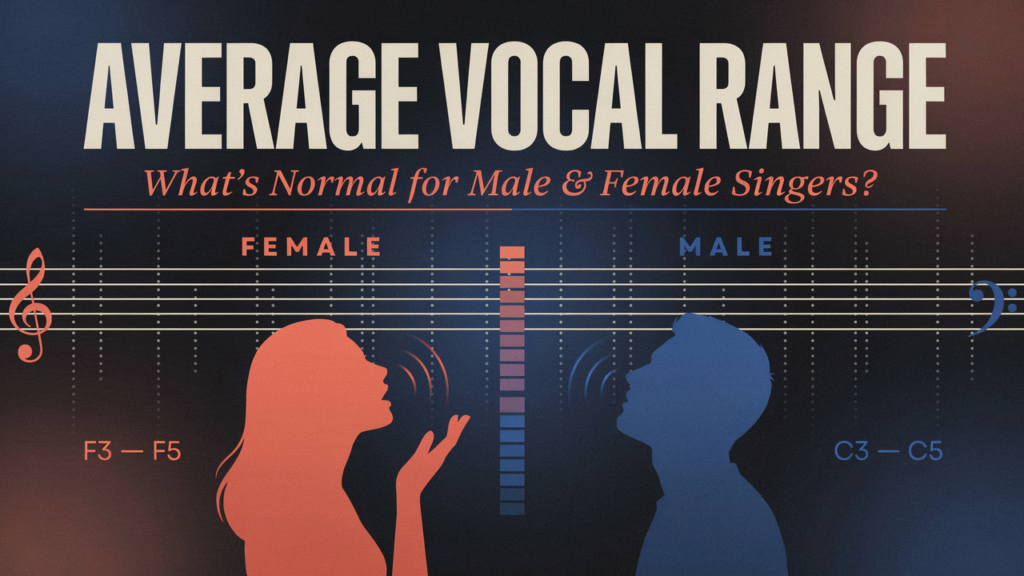
The average untrained adult female has a comfortable singing range of approximately E3 to E5 — two octaves. With training, most women extend this by a half to a full octave in both directions.
Average female vocal ranges by voice type:
| Voice Type | Typical Range | Tessitura (Best Zone) |
|---|---|---|
| Soprano | C4 – C6 | F4 – A5 |
| Mezzo-Soprano | A3 – A5 | C4 – F5 |
| Contralto | F3 – F5 | A3 – D5 |
What is the average range for a female singer? For an untrained adult woman, a comfortable singing range of E3 to E5 (2 octaves) is typical. Most women who have sung regularly — in choirs, at school, in casual contexts — will fall somewhere between E3 and A5 depending on their natural voice type.
Average female Hz (fundamental frequency): The average female speaking voice sits around 165–255 Hz (approximately E3–B3). In singing, women extend well above this — up to C6 (1047 Hz) for sopranos in trained performance.
Average Vocal Range for a Male
The average untrained adult male has a comfortable singing range of approximately C3 to C5 — two octaves. Male voices are generally lower due to the larger larynx and longer vocal cords that develop during puberty.
Average male vocal ranges by voice type:
| Voice Type | Typical Range | Tessitura (Best Zone) |
|---|---|---|
| Tenor | C3 – C5 | D4 – A4 |
| Baritone | A2 – A4 | G3 – E4 |
| Bass | E2 – E4 | D3 – B3 |
What is the average range for a male singer? For an untrained adult man, a comfortable range of C3 to C5 (2 octaves) is typical. Most men who have not sung formally will be most comfortable between E3 and G4, with the outer edges of their range underdeveloped.
Average male Hz (fundamental frequency): The average male speaking voice sits around 85–180 Hz (approximately E2–A3). In singing, men extend significantly above this — up to C5 and beyond for trained tenors.
Average male voice Hz by type:
| Voice Type | Avg Speaking Hz | Typical Low Note | Typical High Note |
|---|---|---|---|
| Tenor | 130–180 Hz | C3 | C5 |
| Baritone | 100–140 Hz | A2 | A4 |
| Bass | 80–110 Hz | E2 | E4 |
How Many Octaves Is a Normal Vocal Range?
2 octaves is the standard benchmark for a normal, functional singing range for an adult. This is the range that allows a singer to comfortably perform most songs written for their voice type, participate in choir, and cover most contemporary pop material.
| Octaves | What It Means |
|---|---|
| 1 octave or less | Very limited — untrained or vocally restricted |
| 1.5 octaves | Below average for a singer — common in completely untrained adults |
| 2 octaves | Average — functional range for most singers |
| 2.5 octaves | Above average — achievable with moderate training |
| 3 octaves | Excellent — professional-level range |
| 3.5+ octaves | Exceptional — top-tier professional vocalists |
| 4+ octaves | Extraordinary — rare, world-class vocalists only |
Is 2 Octaves a Good Vocal Range?
Yes — 2 octaves is a solid, functional range for a singer.
Two octaves is the average trained singing range and covers the majority of popular music repertoire. Most songs written for a specific voice type sit within a 1.5–2 octave range, so a singer with 2 octaves can access most of their appropriate repertoire without strain.
Two octaves is not a ceiling to be embarrassed about — it is a practical foundation. Adele, for example, works primarily within approximately 2 octaves (C3–E5) in most of her recorded material, despite having a wider potential range. Many of history’s most celebrated vocalists have built careers on 2 octaves of exceptional quality rather than 3 or 4 octaves of uneven development.
The honest benchmark: If you have 2 full octaves of clean, controlled, resonant voice — you have enough range to sing professionally. What matters most is what you do within that range, not how wide it is.
Is 3 Octaves a Good Vocal Range?
Yes — 3 octaves is an excellent vocal range, well above average.
Three octaves places a singer in approximately the top 10–15% of all vocalists. It is the range associated with accomplished professional singers who have undergone serious training and can access all registers of their voice cleanly.
Famous singers with approximately 3 octaves include:
- Carrie Underwood — D3–C6 (~3 octaves), lyric soprano
- Whitney Houston — A2–G#5 (~3 octaves), soprano
- Freddie Mercury — B2–F6 (~3.5 octaves), baritone-tenor
- Elvis Presley — G2–B4 (~2.5 octaves, with extensions to ~3)
A 3-octave range gives a singer access to a genuinely wide repertoire, the ability to sing in multiple voice registers with confidence, and enough ceiling to handle demanding material in the right key.
3-octave vocal range context:
- Most songs for any voice type require at most 1.5–2 octaves
- 3 octaves means you can sing most material from your voice type comfortably in the centre of your range
- It allows comfortable key flexibility — if a song is slightly too high or too low in its standard key, you can adjust without hitting limits
Is 4 Octaves a Good Vocal Range?
Yes — 4 octaves is exceptional and puts a singer in a very small percentage of all vocalists worldwide.
Four octaves is not a common achievement. It typically requires either an unusually rare natural range or years of dedicated professional training that specifically targets range development. Most singers who claim 4 octaves are counting falsetto or extended registers; a true 4-octave range in controlled, musical tone across chest voice, mixed voice and head voice is genuinely rare.
Singers with documented ranges near or above 4 octaves:
| Singer | Documented Range | Octaves |
|---|---|---|
| Mariah Carey | F2 – G#7 | ~5 octaves |
| Christina Aguilera | C3 – E7 | ~4 octaves |
| Celine Dion | B2 – E6 | ~3.5 octaves |
| Dimash Kudaibergen | D2 – D8 | ~6 octaves |
| Mike Patton | E2 – E7 | ~5 octaves |
| Adam Lambert | C3 – C6 | ~3 octaves |
| Brendon Urie | C3 – G6 | ~3.5 octaves |
The reality of 4 octaves: Most mainstream pop singers work within 2–2.5 octaves in actual song performance even when their maximum tested range is wider. A singer with 4 octaves who uses 2 octaves well is more effective than a singer with 4 octaves who uses all of them unevenly.
Average Vocal Range by Voice Type — Complete Reference Table
| Voice Type | Gender | Low Note | High Note | Octaves | Famous Example |
|---|---|---|---|---|---|
| Soprano | F | C4 | C6 | 2 | Celine Dion, Carrie Underwood |
| Mezzo-Soprano | F | A3 | A5 | 2 | Adele, Amy Winehouse |
| Contralto | F | F3 | F5 | 2 | Tracy Chapman, Cher |
| Tenor | M | C3 | C5 | 2 | Pavarotti, Justin Timberlake |
| Baritone | M | A2 | A4 | 2 | Elvis Presley, Frank Sinatra |
| Bass | M | E2 | E4 | 2 | Johnny Cash, Barry White |
Note: these are average ranges for each type. Trained singers extend beyond these in both directions.
Average Vocal Range for Pop vs Classical Singers
Classical singers tend to access a wider portion of their range in performance than pop singers, due to the demands of singing without amplification over a full orchestra.
| Style | Average Trained Range | Reason |
|---|---|---|
| Classical (opera) | 2.5–3 octaves in performance | No microphone — full body resonance required |
| Pop / Rock | 1.5–2.5 octaves in performance | Amplification allows narrower working range |
| Musical theatre | 2–2.5 octaves | Mix of both traditions |
| Jazz | 1.5–2 octaves | Focused tessitura, stylistic restraint |
The total tested range of pop and classical singers of the same voice type is often similar. The difference is in how much of that range is regularly used and developed in performance.
What Is Considered a Good Vocal Range?
“Good” depends entirely on context:
For a casual singer: 1.5–2 octaves of controlled, pleasant tone is good.
For a choir singer: 2 octaves covering your voice part comfortably is good.
For a professional pop singer: 2–2.5 octaves with strong control throughout is good. Range extremes matter less than consistency and tone quality in the working range.
For a professional theatre singer: 2.5 octaves with clean registration and strong belt capability is typically required.
For an opera singer: 2+ octaves with full resonance, no amplification, consistent over a 2-hour performance is the baseline.
The honest answer is: a good vocal range is the one that lets you sing the music you want to sing, in tune, with good tone, without straining. That looks different for every singer and every context.
FAQs
What is the average vocal range? The average vocal range for an untrained adult is 1.5–2 octaves. For trained singers the average rises to 2–2.5 octaves. Professional vocalists typically work within 2.5–3.5 octaves.
What is the average vocal range for a female? The average untrained adult female has a comfortable singing range of approximately E3 to E5 — 2 octaves. Trained female singers extend this to 2.5–3 octaves depending on voice type. Sopranos typically range from C4 to C6; mezzo-sopranos from A3 to A5; contraltos from F3 to F5.
What is the average vocal range for a male? The average untrained adult male has a comfortable singing range of approximately C3 to C5 — 2 octaves. Tenors typically range from C3 to C5; baritones from A2 to A4; basses from E2 to E4.
How many octaves is a normal vocal range? Two octaves is normal for a trained adult singer. Untrained adults typically access 1–1.5 octaves comfortably. Three octaves is above average and considered excellent. Four octaves is exceptional and rare.
Is 2 octaves a good vocal range? Yes. Two octaves is the average trained range and covers the majority of popular music repertoire. Many celebrated professional singers work primarily within 2 octaves. It is a solid, functional range for any style of music.
Is 3 octaves a good vocal range? Yes — 3 octaves is an excellent range, well above average, placing a singer in roughly the top 10–15% of all vocalists. Famous singers with approximately 3 octaves include Whitney Houston, Carrie Underwood, and Freddie Mercury.
Is 4 octaves a good vocal range? Four octaves is exceptional and very rare in true controlled singing range. It places a singer among the top professional vocalists in the world. Only a small number of singers have documented 4+ octave ranges with musical application across the full span.
What is a good vocal range for a beginner? For a beginner, any range is a starting point rather than a limit. Most beginners discover their comfortable range is 1–1.5 octaves, which expands with consistent training. Focus on developing the quality of your existing range before chasing its expansion.
What is the average Hz for a male voice? The average male speaking voice sits around 85–180 Hz. In singing, baritones typically operate between 98 Hz (G2) and 440 Hz (A4). Tenors reach up to 523 Hz (C5) and beyond in performance.
Related article:
- Find your voice type →
- Voice types explained →
- Is 3 octaves a good vocal range? →
- Is 2 octaves a good vocal range? →
- Is 4 octaves a good vocal range? →
- Human vocal range explained →
- Soprano vocal range →
- Mezzo-soprano vocal range →
- Contralto vocal range →
- Tenor vocal range →
- Baritone vocal range →
- Bass vocal range →
- How to improve your vocal range →
- Compare your range to famous singers →
Erika Parker is a vocal analysis and singing education writer at Vocal Range Test. She focuses on vocal range testing, voice type analysis, pitch recognition, and singing tools for vocalists, musicians, choir singers, and beginners.