
The Alexander Method, formally known as the Alexander Technique, is a science-backed system of neuromuscular re-education that helps you identify and undo harmful movement habits. These habits—often invisible to us—can lead to tension, pain, restricted breath, poor posture, and inefficient movement.
Alexander Method exercises teach you to move with less effort and more coordination, using a combination of awareness, inhibition, and direction. They are widely used by musicians, actors, dancers, athletes, office workers, and anyone experiencing posture-related discomfort.
This is the definitive guide to expert-level Alexander Method exercises, with step-by-step instructions, biomechanical reasoning, and practical integration methods that outperform all standard online resources.
What Are Alexander Method Exercises?
Alexander exercises are mind-body retraining practices designed to:
- Interrupt automatic tension patterns
- Restore natural head–neck–spine coordination
- Improve posture at rest and in movement
- Recalibrate proprioception (your sense of alignment)
- Support breath efficiency
- Reduce chronic muscular effort
Unlike stretching or strength training, Alexander exercises change the way your nervous system organizes movement. They are subtle, precise, and deeply transformative.
The Scientific Principles Behind Alexander Method Exercises
1. Inhibition (The Pause Before Habit)
Rather than automatically tensing before movement, you pause and allow a new coordination to emerge.
2. Direction (Gentle Mental Cues That Guide the Body)
These cues include:
- “Allow my neck to be free.”
- “Let my spine lengthen and my back widen.”
- “Allow my shoulders to release outward.”
Directions create upward, expansive coordination, not collapse or rigidity.
3. Primary Control (Head–Neck–Spine Relationship)
This dynamic alignment organizes the entire body.
When primary control is improved:
- Movement becomes light
- Posture becomes effortless
- Pain reduces
- Breath deepens naturally
4. Psychophysical Unity
Mind and body are a single system.
Changing thoughts changes movement; changing movement changes thoughts.
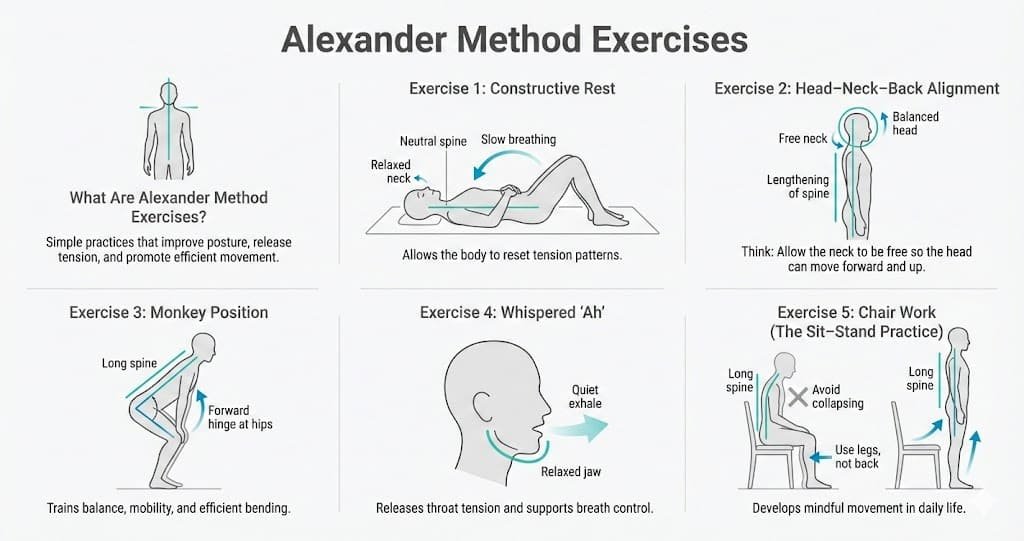
Foundational Exercise: Constructive Rest (Semi-Supine)
The most essential Alexander Method exercise.
Used by musicians, therapists, and performers worldwide.
How to Do It (Expert Version)
- Lie on your back on firm ground.
- Bend knees so feet rest flat.
- Support head with 1–3 books: neck long, throat open.
- Place hands on ribs or abdomen.
- Direct your system:
- “Neck free.”
- “Back widening.”
- “Spine lengthening.”
- “Ribs floating.”
- Let breath move automatically—no control, no forcing.
- Allow gravity to undo unnecessary holding.
Biomechanical Benefits
- Decompresses lumbar and thoracic spine
- Rebalances postural reflexes
- Resets head–neck orientation
- Softens chronic back, shoulder, and hip tension
- Improves parasympathetic nervous system activation
This is the daily reset for anyone experiencing tension.
Chair Work: Relearning Sitting and Standing
This is the most practical AT exercise because we sit and stand hundreds of times daily.
How to Practice (Advanced Breakdown)
- Sit near the front edge of your chair.
- Think: “Neck free, head forward and up.”
- Lean slightly forward from your hip joints—not your waist.
- Let legs do the work; do not stiffen the neck or shoulders.
- Stand in one smooth, unforced motion.
- To sit: reverse the movement with awareness and direction.
Why This Exercise Transforms Posture
- Reprograms habitual bracing
- Eliminates collapsing during sitting
- Improves hip mobility
- Teaches efficient movement sequencing
- Prevents back strain
This movement is the gateway to improved posture in everyday life.
Monkey Position (Hinged Alignment for Movement Tasks)
Used by musicians, athletes, and manual workers.
Steps
- Stand with feet shoulder-width apart.
- Release neck; allow head to float upward.
- Soften knees slightly (never lock).
- Fold forward at hip joints while keeping back long and wide.
- Allow weight to distribute evenly across both feet.
Applications
- Picking objects up
- Instrument positioning (violin, guitar, cello)
- Computer workstation setup
- Preventing lower-back compression
Monkey is the Alexander Technique’s functional movement blueprint.
Wall Alignment Exercise (Posture Recalibration)
How to Do It
- Stand with back against a wall—heels 2–4 inches away.
- Allow back of pelvis, ribs, and head to lightly touch without forcing.
- Direct upward length through spine.
- Release shoulder blades down and outward.
- Allow breath to expand ribs sideways and backward.
Benefits
- Teaches dynamic vertical alignment
- Reveals habitual slouching or over-arching
- Improves proprioception
- Pairs well with desk-ergonomics correction
Alexander Breathing Exercise: Natural Breath Coordination
Goal: Restore natural, non-forced breath.
Steps
- Sit or stand comfortably with neck free.
- Think “allow breath to come in” instead of “inhale.”
- Let exhale release—not push out.
- Notice rib movement in 360 degrees.
- Avoid lifting shoulders or tightening throat.
Benefits
- Frees diaphragm
- Reduces vocal strain
- Improves airflow for wind players
- Helps anxiety regulation
Walking Exercise: Integrating AT Into Full-Body Movement
How to Practice
- Thinking direction: “Head forward and up.”
- Allow arms to swing freely.
- Release lower back away from compression.
- Let feet roll heel → ball → toe.
- Avoid bracing legs or gripping pelvis.
Purpose
- Coordinates whole-body movement
- Reduces gait rigidity
- Strengthens natural postural reflexes
Task-Based Alexander Exercises (Real-World Integration)
For Musicians
- Constructive rest before practice
- Monkey for instrument posture
- Chair work for rehearsals
- Breath exercise for singers/wind players
For Desk Workers
- Chair work every hour
- Wall alignment at breaks
- Direction cues while typing
For Athletes
- Monkey for lifting mechanics
- Inhibition during rapid movement
- Direction cues to prevent bracing
For Dancers & Actors
- Integration of breath + alignment
- Grounding through feet
- Use of inhibition to reduce over-performance
If you’re experimenting with different warm-up strategies, begin with the quick warm-up routine and compare it with the more structured daily vocal warm-up. After preparing your voice, try tools like the microphone tester to ensure your device captures accurate sound. From there, jump into the voice type test to see which range category your warm-ups support.
Daily Alexander Method Routine (Beginner → Advanced)
Beginner (5 minutes)
- Constructive rest – 2 minutes
- Neck-free direction – 30 seconds
- Chair work – 2 cycles
- Breath release – 1 minute
Intermediate (10 minutes)
- Constructive rest – 4 minutes
- Monkey – 3 reps
- Wall alignment – 1 minute
- Walking awareness – 1 minute
Advanced (15–20 minutes)
- Constructive rest – 5–8 minutes
- Slow chair work – 5 reps
- Monkey with objects (instrument, book, laptop)
- Breath coordination while standing
- Inhibition practice before every movement
Common Mistakes in Alexander Exercises
- Forcing “good posture”
- Pulling the shoulders back and down
- Holding breath
- Tightening jaw or tongue
- Trying too hard (effort blocks change)
- Over-controlling rather than allowing
- Collapsing in the name of “relaxation”
- Attempting to imitate rigid alignment models
AT is about ease, not perfection.
When You Should Work With a Certified Alexander Teacher
Seek a teacher if you:
- Have chronic tension or pain
- Want rapid improvement
- Aren’t sure if you’re doing the exercises correctly
- Are a musician, actor, or athlete needing precision
- Tend to over-correct posture
- Want deeper neuromuscular change
Legitimate certification bodies include:
- STAT
- AMSAT
- CANSTAT
- APATA
Hands-on guidance accelerates progress dramatically.
Frequently Asked Questions
Are Alexander Method exercises safe?
Yes. They are gentle, non-invasive, and appropriate for nearly all ages and conditions.
How long until I see results?
Some feel relief immediately. Long-term habit change takes weeks to months.
Can AT fix posture permanently?
It gradually retrains your coordination, which naturally improves posture.
Is AT the same as stretching or strengthening?
No. It focuses on neuromuscular efficiency, not force or flexibility.
Can I practice without a teacher?
Yes—but professional guidance deepens and accelerates results.
- Releasing chronic tension becomes much easier when paired with focused Alexander Technique training for musicians.
- Many posture problems are reinforced by poor breathing habits taught incorrectly in some singing lesson environments.
- Functional body use improves dramatically when students follow structured adult vocal programs.
- Early retraining is often fastest through guided beginner voice lessons.
- Understanding muscular release makes more sense once you learn how the vocal cords work.
- Gentle coordination is reinforced through carefully designed vocal range exercises.
- To explore posture-based learning at no risk, the free singing course introduces foundational body awareness.
Erika Parker is a vocal analysis and singing education writer at Vocal Range Test. She focuses on vocal range testing, voice type analysis, pitch recognition, and singing tools for vocalists, musicians, choir singers, and beginners.