
The lowest vocal range refers to the deepest pitches the human voice can produce, measured using scientific pitch notation and, in some cases, verified frequency analysis. While most singers can only reach the low notes of their assigned voice types—such as bass or baritone—some individuals achieve extraordinarily deep tones far beyond typical human limits.
This guide presents the lowest human vocal ranges, the deepest notes ever recorded, and the vocal mechanisms that make such frequencies possible. It also includes practical insights for singers interested in expanding their own lower range, supported by internal references to range-testing tools, vocal science resources, and bass-range studies.
What Is the Lowest Vocal Range?
The lowest vocal range describes the lowest pitches a singer can produce with clarity, either in modal voice (full voice), chest voice, or extended techniques like vocal fry and subharmonics. These notes are typically measured using:
- Pitch notation (E2, C2, A1, etc.)
- Frequency in Hertz (Hz)
- Spectral verification for extreme low notes
Most human voices fall within a predictable range, but some singers—particularly basses and basso profondos—access notes dramatically below typical vocal standards.
If you want to map your own lowest note with accuracy, you can start with a vocal range testing tool, which identifies your lowest stable pitch and places it on an octave map.
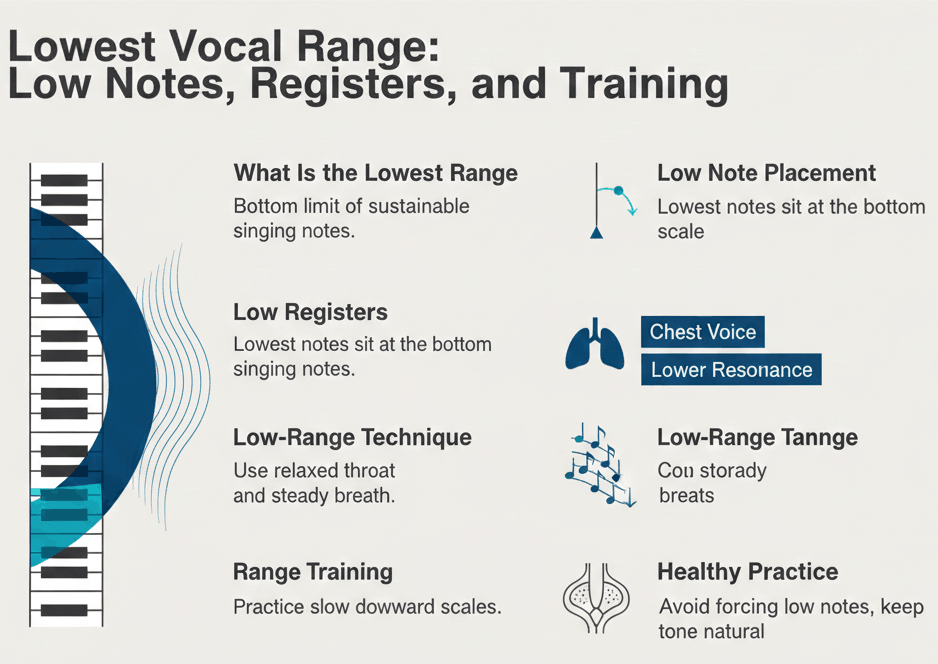
Average Lowest Vocal Range (Men & Women)
Although every individual is unique, large studies of vocal performance show clear averages:
Typical Lowest Notes for Men
- Average male lowest note: A2 – C3
- Trained baritones: F2 – A2
- Professional bass singers: C2 – E2
- Basso profundo specialists: G1 – C2
Typical Lowest Notes for Women
- Average female lowest note: A3 – C4
- Mezzo-sopranos: F3 – A3
- Contraltos: D3 – F3
- Rare low female voices: A2 – C3 (uncommon but possible)
For a deeper breakdown of low female and male categories, the educational guide on male vocal ranges and female range classifications provides standardized examples and scientific pitch charts.
The Lowest Notes Humans Have Ever Produced
Some individuals possess laryngeal anatomy and neuromuscular coordination that allow unusually deep frequencies.
Tim Storms – Lowest Human Note (Guinness Record)
- Lowest note: G−7 (0.189 Hz)
- Widest range: ~10 octaves
- Achieved using extreme subharmonic vibration far below musical pitch.
- Considered the deepest recorded human sound.
Basso Profundo Singers (Classical Tradition)
Professionally trained deep basses often reach:
- D1 – F1 (extremely rare)
- B1 – D2 (strong fundamentals)
Some Russian Orthodox choir basses consistently demonstrate notes below C2, employing resonance strategies unique to Slavic basso singing.
Contemporary Deep-Voice Singers
Genres like country, gospel, and metal include singers who regularly access:
- E1 – G1
- Low growls and fry tones for stylistic effect
For comparisons across popular artists, the dataset of famous singers’ vocal ranges helps contextualize how low professional singers typically go.
Vocal Physiology Behind Extremely Low Notes
Producing exceptionally low pitches requires specific biomechanical adjustments in the vocal folds and vocal tract.
1. Increased Vocal Fold Mass
Thickened, relaxed vocal folds vibrate more slowly, lowering pitch.
2. Lengthened Vocal Tract
A lowered larynx lengthens the resonant tube, amplifying sub-100-Hz frequencies.
3. Subharmonics and Fry Register
Low notes often rely on:
- Vocal fry (irregular, slow vibration)
- Subharmonic phonation (vibrating at integer fractions of the fundamental frequency)
A detailed explanation of this mechanism appears in the article discussing how the vocal cords generate different pitches, offering foundational insight into extreme low-frequency phonation.
Registers That Influence the Lowest Vocal Range
The human low range includes several registers, each with different acoustical characteristics.
Chest (Modal) Voice
- Produces most musical low notes
- Typically strong down to:
- E2 (men)
- F3 (women)
Vocal Fry
- Produces the lowest human frequencies
- Used to measure absolute low limits
- Can extend below C2 and, in rare cases, below C1
Subharmonic Register
- Creates notes lower than modal capability
- Often used by deep basses in choral settings
- Generates “growling” low fundamentals in some male singers
Understanding the differences between registers is critical when testing your own capabilities. The resource on chest voice and head voice helps clarify how the vocal system transitions between ranges.
Lowest Notes in Music: Classical vs Contemporary
Classical (Opera & Choral Music)
- Basso Profundo roles demand notes such as:
- B1, A1, occasionally G1
- Russian Orthodox choirs are famous for ultra-deep bass sections
Contemporary Music
- Gospel and country basses often use resonant low E2–C2 notes
- Metal vocalists may use subharmonics below A1
- R&B / pop rarely explores extreme low registers except stylistically
How to Measure Your Lowest Vocal Range
Accurately testing low notes requires proper technique and reliable pitch detection.
1. Warm Up
Use gentle humming and descending slides to activate the lower folds.
2. Descend Slowly
Move down by semitones, maintaining clarity in tone.
3. Recognize the Difference Between Modal and Fry
Only include fry if measuring extreme limits, not everyday singing range.
4. Use a Pitch Tool
A frequency-based vocal measurement tool ensures your lowest note is properly identified.
A structured tutorial for beginners is available in the method outlined under how to test vocal range, ideal for accurate self-assessment.
You can then map your results using a vocal range calculator, which converts frequencies and notes into octave-based measurements.
How to Expand Your Lower Vocal Range Safely
Developing deeper notes takes consistent technique and control—not force.
1. Strengthen Breath Support
Low notes require slower airflow, not excessive pressure.
2. Relax the Larynx
A lowered, stable laryngeal position is essential.
3. Develop Resonance
Open, relaxed throat space enhances low-frequency amplification.
4. Use Controlled Fry Exercises
Fry should be used carefully to train coordination, not to strain the folds.
Evidence-based approaches to range development are covered in how to increase vocal range safely, which applies to both upward and downward expansion.
Frequently Asked Questions
What is the lowest note a human can sing?
The lowest verified note is G−7 by Tim Storms (0.189 Hz).
What is a normal lowest note for men?
Most men reach A2–C3, while trained basses may reach E2–C2.
What is the lowest female vocal range?
Contraltos often reach D3–F3; rare low female voices may reach A2.
Is vocal fry considered part of vocal range?
For measurement: yes. For practical singing: often no.
Can training deepen my voice?
Yes—coordination, breath control, and resonance can all extend your lower range.
- To understand how extremely low voices are classified, this overview of the bass vocal range gives a solid reference point.
- Many deep-voice singers compare their notes using the specialized deep voice test.
- To see how rare ultra-low notes really are, this breakdown of the human vocal range adds scientific context.
- Some of the deepest recorded singers are featured in this profile of the Tim Storms vocal range.
- For another extreme example, this look at the Tim Foust vocal range shows how low modern basses can go.
- Comparing vocal depth across styles is easier when you review the choir vocal ranges.
- To find where your own low notes start, a simple voice frequency test makes it easy.