
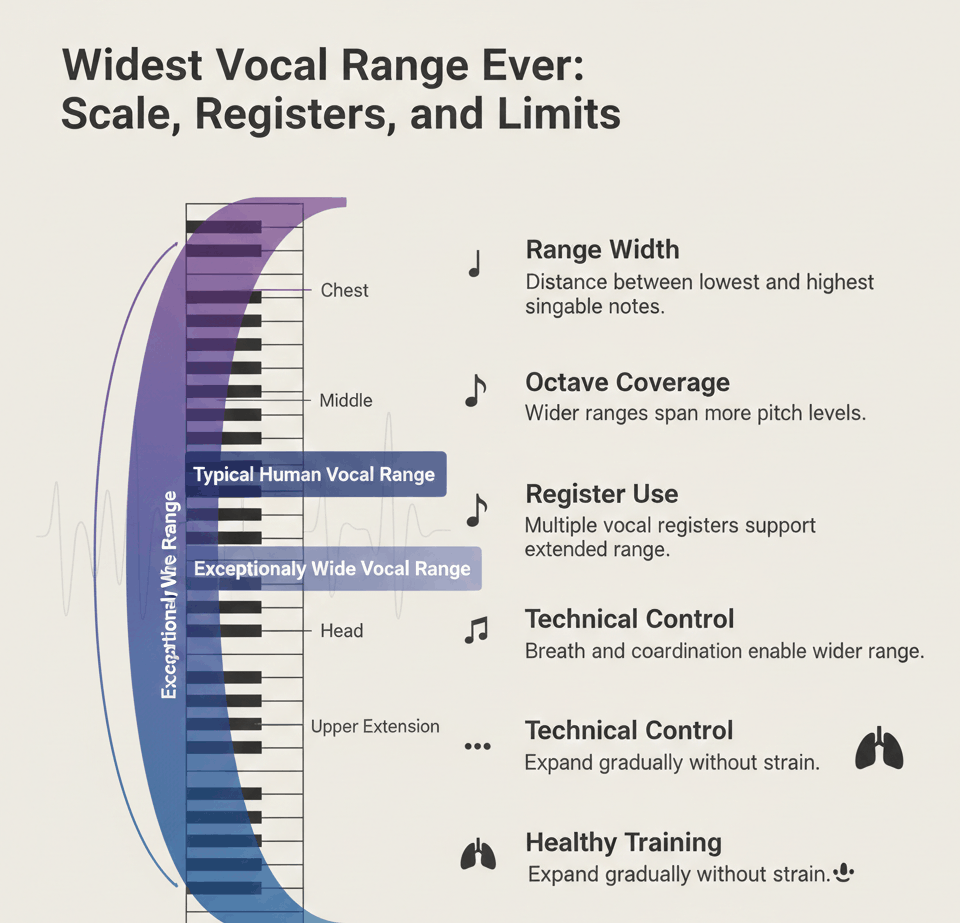
The widest vocal range refers to the greatest measurable distance between the lowest and highest pitches a singer can produce. Unlike the “highest vocal range,” which focuses only on upper pitches, the widest range spans the entire set of notes reachable across all registers—modal voice, falsetto, vocal fry, subharmonics, and the whistle register.
Most trained singers achieve 2.5 to 4 octaves, while rare exceptional vocalists reach 5, 6, or even 10 octaves when all registers are included. Measuring and understanding these extremes provides valuable insight into vocal physiology, acoustics, and technique development.
If you want to identify your own lowest and highest notes, you can begin with a vocal range test that accurately maps your boundaries across an octave chart.
What Does “Widest Vocal Range” Actually Measure?
A singer’s complete vocal range is defined by:
- Lowest phonated note (usually vocal fry or subharmonics)
- Highest phonated note (head voice, falsetto, or whistle register)
- Total interval between the two
This measurement uses scientific pitch notation—C1, E2, G5, C7, etc. Each octave doubles in frequency, making very low and high notes significantly more challenging to produce.
To convert your own range into octaves, a vocal range calculator translates note values into interval spans and provides a precise octave total.
The Widest Vocal Range Ever Recorded
Tim Storms — 10 Octaves (Widest Human Range in History)
Tim Storms holds the Guinness World Record for the widest documented human vocal range, measuring approximately 10 octaves.
- Lowest note: G−7 (0.189 Hz)
- Highest notes: Mid–G5 area
- Mechanisms used: vocal fry + subharmonics + modal voice
Storms’ extreme low notes come from subharmonic vibration, where the vocal folds vibrate at fractional frequencies. His range is so large that much of it lies outside traditional musical pitch perception.
For reference, the bass vocal range guide outlines how rare true low-frequency capability is among typical singers.
Professional Singers With Extremely Wide Ranges
Although no singer approaches Storms’ record, several high-profile artists demonstrate unusually large spans.
Dimash Kudaibergen — Over 6 Octaves
Dimash combines refined classical training with contemporary technique.
- Strong chest and head voice
- Extended falsetto
- Whistle capability
His range is one of the most balanced across registers.
Mike Patton — Over 6 Octaves
Known for extreme versatility, Patton uses:
- Fry lows
- Falsetto
- Distortion
- Experimental phonation
He explores nearly every vocal register available to humans.
Axl Rose — Approx. 5.5 Octaves
Famous for both extreme lows and powerful highs.
Axl’s range spans fry tones at the low end and brilliant upper resonance at the top.
Mariah Carey — About 5 Octaves
Her pioneering use of the whistle register extends her upper range dramatically.
Mariah regularly reaches G7, far above typical female soprano limits.
Georgia Brown — Claimed 8 Octaves
Georgia Brown is frequently cited for extreme whistle notes.
Several recordings suggest a range above 7 octaves, though not all claims are independently verified.
To see how these singers compare, the famous singer vocal range chart offers octave-based examples across genres.
How Octaves and Registers Combine to Create Wide Ranges
Octaves: The Mathematical Backbone
Each octave represents a doubling in frequency.
Example:
- C3 → C4 doubles the Hz
- C4 → C5 doubles again
Small changes in pitch produce exponential increases or decreases in frequency at the extremes.
Registers That Extend the Total Range
To achieve very wide ranges, singers rely on multiple phonation modes:
1. Modal Voice (Chest + Head Voice)
The foundation of singing—tone-rich and resonant.
Most singers operate primarily here.
2. Falsetto
Light, airy extension above head voice.
Adds additional semitones to high range.
3. Whistle Register
The highest register the human voice can phonate.
Range: C6 – C8, sometimes higher
Used by singers like Mariah Carey and Ariana Grande.
To understand how head voice and upper registers interact, the article on chest voice vs head voice explains transitions in detail.
4. Vocal Fry (Lowest Register)
Produces low-frequency pops or creaks.
Expands the lower range beyond modal capability.
5. Subharmonics
Special low-frequency vibration used by deep basses.
Capable of producing notes below musical pitch ranges.
Together, fry + modal + falsetto + whistle create the full width of the human range.
Widest Vocal Range vs Highest Vocal Notes
These terms are commonly misunderstood.
Highest Vocal Range
= Who sings the highest notes
Examples:
- Mariah Carey
- Georgia Brown
- Coloratura sopranos
Widest Vocal Range
= Total notes from lowest to highest, including all registers
Examples:
- Tim Storms (~10 octaves)
- Dimash (~6 octaves)
- Mike Patton (~6 octaves)
A singer could have:
- The highest notes without the lowest
- Or extremely low notes without significant whistle register capability
This distinction is important when evaluating vocal ability and classification. For understanding typical boundaries, the guide on voice types explains where standard soprano, tenor, baritone, and bass ranges fall in comparison.
Why Only a Few Humans Have Very Wide Ranges
Several physiological and neurological factors govern vocal limits:
A. Vocal Fold Shape & Composition
Thinner, longer, or highly elastic folds enable greater pitch flexibility.
B. Extreme Neuromuscular Control
Elite singers manage subtle muscular adjustments across multiple phonation modes.
C. Resonance Strategy
Tuning vocal tract shape amplifies either low or high frequencies, enabling extreme ranges.
D. Genetic Predisposition
Certain individuals are naturally capable of unusual frequency production.
E. Specialized Training
Singers with wide ranges dedicate years to breath support, register blending, and tension-free phonation.
The educational resource on how the vocal cords produce different pitches explains these biomechanical principles clearly.
How to Measure Your Own Total Vocal Range
A reliable range measurement must include both lowest and highest phonations.
Step 1 — Identify Your Lowest Usable Note
Explore descending scales, gently entering fry without strain.
Step 2 — Identify Your Highest Sustainable Note
Move through head voice and falsetto; attempt whistle cautiously.
Step 3 — Use a Measurement Tool
A vocal range calculator helps convert notes into octave totals.
Step 4 — Classify Your Voice Type
A voice type test compares your results to standard voice profiles.
Step 5 — Compare to Famous Singers
Using a singer comparison tool reveals how your own range aligns with notable vocalists.
For detailed assessment techniques, the guide on how to test vocal range outlines a safe, step-by-step process.
Can Training Expand Your Total Vocal Range?
Yes—most singers can expand their range by 5–12 semitones through:
- Breath control
- Laryngeal mobility
- Register balance
- Resonance shaping
- Strengthening coordination
- To understand what counts as extreme, it helps to start with the limits of the lowest vocal range.
- Many readers compare extremes by looking at the six octave vocal range.
- To see how rare massive ranges really are, this breakdown of four octave voices adds perspective.
- Legendary outliers are highlighted in this overview of who has the largest vocal range.
- For scientific context, reviewing the full human vocal range helps explain the limits.
- Many extreme singers rely on special registers, which are explained in the guide to the whistle voice.
- To see where you personally fall, a simple how to find your vocal range makes comparison easy.