
Alicia Keys’ vocal range spans approximately A2 to E5, classifying her as a mezzo-soprano with contralto-like lower warmth. She is recognized for her soulful chest voice, expressive rasp, mid-range dominance, and emotionally charged vocal delivery in R&B, soul, and neo-soul genres.
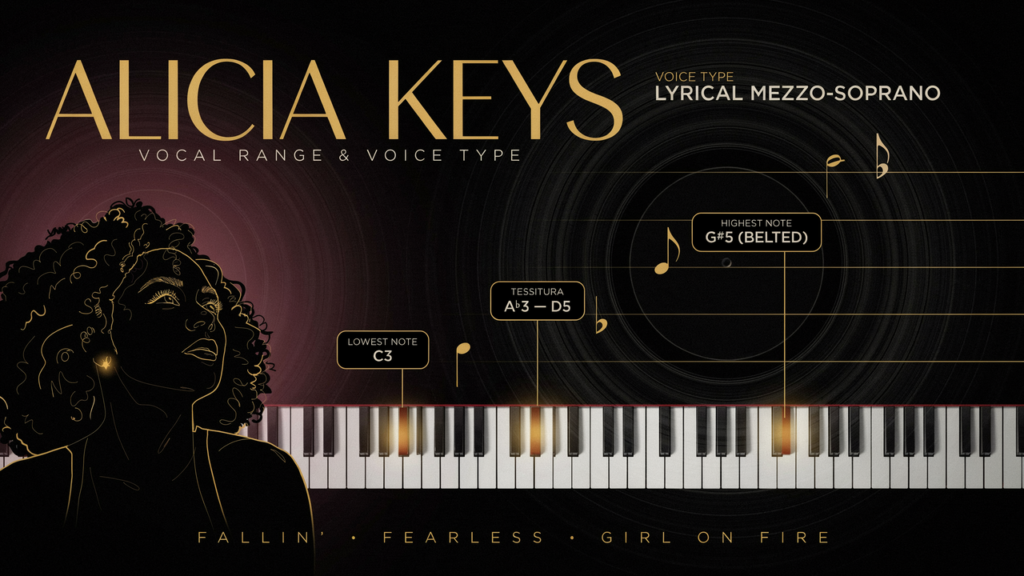
Alicia Keys’ Complete Vocal Range (A2 – E5)
Alicia Keys operates within a functional range of A2 to E5, but her true vocal identity lies in her mid-lower female tessitura, which suits rich, warm, piano-driven soul.
Technical Range Overview
| Attribute | Detail |
|---|---|
| Total Range | A2 – E5 |
| Comfortable Tessitura | G3 – C5 |
| Dominant Registers | Chest voice and chest-mix |
| Upper Register | Light, limited head voice |
| Lower Register | Warm, expressive, contralto-like |
| Vocal Tone | Soulful, textured, earthy, sometimes raspy |
While her range is not unusually large, it is stylistically powerful and emotionally saturated, which is central to her artistic identity.
What Voice Type Is Alicia Keys?
Alicia Keys is consistently classified by vocal experts as a mezzo-soprano, but her darker timbre and low-range ease can make her sound like a contralto at times.
Why Alicia Keys Is a Mezzo-Soprano
- Her tessitura (where her voice sits most naturally) is mezzo-soprano
- Her upper mid-range has brightness despite rasp
- Her lower notes, though warm, lack the density of true contraltos
- Her resonance placement is forward, not deep or cavernous
Why People Mistake Her for a Contralto
- Strong, warm low register
- R&B vocal phrasing associated with deeper female voices
- Chest-dominant technique that darkens the tone
- Her tone has deep coloration due to stylistic rasp
Final Classification
Mezzo-Soprano with contralto-like lower shading, ideal for soulful R&B.
Alicia Keys’ Highest Notes (Upper Register Analysis)
Alicia Keys’ upper register is not her primary strength. She typically avoids extremely high notes and rarely uses an extended head voice.
Highest Verified Notes
- E5 – consistent upper-limit belt
- F5 – occasional early-career peaks, not sustained
- D5–E5 – dominant belt/mix range in major hits
Examples in Songs
- “No One” – prominent chest-dominant mix near D5
- “Fallin’” – emotional high belts in chorus
- “If I Ain’t Got You” – expressive upper-mixed phrases
Upper Register Traits
- More emotional than technical
- Often raspy due to chest dominance
- Limited height compared to powerhouse belters
She prioritizes raw expression over vocal gymnastics, giving her high registers a human, vulnerable texture.
Alicia Keys’ Lowest Notes (Full Lower Register Breakdown)
Alicia’s lower range provides much of her vocal richness.
Lowest Verified Notes
- A2 – documented in controlled studio recordings
- Bb2–C3 – used naturally in live settings
- Frequent use of D3–G3 in ballads and verses
Why Her Low Notes Sound Contralto-Like
- Natural warmth in lower harmonics
- Chest-resonant placement
- Forward projection that preserves clarity
- Smooth airflow and relaxed vocal fold engagement
Her lower register is one of the most compelling features of her voice—warm, soulful, and resonant.
Alicia Keys’ Vocal Registers (Advanced Vocal Science)
Chest Voice (A2 – C4)
Her strongest register.
Characteristics:
- Full, warm resonance
- Natural soulful inflection
- Slight rasp due to stylistic compression
- Dominant in nearly all verses and choruses
Mixed Voice (C4 – E5)
Alicia uses a chest-dominant mix, meaning:
- The mix leans heavily toward chest voice
- Produces a gritty, soulful tone
- Can lead to vocal fatigue when pushed
- Creates signature rasp during emotional climaxes
Head Voice (D5 – F5)
Least used register.
When accessed:
- Light, floating, and breathy
- Less controlled
- Used only for stylistic soft peaks, not power
Falsetto
Alicia rarely uses falsetto; when she does:
- It is airy and subtle
- Used more as texture than melody
Her overall vocal technique leans toward chest-driven power rather than balanced classical placement.
Alicia Keys’ Rasp Explained (Technique, Wear, and Style)
Alicia Keys’ raspy sound has multiple contributing factors:
1. Chest-Dominant Belting
She relies heavily on chest voice even at high pitches, which naturally produces rasp.
2. Vocal Fold Compression
A stylistic level of “grit” occurs when the folds press slightly tighter, creating textured sound waves.
3. Natural Vocal Evolution
With age and frequent touring, her rasp has become more permanent and identifiable.
4. Genre Expectations
Neo-soul rewards authenticity, rawness, and textured vocals over purity.
Her rasp is a blend of stylistic choice and natural vocal maturity, not simply strain.
Alicia Keys Live vs Studio Vocals (Detailed Comparison)
Studio Vocals
- Controlled tone
- Smoother high notes
- More refined rasp
- Layered harmonies for warmth
- Cleaner vocal compression
Live Vocals
- More pronounced rasp
- Occasional pitch fluctuations
- Strong emotional delivery
- Heavier use of chest voice
- Vulnerable, authentic tone
Alicia Keys’ live performances emphasize expression, often prioritizing emotion over technical precision.
Alicia Keys’ Best Songs for Vocal Range & Technique Analysis
Lower Register Excellence
- “Diary” – rich A2–C3 phrases
- “Un-thinkable (I’m Ready)” – smooth low tones
- “In Common” – breathy and warm lower lines
Mid-Range Strength
- “Fallin’”
- “A Woman’s Worth”
- “You Don’t Know My Name”
Upper Mix & Emotional Rasp
- “No One”
- “If I Ain’t Got You”
- “Girl on Fire”
Alicia Keys Vocal Range Chart
A2 ——— C3 ——— G3 ——— C4 ——— G4 ——— C5 ——— E5
  Low Range    Lower Mid   Mid Range  Upper Mid   Belting Range
This chart shows how her central power lies in the mid and lower registers, not the extreme high end.
Frequently Asked Questions
What is Alicia Keys’ vocal range?
Approximately A2 – E5.
What voice type is Alicia Keys?
Mezzo-soprano with contralto-like lower warmth.
What is Alicia Keys’ highest note?
Around E5, occasionally F5 in early performances.
What is Alicia Keys’ lowest note?
Approximately A2.
Why is Alicia Keys’ voice so raspy?
A mixture of chest-dominant belting, stylistic choice, and natural vocal evolution.
Does Alicia Keys use head voice?
Yes, but sparingly. It is not her technical focus.
Is Alicia Keys a strong live vocalist?
She is expressive and emotional live, though her high notes may vary in consistency.
Has Alicia Keys’ voice changed over time?
Yes—her tone is now raspier, deeper, and more textured compared to her early 2000s recordings.
- To compare Alicia Keys’ soulful power with another diva, reviewing Mariah Carey’s vocal range shows how different techniques achieve wide ranges.
- Her placement in the mezzo–alto area becomes clearer when you study how to identify if you are a mezzo soprano or contralto.
- Understanding how her notes are counted is explained in does head voice count in vocal range.
- Many of her lower tones align with principles from tips to extend your lower vocal range.
- If you want to analyze her octave span, this guide on how to find your vocal range on piano makes it easy to map the notes.
- Her vocal consistency over decades ties into research on how age affects your vocal range over time.
- For singers inspired by her tone, these vocal range and singing techniques explain how to develop similar control.
Erika Parker is a vocal analysis and singing education writer at Vocal Range Test. She focuses on vocal range testing, voice type analysis, pitch recognition, and singing tools for vocalists, musicians, choir singers, and beginners.