
Amy Lee’s vocal range spans approximately C3 to E6, placing her in the mezzo-soprano category with a soprano-capable head voice. Her voice is distinguished by powerful mid-range belts, operatic upper-register clarity, wide vibrato, precise sustain, and a dark, ethereal tone that has become fundamental to Evanescence’s musical identity.
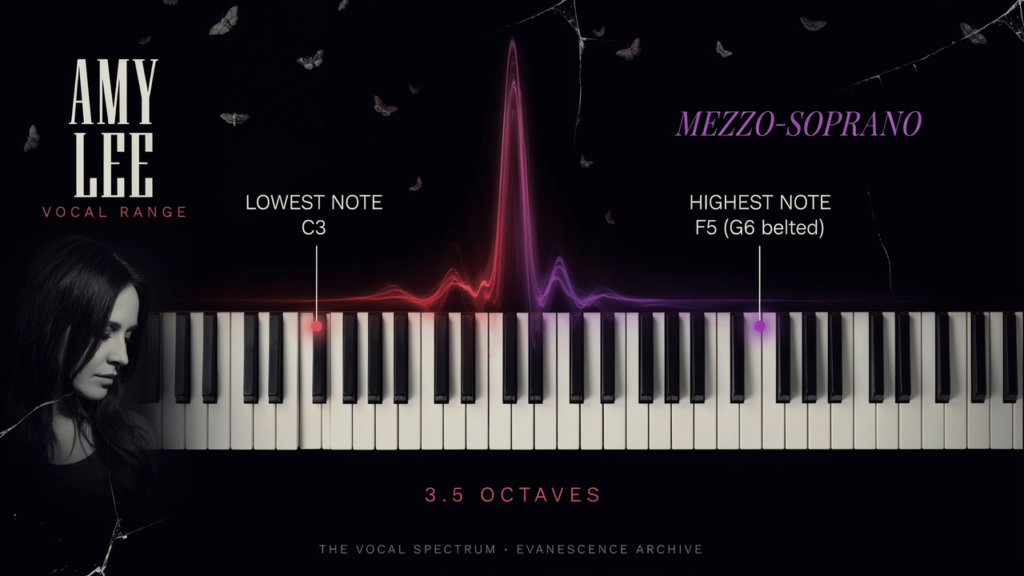
Amy Lee’s Full Vocal Range (C3 – E6) Explained
Amy Lee has demonstrated a consistent functional range from C3 in the lower register to E6 in the upper head register. Her voice is notable not for sheer octave count but for a rare combination of classical resonance and rock intensity.
Technical Range Overview
| Attribute | Detail |
|---|---|
| Total Range | C3 – E6 |
| Practical Performance Range | G3 – C6 |
| Voice Category | Mezzo-soprano with soprano extension |
| Strength Zones | Mid-range belts, head resonance |
| Register Balance | Strong chest/mix + operatic head tone |
| Tone Qualities | Dark, resonant, cinematic, haunting |
She displays full control across multiple registers, enabling dynamic shifts from intimate softness to full dramatic intensity.
What Voice Type Is Amy Lee?
Amy Lee’s voice is often misclassified due to her operatic tendencies, but the most accurate classification is mezzo-soprano.
Why Amy Lee Is a Mezzo-Soprano
- Her natural tessitura sits lower, around G3–C5
- Her mid-range is dark, weighty, and warm
- Belting registers (A4–E5) align with mezzo resonance
- Lower tones retain clarity without contralto heaviness
Why She Appears Soprano-Like
- She has an unusually strong head voice up to E6
- She uses classical shaping to achieve a bright, ringing upper tone
- Her vibrato resembles that of lyric and dramatic sopranos
Final Voice Type Conclusion
Amy Lee is a mezzo-soprano who has cultivated a soprano-grade head voice, enabling her to bridge rock, classical, and cinematic vocal styles seamlessly.
Amy Lee’s Highest Notes (Dramatic Upper Register)
Amy Lee’s high notes are among the most recognizable in 2000s–2020s rock, thanks to their operatic color and emotional intensity.
Highest Verified Notes
- E6 – upper-limit head voice
- C6–D6 – frequently used for climactic passages
- A5–B5 – regular high-register moments in early Evanescence material
Notable Songs with High Notes
- “Lithium” — haunting C6 sustain
- “Your Star” — powerful upper-register resonance
- “Snow White Queen” — dramatic head-voice transitions
- “My Immortal” (live) — clean, vibrato-rich upper tones
Characteristics of Her High Register
- Strong airflow support
- Operatic vowel alignment
- Wide, slow vibrato for emotional emphasis
- Crystal-clear resonance uncommon in rock singers
Her head voice is one of the most technically developed in mainstream rock.
Amy Lee’s Lowest Notes (C3 Lower Boundary)
Amy Lee’s lower register is warm, grounded, and surprisingly well-supported for a mezzo-soprano.
Lowest Verified Notes
- C3 — established lower limit in recorded performances
- D3–F3 — commonly featured in ballads and intimate verses
Traits of Her Low Register
- Smooth, unforced delivery
- Rounded tone with slight breathiness for stylistic effect
- Strong enough to anchor darker, more emotional passages
- Maintains clarity even at quiet dynamics
Her lower vocal color contributes to Evanescence’s gothic, emotional sound.
Amy Lee’s Vocal Registers (Advanced Vocal Science)
Chest Voice (C3 – A4)
- Surprisingly strong for a mezzo
- Warm and full-bodied
- Slight rock grit at higher intensities
- Used to anchor verses and create emotional depth
Mixed Voice (A4 – E5)
This is where Amy Lee’s power truly emerges.
- Chest-dominant, not heavily nasal
- Strong resonance without shouting
- Powerful sustain on mid-high belts
- Characteristic “rock-meets-opera” sonic intensity
Her mix voice blends classical breath support with rock phrasing—a hybrid technique few singers achieve well.
Head Voice (C5 – E6)
Her most technically refined register.
- Pure, clean tone
- Operatic shaping
- Exceptional sustain
- Controlled pitch even at high vibrato amplitude
This allows Amy Lee to hit soprano notes while still sounding unmistakably like herself.
Falsetto
Rarely used, because:
- Her head voice is powerful enough to avoid falsetto reliance
- Falsetto does not suit her darker, dramatic tonal aesthetic
As your technique develops, smoothing transitions between registers becomes essential, which is why our guide on chest voice vs head voice is a key resource. After reviewing those concepts, explore strategies to extend your abilities with expand vocal range safely. If higher notes are your primary challenge, the targeted exercises in high notes singing can help. For an even clearer picture of your vocal strengths, analyze your recordings through our AI voice analysis tool.
Amy Lee’s Tone, Timbre & Resonance (Technical Breakdown)
Tone Qualities
- Dark
- Ethereal
- Dramatic
- Cinematic
- Emotionally charged
Resonance Characteristics
- Forward mask placement
- Strong, ringing overtones
- Balanced brightness despite dark timbre
- Exceptional projection even with heavy instrumentation
Vibrato Characteristics
- Slow, wide, expressive
- Often used intentionally as a stylistic device
- Key element of her “haunting” vocal identity
Amy Lee’s tone is one of the most identifiable in modern rock music.
Classical Technique vs Rock Power (Hybrid Skillset)
Amy Lee’s voice is built on a hybrid technique that integrates classical fundamentals with contemporary rock demands.
Classical Elements
- Breath management
- Vowel shaping (“ah,” “oh,” “eh” rounded for resonance)
- Head-voice projection
- Controlled vibrato
Rock Elements
- Chest-driven power
- Dynamic phrasing
- Grit accents
- Dramatic emotional interpretation
This dual influence enables her to remain uniquely versatile.
Amy Lee Live Vocals (Strengths & Real-World Performance Behavior)
Live Strengths
- Strong pitch stability
- Excellent breath control even during movement
- Consistent resonance in loud mixes
- Maintains tone quality across long sets
Observable Live Variations
- Occasional huskiness from tour fatigue
- Slightly reduced upper extension on back-to-back performances
- More emotional improvisation than in studio versions
Despite these natural variations, Amy Lee is widely considered one of the most reliable and consistently strong live vocalists in rock.
Amy Lee Vocal Range Chart
C3 ——— F3 ——— A3 ——— D4 ——— A4 ——— D5 ——— C6 ——— E6
Low      Lower-Mid     Mid      Upper Mid     Belting     Head Voice   Upper Head
Her range is broad, but her dominant expressive zone lies between A3 and E5, where her dramatic presence is strongest.
Best Songs to Experience Amy Lee’s Vocal Range
Low-Range Showcases
- “My Heart Is Broken”
- “End of the Dream”
- “Secret Door”
Mid-Range Emotional Power
- “Bring Me to Life”
- “Going Under”
- “My Immortal”
Upper-Range Mastery
- “Lithium”
- “Your Star”
- “Snow White Queen”
These songs illustrate her hybrid technique and dynamic control.
Frequently Asked Questions
What is Amy Lee’s vocal range?
Approximately C3 to E6.
What voice type is Amy Lee?
Mezzo-soprano with soprano extension.
What is Amy Lee’s highest note?
Around E6 in head voice.
What is her lowest note?
Approximately C3.
Does she have classical training?
Yes. Her breath support, vibrato, and head resonance reflect classical influence.
Why does Amy Lee sound operatic?
She shapes vowels and resonance using classical technique, especially in head voice.
Is Amy Lee good live?
Amy Lee is considered one of the most technically reliable live rock vocalists.
Does Amy Lee belt?
Yes. Her chest-dominant mix between A4–E5 gives her signature belting power.
- To see how Amy Lee’s dramatic soprano compares to other powerhouses, studying Whitney Houston’s vocal range provides a useful contrast in technique.
- Her ability to hit extreme notes can be measured against the limits explained in what is the highest vocal range.
- Understanding whether her airy highs count requires knowing does falsetto count in vocal range.
- The way her belts connect to lighter registers is clarified by the chest voice to head voice transition guide.
- Singers inspired by her sustained power should train with daily vocal stamina exercises.
- If you want to benchmark her span, the vocal range of famous singers provides comparative data.
- For readers curious about natural limits, this article on is vocal range genetic explains how much of her ability is inherited versus trained.
Erika Parker is a vocal analysis and singing education writer at Vocal Range Test. She focuses on vocal range testing, voice type analysis, pitch recognition, and singing tools for vocalists, musicians, choir singers, and beginners.