
Amy Winehouse’s vocal range spans approximately D3 to E5, placing her in the low mezzo-soprano (mezzo-contralto) category. Her voice is characterized by a smoky, jazz-inflected timbre, rich low register, chest-focused phrasing, and expressive rasp that defined her iconic sound in soul, jazz, and retro R&B.
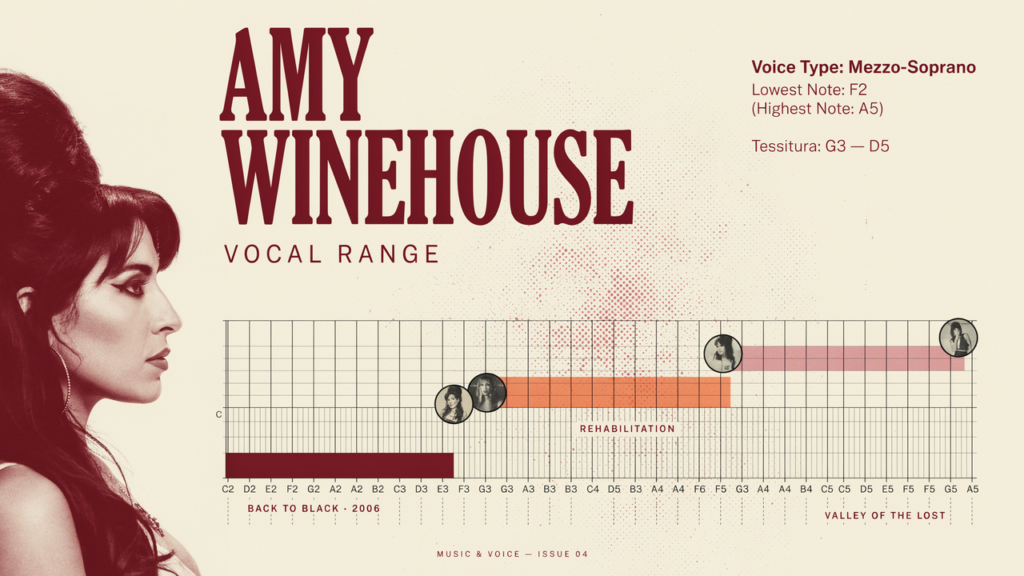
Amy Winehouse’s Full Vocal Range (D3 – E5)
Amy Winehouse’s functional singing range extends from D3 in her lower register to E5 in her upper register. She rarely used extreme highs or lows; instead, her artistry centered on tone, texture, emotional phrasing, and rhythmic nuance.
Technical Range Overview
| Metric | Detail |
|---|---|
| Total Range | D3 – E5 |
| Practical Tessitura | G3 – C5 |
| Voice Type | Low Mezzo-Soprano / Mezzo-Contralto |
| Strongest Zone | Chest register (D3–Bb4) |
| Upper Register | Light mix, limited head voice |
| Tonal Identity | Smoky, textured, soulful, vintage |
Amy’s vocal identity is rooted not in octave span but in how she interprets melody through timbre and phrasing.
What Voice Type Was Amy Winehouse? (Low Mezzo-Soprano / Mezzo-Contralto)
Amy Winehouse is often described as a contralto, but this is an oversimplification.
She fits most accurately into the category of low mezzo-soprano (mezzo-contralto).
Why She’s Not a True Contralto
- True contraltos have a darker, heavier lower resonance
- Her D3–F3 notes were warm but not dramatically weighted
- Her vowels and resonance did not match classical contralto structure
- Her upper range (C5–E5) was brighter and more flexible than a contralto’s typical register
Why She’s Not a Soprano
- Tessitura was too low
- Head voice was rarely used
- Lack of soprano brightness and lift above C5
Why Low Mezzo-Soprano Is Correct
- Natural comfort zone sits between G3 and C5
- Strong, chest-dominant production
- Natural warmth in mid-range
- Ability to dip comfortably into D3–E3
Final classification:
Low mezzo-soprano (mezzo-contralto) — a voice type ideal for retro soul, jazz, blues, and R&B.
Amy Winehouse’s Highest Notes (Upper Register Analysis)
Amy Winehouse was less concerned with hitting exceptionally high notes and more focused on tone consistency, phrasing, and emotional connection.
Highest Verified Notes
- E5 – consistent high limit in studio recordings
- D5–E5 – frequently used across Back to Black
- Rare head-voice usage, typically soft and breathy
Songs Demonstrating Her Upper Range
- “Back to Black” — expressive E5 on choruses
- “He Can Only Hold Her” — soulful mid-high mix passages
- “Love Is a Losing Game” — controlled upper-mid lines
High Register Characteristics
- Light, soft, intentionally understated
- Slight vibrato on held notes
- Jazz-style vowel shaping
- Never pushed for pop-style power
Amy’s upper register remained true to her jazz and soul vocal heritage, prioritizing tone over range.
If you’re beginning a structured practice routine, start with a solid foundation using our daily vocal warm-up to build consistency. Once you’re warmed up, review key fundamentals like breathing techniques for singing to improve breath control and stamina.
Amy Winehouse’s Lowest Notes (D3 Lower Signature)
Amy Winehouse’s lower register was one of her most defining assets.
Lowest Verified Notes
- D3 – lowest reliable note
- E3–F3 – commonly used throughout albums
- Often delivered with warmth, fullness, and emotional gravity
Lower Register Traits
- Rich in chest resonance
- Naturally smoky and intimate
- Produces a “vintage” tonal color
- Perfect for her conversational jazz delivery
Her lower notes created the emotional grounding of her vocal identity.
Complete Register Breakdown (Advanced Vocal Science)
Chest Voice (D3 – Bb4)
This was Amy’s primary register.
Characteristics:
- Full, warm, and heavily resonant
- Slight rasp due to compression and airflow styling
- Retro jazz coloration
- Smooth phrasing, minimal strain
- Clear diction and rhythmic precision
Her chest voice is responsible for the signature “Winehouse sound.”
Mixed Voice (A4 – E5)
Used sparingly and gently.
Characteristics:
- Light, subtle blending
- More tonal than powerful
- Designed for emotional emphasis, not belting
- Slightly brighter than chest register
Amy Winehouse didn’t perform heavy pop belts; instead, she used a light, soulful mix for melodic lift.
Head Voice (Rare Use)
Amy rarely ventured into true head voice.
Traits:
- Breathier and softer
- Used only for stylistic delicacy
- Rare in Evanescence-style belting singers but normal for jazz stylists
This underuse added to her low-centered vocal identity.
Amy Winehouse’s Tone, Timbre & Vocal Texture
Amy Winehouse’s tone is one of the most iconic in modern vocal history.
Tone Qualities
- Smoky
- Warm
- Dark
- Buttery, rich midrange
- Light rasp
- Vintage analog coloration
Why Her Tone Sounded “Older”
- Resonance Placement — chest-dominant with low laryngeal tilt
- Jazz Influence — heavy use of scoops, slides, microtonal nuance
- Phrasing — conversational, behind-the-beat delivery
- Production Choices — ribbon mic emulation, analog distortion
- Timbre — thick low-mid harmonics
These combined to give her voice the characteristic retro soul timbre.
Singers aiming to understand their natural range can also take the voice type test, and those wanting a full breakdown of their highest and lowest notes can use the vocal range calculator for precise results.
Jazz, Soul & Blues Influence on Her Technique
Amy Winehouse was deeply influenced by singers such as:
- Sarah Vaughan
- Billie Holiday
- Dinah Washington
- Nina Simone
Technical Features She Adopted
- Loose rhythmic placement (“dragging the beat”)
- Micro-slides and scoops
- Minimalistic vibrato
- Blues phrasing rather than classical shaping
- Soft consonant articulation
- Emotional riffing instead of melismatic runs
Her vocals feel authentic because they reflect deep cultural lineage, not modern pop vocal trends.
How Amy Winehouse’s Voice Evolved Over Time
Early Era – Frank (2003)
- Cleaner tone
- Less rasp
- More jazz agility
- Brighter resonance
Back to Black (2006)
- Darker timbre
- Thicker, smokier texture
- More chest-dominant vocals
- Increased emotional rawness
Later Live Years (2007–2011)
- Noticeable breathiness
- Increased rasp
- More vocal fatigue
- Authenticity remained but technical control fluctuated
Her voice evolution was shaped by artistic intention, lifestyle factors, and natural vocal maturation.
Amy Winehouse Vocal Range Chart
D3 ———— G3 ———— C4 ———— F4 ———— C5 ———— E5
 Low       Low-Mid     Mid       Upper-Mid      Mix Range
This chart reflects her functional singing territory, especially prominent between G3 and C5, where her tone is richest.
Best Songs Showcasing Amy Winehouse’s Range & Tone
Lower Register Strength
- “You Know I’m No Good”
- “Wake Up Alone”
- “Some Unholy War”
Mid-Range Power
- “Rehab”
- “Back to Black”
- “Tears Dry on Their Own”
Upper Register Moments
- “Valerie (Live Lounge)”
- “Love Is a Losing Game” (upper mix)
These recordings best demonstrate her expressive artistry.
Frequently Asked Questions
What is Amy Winehouse’s vocal range?
Approximately D3 – E5.
What was Amy Winehouse’s voice type?
Low mezzo-soprano (mezzo-contralto).
Why was her voice so deep?
A combination of natural tessitura, chest-dominant resonance, jazz tonal shaping, and production choices.
Could Amy Winehouse belt?
Her mix was light; she preferred controlled, soulful phrasing over powerful belting.
Did Amy Winehouse sing in head voice?
Rarely. Her style was chest/mid-range focused.
What made Amy Winehouse’s tone unique?
Her smoky timbre, jazz phrasing, low tessitura, analog-style production, and emotional realism.
How did her voice change over time?
It became darker, raspier, and more textured, especially after the Back to Black era.
- To see how Amy Winehouse’s smoky contralto compares with other legends, reviewing Freddie Mercury’s vocal range highlights how different styles use similar note spans.
- Understanding where her notes sit musically starts with knowing what the average vocal range is.
- Many of her gritty highs rely on techniques explained in how to sing high notes without straining.
- Mapping her lowest tones becomes easier when you learn how to calculate your vocal range.
- Fans curious about comparable artists can explore which famous singer matches your vocal range.
- Her expressive use of lighter registers ties into the science behind does head voice count in vocal range.
- For singers wanting to develop similar depth, this guide on how to increase vocal range provides a practical training path.
Erika Parker is a vocal analysis and singing education writer at Vocal Range Test. She focuses on vocal range testing, voice type analysis, pitch recognition, and singing tools for vocalists, musicians, choir singers, and beginners.