
Barry Gibb’s vocal range spans approximately B2 to B5, with reinforced falsetto extending into the upper fifth octave. His natural voice type is a light lyric tenor, but he is globally recognized for his powerful, sustained falsetto, which defined the Bee Gees’ signature sound during the disco era. His unique falsetto strength, breath efficiency, tonal clarity, and harmonic layering make him one of the most influential male vocalists in pop history.
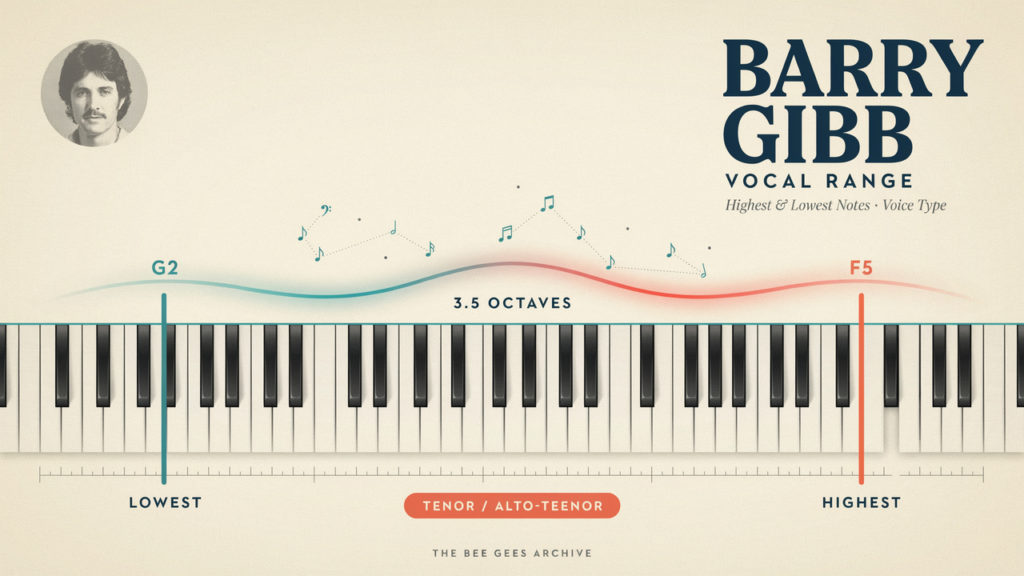
Barry Gibb’s Full Vocal Range (B2 – B5)
Barry Gibb’s documented singing range extends from B2 in the low chest register to B5 in reinforced falsetto.
While many singers rely on head voice or mixed voice to achieve high notes, Barry sings much of his upper material in full-bodied falsetto, supported by advanced airflow and resonance.
Technical Range Overview
| Attribute | Value |
|---|---|
| Total Range | B2 – B5 |
| Falsetto Extension | F4 – B5 |
| Natural Voice Type | Light Lyric Tenor |
| Main Vocal Identity | Reinforced falsetto |
| Strongest Range Zone | F4 – A5 |
His range is not extreme, but his falsetto clarity and durability are unmatched.
What Voice Type Is Barry Gibb?
Although often associated with falsetto, Barry Gibb’s natural voice is a light lyric tenor—bright, agile, and melodically flexible.
Why Barry Gibb Is a Light Lyric Tenor
- His speaking voice sits comfortably in the tenor range
- Early Bee Gees recordings feature pure tenor placement
- Smooth head-voice transitions
- Natural brightness and forward resonance
- Capable of effortless high melodic lines
Why Falsetto Became His Signature Sound
- Disco production favored brighter, upper-register vocals
- His falsetto had unusually strong presence on tape
- The Bee Gees’ harmonies were built around his falsetto tone
- His falsetto remained stable even during intense touring
Final Voice Type Classification
Light Lyric Tenor with unusually powerful reinforced falsetto.
Barry Gibb’s Highest Notes (Falsetto & Head Register)
Barry Gibb’s most iconic singing happens in the top portion of his range, where he avoids strain by employing reinforced falsetto instead of mixed belting.
Highest Verified Notes
- B5 — top reinforced falsetto
- A5–Bb5 — common disco-era peaks
- F5–G5 — frequent melodic falsetto lines
Song Examples (Exact Note Zones)
- “Stayin’ Alive” — A5 falsetto peaks
- “Night Fever” — rising lines around G5
- “You Should Be Dancing” — recurring G5–A5 falsetto motifs
- “Nights on Broadway” — transitional falsetto phrases that inspired his full falsetto era
High Register Characteristics
- Not breathy—tone is bright, centered, and reinforced
- Narrowed vowel shapes for upper resonance
- Tight vibrato, adding shimmer without wobble
- Remarkably stable even in late-career performances
Barry’s ability to lead full songs in falsetto is exceptionally rare among male singers.
Barry Gibb’s Lowest Notes (Down to B2)
Although his vocal legacy is built on upper notes, Barry Gibb has a clean, functional low register.
Lowest Verified Notes
- B2 — firm, resonant lower chest note
- C3–E3 — regularly used in early Bee Gees ballads
Lower Register Traits
- Light but steady chest resonance
- Intelligible diction
- Smooth transitions into mid-range
- Reflective of tenor anatomy rather than baritone heft
His low range complements his falsetto, giving him a balanced overall spectrum.
If you’re working to improve musical accuracy, begin with the ear training game to strengthen interval recognition. After training your ear, analyze tone consistency with AI voice analysis. You can also measure how this practice affects your upper and lower limits using the octave range test.
Complete Register-by-Register Analysis
Chest Voice (B2 – E4)
Barry’s early career emphasized his natural tenor chest voice.
Technical Features:
- Warm, youthful timbre
- Smooth vibrato
- Clean vowel shaping
- Strong consistency across early records
Chest voice examples:
“To Love Somebody,” “Words,” “I Started a Joke.”
Mixed Voice (E4 – G4)
Barry rarely belts in mix—he transitions early and gracefully into falsetto rather than pushing mix voice.
Technical Features:
- Light, controlled blend
- Often used as a bridge to falsetto
- Not used for high belting (unlike rock tenors)
Mix examples:
“Massachusetts,” “How Deep Is Your Love.”
Falsetto (F4 – B5)
Barry’s falsetto is his signature—powerful enough to serve as a lead vocal in full songs.
Unique Traits:
- Reinforced airflow gives fullness
- High adduction compared to typical falsetto
- Not airy—clear, laser-focused tone
- Exceptional pitch stability
- Effortless transitions from mid voice
Falsetto examples:
“Stayin’ Alive,” “Night Fever,” “You Should Be Dancing.”
Barry Gibb’s falsetto is one of the most iconic male vocal sounds ever recorded.
Why Barry Gibb’s Falsetto Is Unlike Any Other
1. It’s Reinforced, Not Breath-Based
Most falsettos collapse at high volume. Barry’s remains strong because he:
- Maintains steady subglottal pressure
- Uses efficient breath flow
- Narrows vowels for brightness
2. His Falsetto Has Lyric Quality
His tone is expressive, not thin or ghostly.
3. He Can Sustain Falsetto for Entire Songs
This is extremely rare among male vocalists.
4. He Harmonizes in Falsetto
The Bee Gees created 3-part falsetto stacks—an industry-shaping innovation.
5. His Falsetto Aged Exceptionally Well
Even into his 70s, Barry retained:
- Pitch accuracy
- Resonance clarity
- Smooth transitions
His falsetto longevity is considered biologically exceptional.
How Barry Gibb’s Voice Evolved Over Time
1960s – Early Bee Gees
- Natural tenor voice dominant
- Soft, emotional phrasing
- Almost no falsetto leads
1970s – Disco Reinvention
- Falsetto becomes lead voice
- Higher tessitura
- Clear, bright, cutting tone
- Bee Gees global signature
1980s–2000s
- Falsetto remains strong
- Slight deepening of chest voice
- Broader stylistic flexibility
2010s–2020s
- Falsetto softens slightly
- Chest voice deepens with age
- Still capable of strong upper-range work
- Tone remains recognizable
Barry’s vocal longevity is due to efficient technique and intelligent vocal adaptation.
Barry Gibb Vocal Range Chart
B2 ———— E3 ———— A3 ———— D4 ———— G4 ———— B4 ———— E5 ———— B5
Low        Mid-Low       Mid        Upper-Mid       Falsetto Zone         Falsetto Peak
His most iconic range lives between F4 and B5, where his falsetto shines with maximum clarity.
Best Songs to Experience Barry Gibb’s Range
Lower & Mid-Range
- “To Love Somebody”
- “Words”
- “How Can You Mend a Broken Heart”
Tenor Midrange
- “Massachusetts”
- “How Deep Is Your Love”
Falsetto Showcases
- “Stayin’ Alive”
- “Night Fever”
- “You Should Be Dancing”
- “Nights on Broadway”
These tracks demonstrate Barry’s technical range, expressive control, and genre-defining falsetto.
Frequently Asked Questions
What is Barry Gibb’s vocal range?
Approximately B2 to B5.
What voice type is Barry Gibb?
A light lyric tenor with a reinforced falsetto.
What is his highest note?
B5, reached in falsetto.
What is his lowest note?
B2.
Why is his falsetto so strong?
Reinforced technique + airflow efficiency + vocal tract narrowing.
Did Barry Gibb always sing falsetto?
No—falsetto became prominent during the Bee Gees’ disco transformation.
Can Barry Gibb still sing falsetto today?
Yes, although with a warmer tone and slightly softened edges.
Why did the Bee Gees use falsetto?
It created a unique, high-energy disco sound that became their trademark.
- To see how Barry Gibb’s falsetto compares to other pop icons, reviewing Mariah Carey’s vocal range highlights how different voices access the upper register.
- Understanding whether his airy highs are counted correctly is explained in does falsetto count in vocal range.
- His smooth transitions make more sense once you know the difference between falsetto and head voice.
- To place his octave span in context, learning how many octaves is a normal vocal range is essential.
- Fans who want to emulate his upper notes can follow this guide on how to expand vocal range.
- Comparing his register blend with other artists is easier using which famous singer matches your vocal range.
- For a technical foundation, this resource on how vocal range affects singing explains how falsetto fits into overall voice use.
Erika Parker is a vocal analysis and singing education writer at Vocal Range Test. She focuses on vocal range testing, voice type analysis, pitch recognition, and singing tools for vocalists, musicians, choir singers, and beginners.