
Chris Cornell—iconic vocalist of Soundgarden, Audioslave, and Temple of the Dog—remains one of the most technically gifted and emotionally expressive rock singers ever recorded. His vocal range spans approximately E2 to E6, covering four octaves of clean, mixed, falsetto, and distorted resonance.
Cornell’s voice blended baritone richness, tenor brightness, extreme high-range agility, and an otherworldly ability to maintain clarity even at high-intensity distortion. Few singers embody the rare hybrid voice type known as a baritenor—Chris Cornell mastered it.
This 2025 definitive guide provides the most complete analysis of Cornell’s vocal range, technical abilities, stylistic characteristics, and vocal evolution across three decades.
Chris Cornell’s vocal range is E2–E6 (four octaves), combining baritone low depth with tenor-level high extension.
He is a baritenor known for soaring belts, haunting falsetto, and powerful, controlled rasp.
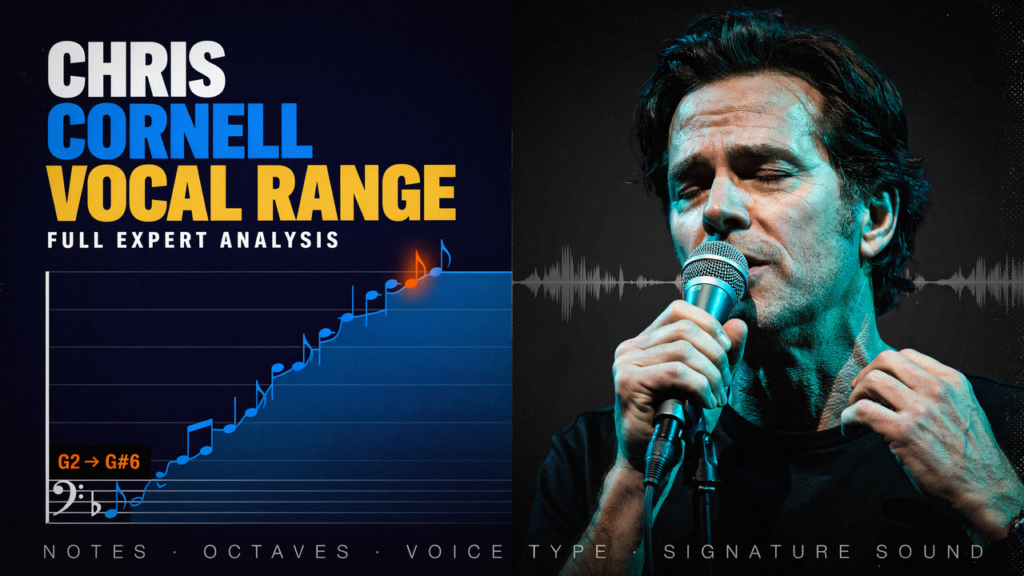
Chris Cornell’s Complete Vocal Range Explained (E2–E6)
Chris Cornell’s four-octave range spans multiple functional registers:
- Lower Register: E2–G2
- Midrange Baritone Zone: A2–D4
- Upper Mix & Tenor Belting: E4–E5
- Head Voice, Falsetto & Distorted Screams: F5–E6
What makes Cornell’s range exceptional is not just its size—it’s the quality, clarity, and emotional expression across every register.
1. Lower Register: E2 – G2
Cornell’s low notes were resonant, smooth, and rich—ideal for the introspective, moody tone he often conveyed.
Examples:
- E2 in Jesus Christ Pose (live variations)
- F2 in Like a Stone (deep spoken-soft phrasing)
- G2 in acoustic songs and vocal warmups
His lower register displayed a baritone foundation—a trait that gave his voice its depth and gravitas.
2. Midrange (Core Tessitura): A2 – D4
Cornell’s midrange is where his storytelling brilliance emerges.
This zone contains:
- His warmest timbre
- Most lyrical control
- Clean resonance without distortion
- Emotional interpretive phrasing
Examples:
- Black Hole Sun (verses around B3–C4)
- Hunger Strike (A3–C4)
- Like a Stone (G3–D4)
- Fell on Black Days (A2–C4)
This middle register allowed Cornell to shift from soft vulnerability to sudden, explosive power effortlessly.
3. Upper Mix & Tenor Belting: E4 – E5
This register is where Chris Cornell’s voice becomes unmistakable.
His belting range is characterized by:
- Massive power
- Open-throated resonance
- Controlled rasp
- Bright, ringing harmonics
- Impressive stamina
Examples:
- E5 in Cochise (chorus apex)
- D5–E5 in Show Me How to Live
- C5–D5 in Outshined
- C5 in Spoonman
- B4–C5 in Rusty Cage
Few rock singers belt above C5 with this level of intensity and clarity.
4. Falsetto, Head Voice & Distorted Highs: F5 – E6
Cornell’s high register is one of the most impressive in rock history.
He could shift seamlessly between:
- Pure falsetto
- Head-voice dominance
- Distortion-heavy high screams
Falsetto Examples
- F5–G5 in Black Hole Sun (dreamlike, floating lines)
- F5 in Like a Stone live extensions
- A5 in Jesus Christ Pose head-voice peaks
His falsetto is breathy yet controlled, uniquely emotional, and instantly recognizable.
Distorted Highs
Cornell used distortion to reach C6–E6, using controlled, breath-supported techniques—not throat strain.
Examples:
- E6 in Slaves & Bulldozers (historic live screams)
- C#6–E6 in Jesus Christ Pose live climaxes
His distorted highs are considered some of the most technically advanced screams ever produced by a mainstream rock vocalist.
Total Octave Count
E2 → E6 = 4 octaves
A rare achievement combining:
- Functional depth
- Tenor brilliance
- Powerful mix
- Ethereal head voice
- Controlled distortion
Cornell’s range is matched by very few rock singers in history.
If you’re pushing for higher notes, it’s essential to follow the safe strategies outlined in how to sing high notes. Support these attempts with proper breath control using the breathing techniques for singing guide. To check whether your range is expanding, retake the vocal range test regularly.
What Voice Type Was Chris Cornell?
Chris Cornell was a baritenor—a hybrid voice type combining:
- Baritone lower resonance
- Tenor upper extension
- Exceptional mixed voice anchoring
Why Cornell is not simply a baritone:
- Too much brightness in upper registers
- Clean belts easily reaching C5–E5
- Agile falsetto to E6
Why he is not simply a tenor:
- Heavy, rich midrange
- Dark timbre in lower notes
- Strong baritone weighting down low
This dual ability made him one of the most versatile rock vocalists ever recorded.
Chris Cornell’s Vocal Range in His Most Iconic Songs
| Song | Range | Technical Highlights |
|---|---|---|
| Black Hole Sun | A3 – G5 | Ethereal falsetto & smooth sustained highs |
| Like a Stone | E3 – F5 | Emotional midrange + soaring head voice |
| Slaves & Bulldozers | G2 – E6 | Pinnacle of Cornell’s screams and range |
| Cochise | G3 – E5 | High-intensity belting |
| Outshined | A2 – C5 | Baritone foundation + gritty mix |
| Hunger Strike | A3 – C5 | Controlled power and soulful tone |
| Fell on Black Days | A2 – C5 | Moody baritone depth and raspy belts |
This spectrum demonstrates Cornell’s dynamic control, technical mastery, and emotional versatility.
What Made Chris Cornell’s Voice Unique?
1. A Perfect Blend of Warmth and Brightness
Cornell’s timbre mixed baritone warmth with tenor brilliance, allowing him to cut through heavy instrumentation while retaining emotional depth.
2. Controlled, Healthy Rasp
His rasp was:
- Breath-supported
- Resonance-based
- Precisely applied
It was expressive, not damaging.
3. Extreme High-Range Power
Cornell’s clean and distorted highs were unmatched for:
- Volume
- Clarity
- Harmonic richness
- Longevity
His E5 belting and E6 screams remain legendary benchmarks.
4. Ethereal Falsetto
Cornell’s falsetto was not a “backup register”—it was a signature artistic tool used for dramatic atmospheres.
5. Emotional Precision
Cornell could deliver:
- Whispered vulnerability
- Raw anguish
- Heroic power
- Meditative calm
- Explosive intensity
This emotional versatility made him one of rock’s most compelling vocalists.
How Chris Cornell’s Voice Evolved Across His Career
Early Soundgarden (1987–1991)
- Young, bright, aggressive tone
- Heavy scream usage
- High velocity vibrato
Superunknown Era (1993–1996)
- Artistic maturity
- Distinctive falsetto
- Balanced rasp and clarity
Audioslave Era (2002–2006)
- Fuller low range
- Increased chest resonance
- Roaring high belts
- Rich, soulful timbre
Solo Era (2007–2017)
- More introspective singing
- Cleaner falsetto
- Controlled rasp
- Emotional phrasing at its peak
Cornell remained one of the most consistent live vocalists in rock for over 30 years.
Chris Cornell Compared to Other Rock Vocalists
| Vocalist | Range | Voice Type | Comparison |
|---|---|---|---|
| Chris Cornell | E2–E6 | Baritenor | Most versatile + best falsetto/rasp balance |
| Chester Bennington | G2–G5 (+B5 screams) | Tenor | More distortion; less falsetto agility |
| Robert Plant | G2–C6 | Tenor | More bluesy, lighter tone |
| Eddie Vedder | B1–E5 | Baritone | Darker, heavier timbre |
| Layne Staley | A2–A5 | Tenor | Iconic vibrato; narrower range |
Cornell stands out as the most versatile vocalist in the grunge movement.
Can You Sing in Chris Cornell’s Vocal Range?
Possible if you:
- Are a baritone with strong extension
- Are a tenor with good low support
- Train mix voice regularly
- Learn safe rasp techniques
- Strengthen breath control
Cornell’s repertoire is advanced difficulty and should not be attempted without technique awareness.
Frequently Asked Questions
What is Chris Cornell’s vocal range?
Approximately E2–E6, about four octaves.
Was Chris Cornell a baritone or tenor?
A baritenor—a rare hybrid voice type.
What is Chris Cornell’s highest note?
Around E6 (distorted screams in Slaves & Bulldozers).
What is his lowest note?
E2 in early Soundgarden recordings and some live performances.
Did Chris Cornell have falsetto?
Yes—one of the most expressive falsettos in rock.
What made his voice so emotional?
A combination of phrasing, timbre, dynamics, and lyrical interpretation.
- Chris Cornell’s towering tenor placement is best understood through what are the male vocal ranges.
- His wide and explosive range stands out when compared to is 4 octaves a good vocal range.
- You can map your own highest notes against his by using voicerangetest.
- The mechanics behind his piercing belts are explained in how vocal cords produce different pitches.
- His ability to shift between clean and grit relies on difference between falsetto and head voice.
- To compare his span with other elite rock vocalists, what singer has the best vocal range gives helpful context.
Erika Parker is a vocal analysis and singing education writer at Vocal Range Test. She focuses on vocal range testing, voice type analysis, pitch recognition, and singing tools for vocalists, musicians, choir singers, and beginners.