
Few vocalists in popular music have displayed the transformative power of the human voice as profoundly as David Bowie. Often described as a musical chameleon, Bowie didn’t just change genres—he changed vocal identities, shifting timbre, placement, resonance and stylistic approach with each new era. His voice became an instrument for storytelling across glam rock, soul, electronic minimalism, art-rock and cinematic balladry.
This comprehensive article provides the deepest expert-level breakdown of David Bowie’s vocal range, from his lowest and highest notes to his voice classification, stylistic eras, technical behaviors, and how his vocal identity evolved across nearly 50 years of performances.
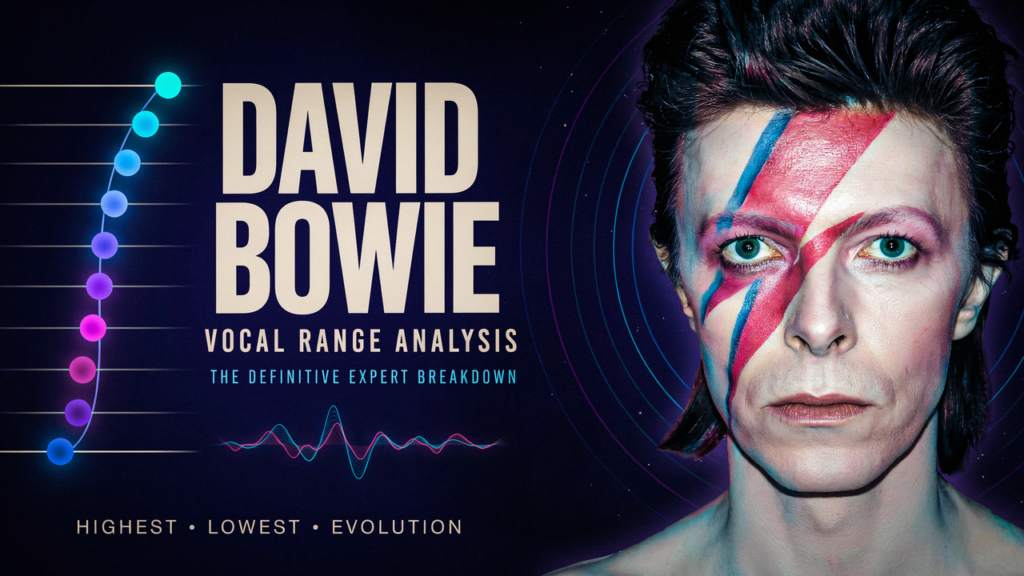
What Is David Bowie’s Vocal Range?
David Bowie’s vocal range is documented as approximately: A1 – A4 (Three Octaves)
With occasional falsetto reaching C5
This range expanded and contracted depending on:
- Era
- Vocal health
- Style
- Persona
- Vocal production choices
While Bowie’s range wasn’t extreme, his expressive versatility and stylistic precision made him one of the most influential voices in modern music.
David Bowie Vocal Range Chart
| Register | Note Range | Tonal Characteristics |
|---|---|---|
| Low Register | A1 – C2 | Dark, resonant, theatrical; strengthened in later career |
| Core Middle Register | C2 – A3 | The expressive center of Bowie’s voice; warm, flexible, emotionally varied |
| Upper Register | A3 – A4 | Bright, intense, often dramatic; used for climactic phrases |
| Falsetto Extension | Up to C5 | Airy, ethereal, occasionally haunting (used selectively) |
Unlike many rock vocalists, Bowie crafted vocal personas with intentional tonal differences across registers.
Is David Bowie a Tenor or Baritone?
David Bowie is most accurately classified as a:
High Baritone
This classification is supported by:
1. Natural Speaking Voice
Bowie’s dialogue and interviews reveal a naturally low, resonant baritone.
2. Primary Singing Tessitura
His vocal sweet spot exists between C2 and A3, typical of a baritone.
3. Tone Weight
He retains warmth and depth even when singing in higher songs.
4. Aging Effects
Later albums (e.g., Blackstar, The Next Day) highlight deep baritone resonance.
Why Some Think Bowie Is a Tenor
His bright glam-rock timbre, nasal placement and occasional falsetto create the illusion of tenor-like qualities. But anatomically and technically, Bowie remains a baritone.
Those exploring voice lessons can learn what to expect from the adult singing lessons guide. Planning your budget becomes easier once you check the singing lesson cost breakdown. If you’re considering online alternatives, the 30-Day Singer review gives a detailed assessment.
David Bowie’s Lowest Notes (A1–C2)
Bowie’s lowest reliably documented notes include: A1 – B1
Examples:
- “Sweet Thing / Candidate” (Diamond Dogs) – rich B1 coloration
- Late-career tracks (Blackstar era) – A1 resonance
Characteristics:
- Full, velvety, theatrical delivery
- Increased darkness and weight over time
- Controlled vibrato and low laryngeal stability
His low range aged like fine wine, deepening significantly in his final decades.
David Bowie’s Highest Notes (A4 and Falsetto C5)
Bowie’s highest supported notes fall around:
A4 (chest/mixed voice)
Occasional falsetto to: C5
Examples:
- “Life on Mars?” – A4 sustained belts
- “Starman” – high mixed phrases
- “Heroes” – emotionally intense A4 belts
- “Lady Grinning Soul” – falsetto passages near C5
Bowie rarely chased extreme high notes; instead, he used highs for emotional punctuation, not technical showmanship.
How David Bowie’s Voice Changed Across Eras
David Bowie’s vocal evolution is one of the most striking in rock history.
Here is a complete era-by-era vocal transformation:
1960s – Early Career (Folk & Mod-Rock Period)
- Thin, youthful tone
- Slight tenor-like brightness
- Limited chest dominance
- Softer vibrato
Early 1970s – Ziggy Stardust / Glam Era
- Bright, theatrical tone
- Increased nasal placement
- Busier vibrato
- More experimentation with upper register
Signature sound:
- High-energy glam delivery
- Crisp, stylized diction
- Emotional exaggeration
Mid-1970s – Soul & R&B Influence
- Warmer resonance
- Richer chest voice
- Improved phrasing and breath control
- Exploration of falsetto less theatrically, more musically
Late 1970s – Berlin Trilogy
- Minimalistic tone
- Controlled vibrato
- Alternations between low baritone phrasing and ethereal falsetto
- More spoken-sung material
Characterized by:
- Haunting timbres
- Creative use of dynamics
1980s – Pop Supernova Era
- Cleaner, polished tone
- Strong articulation
- More stable mid-range belts
- Increased vocal consistency due to production refinement
1990s–2000s – Experimental & Industrial Period
- Deeper resonance
- Stronger baritone presence
- More theatrical phrasing
- Emphasis on mood over range
2010s – The Next Day & Blackstar
- Deep, resonant, haunting baritone
- Strong lower register
- Refined vocal control
- Dark, introspective timbre
This final vocal evolution showcased Bowie’s most mature and emotionally potent vocal work.
Technical Breakdown of Bowie’s Vocal Technique
1. Timbre Manipulation
Bowie engineered his own voice to match personas:
- Bright and nasal for Ziggy
- Hollow and cold for Thin White Duke
- Ethereal for Berlin era
- Dark baritone for Blackstar
He treated the voice as a dramatic tool.
2. Controlled Vibrato
His vibrato evolved from:
- Tight glam-rock vibrato
- Broad emotive vibrato in ballads
- Minimal vibrato for modernist tracks
He used vibrato as an expressive effect, never as a default.
3. Mixed Voice Usage
Bowie’s mixed voice was:
- Moderate and expressive
- Not operatic
- Used to achieve climatic A4 phrases
- Enhanced with stylistic distortion
4. Falsetto Application
Used sparingly but effectively:
- For emotional contrast
- To portray vulnerability
- For artistic color rather than power
5. Theatricality & Persona Singing
Bowie approached singing as acting:
- He built characters through vocal tone
- Lyrics, persona and voice formed integrated identities
- His vocal changes paralleled his artistic reinventions
This theatricality set Bowie apart from his contemporaries.
David Bowie vs Other Iconic Vocalists (Expert Comparison)
| Vocalist | Range | Voice Type | Key Strength |
|---|---|---|---|
| David Bowie | A1 – A4 | High Baritone | Timbral versatility & persona-based singing |
| Freddie Mercury | F2 – F6 | Tenor | Extreme range & operatic power |
| Elton John | B2 – A4 | Baritone/Tenor mix | Strong middle range & pop clarity |
| Mick Jagger | E2 – B4 | Tenor/Baritone | Nasal high-energy rock tone |
| Peter Gabriel | C3 – B4 | Baritone | Dramatic phrasing & emotional expression |
Bowie stands out not for extremes, but for stylistic transformation.
Best Songs Demonstrating David Bowie’s Vocal Range
Low Register Highlights (A1–C2)
- “Sweet Thing / Candidate”
- “Where Are We Now?”
- “Sue (Or in a Season of Crime)”
Middle Register (C2–A3)
- “Space Oddity”
- “Changes”
- “Let’s Dance”
Upper Register & Belting (A3–A4)
- “Life on Mars?”
- “Heroes”
- “Starman”
Falsetto Use (Up to C5)
- “Lady Grinning Soul”
- “Ashes to Ashes”
Frequently Asked Questions
What is David Bowie’s vocal range?
Approximately A1 – A4, extending to C5 in falsetto.
Was David Bowie a tenor or baritone?
A high baritone with stylistic upper-register brightness.
How did Bowie’s voice change over time?
It deepened, warmed, and took on a darker timbre, especially in later years.
What is Bowie’s lowest note?
Documented around A1.
What is Bowie’s highest supported note?
Typically A4, with falsetto sometimes reaching C5.
Did David Bowie have vocal training?
He trained in theatre and mime, not operatic voice, shaping his expressive and dramatic style.
- David Bowie’s baritone-leaning tenor becomes clearer when viewed through difference between soprano alto tenor and bass.
- His wide stylistic span stands out even more when compared to is 3 octaves a good vocal range.
- You can see how your own highs and lows compare to his by using voice range test.
- The way he shifted tone across decades is explained in does vocal range change with age.
- The mechanics behind his expressive pitch control are detailed in how vocal cords produce different pitches.
- To compare his span with other genre-defining voices, vocal range of famous singers examples and charts offers valuable context.
Erika Parker is a vocal analysis and singing education writer at Vocal Range Test. She focuses on vocal range testing, voice type analysis, pitch recognition, and singing tools for vocalists, musicians, choir singers, and beginners.