
Donald Fagen, the co-founder and lead vocalist of Steely Dan, possesses one of the most recognizable voices in modern music. His vocal identity is defined not by extreme highs or virtuosic displays, but by tone, phrasing, precision, and narrative clarity.
Learning theory is easier once you know your vocal range.
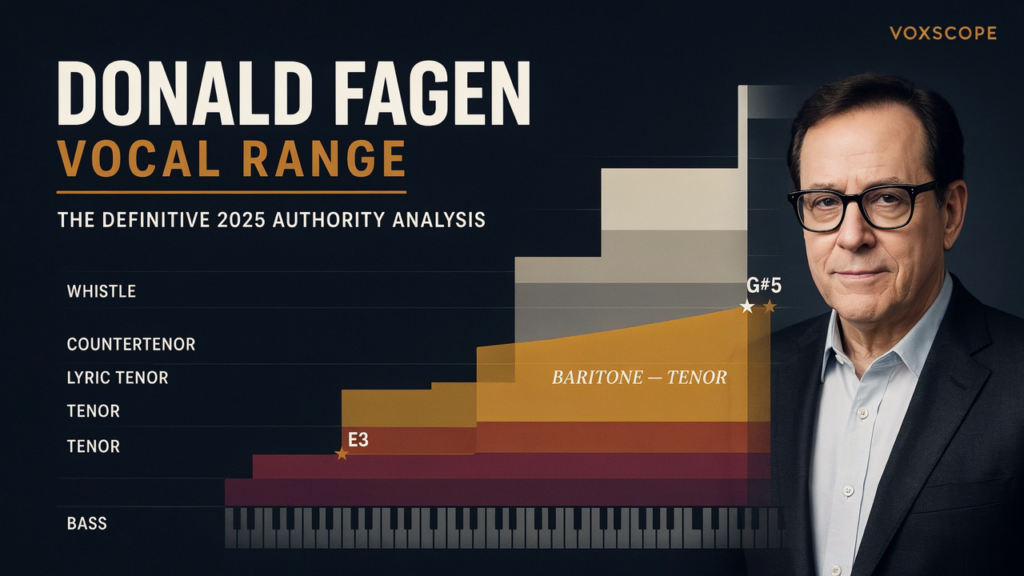
Donald Fagen’s Vocal Range (E2–A4) Explained
Donald Fagen’s vocal range is generally estimated at: E2 to A4
(approximately 2 to 2.5 octaves)
While this span is modest compared to celebrated vocal powerhouses, Fagen’s voice is a case study in how intonation, diction, timbre, and phrasing can create a signature sound without relying on extremes.
Low Range
Fagen’s lower register typically extends to E2–G2, delivered with relaxed consistency. His low notes are never forced, fitting seamlessly into Steely Dan’s characteristic harmonic textures.
Middle Range
The core of his voice lies in the baritone midrange (A2–E4), where he delivers most of his melodic content. This range supports the band’s dense arrangements and lyrical sophistication.
High Range
Fagen’s upper register reaches approximately G4–A4, which he approaches with his trademark nasal-forward resonance. He rarely pushes higher, as his phrasing-centered style does not require belting or extended high-note passages.
Voice Type: A High Baritone With Jazz-Inspired Delivery
Donald Fagen is best classified as a high baritone, a category characterized by:
- A bright, forward-placed tone
- Strong intelligibility of lyrics
- Moderate upper extension
- Control in the lower-mid spectrum
Unlike many baritones, Fagen’s resonance leans nasal and frontal, contributing to the clarity and bite of his sound in mixes dominated by electric pianos, horns, and complex jazz chords.
His tessitura (comfortable singing zone) is generally A2–F4, an ideal fit for Steely Dan’s rhythmic and harmonic language.
What Makes Donald Fagen’s Voice So Distinctive
Fagen’s vocal identity comes from stylistic and technical choices rather than sheer range. Several features define his unique sound:
Forward, Nasal Resonance
By placing the sound near the front of the face, Fagen achieves a pointed tone that pierces through dense arrangements. This resonance enhances clarity without requiring high volume.
Speech-Oriented Phrasing
Fagen often blurs the line between singing and rhythmic speech. This “talk-sing” approach is informed by jazz phrasing, Beat-era cadence, and spoken-word storytelling traditions.
Precision and Diction
Few vocalists articulate syllables with the precision found in Fagen’s recordings. His diction gives Steely Dan’s intricate lyrics the clarity they demand.
Minimal Vibrato
Fagen famously avoids heavy vibrato. This straight-tone approach adds to the sardonic, understated tone that defines Steely Dan’s narrative voice.
Studio Discipline
Steely Dan’s records are meticulously produced. Fagen’s vocals are often comped with surgical precision, resulting in a clean, polished sound that emphasizes intention over vocal athleticism.
Song Examples That Illustrate His Range and Technique
Peg
Demonstrates his controlled upper range around F4–A4, with crisp articulation and forward brightness.
Deacon Blues
Features his comfortable baritone storytelling tone, generally within A2–D4, supported by smooth breath control and steady tonal placement.
Babylon Sisters
A masterclass in talk-singing and rhythmic nuance, staying mostly within B2–E4.
The Nightfly
Fagen’s vocal performance on this album shows slightly more melodic flexibility, with phrases ranging from C3 to G4, delivered with youthful clarity.
Across all these works, Fagen’s consistent tonal identity matters more than range expansion.
Technical Vocal Characteristics
Breath Efficiency
Fagen’s singing relies on controlled, short-phrase airflow rather than sustained belting. This keeps his tone stable and his delivery percussive.
Resonance Strategy
He uses front-focused resonance for clarity, especially important in Steely Dan’s layered mixes.
Rhythmic Intelligence
Fagen’s rhythmic delivery—often slightly behind or ahead of the beat—is central to his musical identity. His timing choices add personality even within narrow pitch movement.
Stylistic Consistency
Regardless of era, Fagen maintains a steady vocal personality: dry, articulate, precise, and narratively grounded.
How His Voice Evolved Through the Decades
1970s
Fagen’s early recordings exhibit brightness, agility, and a youthful tone that allows easy access to A4 when needed.
1980s (The Nightfly Era)
His voice sounds slightly warmer and rounder while still retaining clarity and weight.
2000s–2020s (Later Live Performances)
With age, his upper range narrowed somewhat and developed a raspy texture. He adapted by leaning further into speech-oriented phrasing and maintaining performance consistency through musical intelligence rather than vocal athleticism.
Unlike many vocalists, Fagen aged gracefully by adjusting style rather than fighting for lost highs.
Comparison to Other Jazz and Rock Vocalists
| Singer | Approx. Range | Voice Type | Notes |
|---|---|---|---|
| Donald Fagen | E2–A4 | High Baritone | Nasal, talk-sing resonance; jazz phrasing |
| Walter Becker | F2–E4 | Baritone | Softer, less nasal tone |
| Michael McDonald | G2–C5 | Baritenor | Powerhouse upper register |
| Mark Knopfler | D2–A4 | Baritone | Speech-like phrasing with warm timbre |
This comparison highlights how Fagen’s vocal impact comes from identity, phrasing, and tone rather than scale or range.
Frequently Asked Questions
What is Donald Fagen’s vocal range?
His range is estimated at E2 to A4, roughly 2 to 2.5 octaves.
Is Donald Fagen a baritone?
Yes. He is a high baritone with distinctive nasal resonance.
Why does his voice sound nasal?
It is an intentional resonance placement that clarifies diction and helps his voice sit above complex instrumentation.
Does Donald Fagen sing high notes?
He rarely goes above A4, as his musical style does not require upper-register power.
How did his voice change with age?
His upper range narrowed slightly, and his tone became raspier, but his phrasing and delivery remain strong.
- To frame Donald Fagen’s tessitura accurately, start with what is tessitura in singing and why it matters.
- His placement sits clearly within the classifications outlined in what are the male vocal ranges.
- If you want to see where his notes fall compared to typical singers, what is the average vocal range for a male gives the baseline.
- You can check how your own voice stacks up against his by using how to test vocal range.
- His mid-range dominance becomes clearer when you understand how many octaves is a normal vocal range.
- The technical reasons behind his smooth pitch control are detailed in how do the vocal cords work.
- For direct comparison with his Steely Dan style, Donald Fagen’s vocal range provides a full breakdown.
Erika Parker is a vocal analysis and singing education writer at Vocal Range Test. She focuses on vocal range testing, voice type analysis, pitch recognition, and singing tools for vocalists, musicians, choir singers, and beginners.