
Eddie Vedder’s voice is one of the most iconic vocal signatures in rock history. As the lead singer of Pearl Jam, his deep, resonant baritone helped define the grunge era and continues to shape rock music over three decades later. While his vocal range is not unusually wide, Vedder’s power lies in tonal character, emotional focus, and chest-heavy, narrative-driven singing.
This expert guide provides a comprehensive breakdown of Eddie Vedder’s vocal range, voice type, highest and lowest notes, and the technical elements that shape his unmistakable sound.
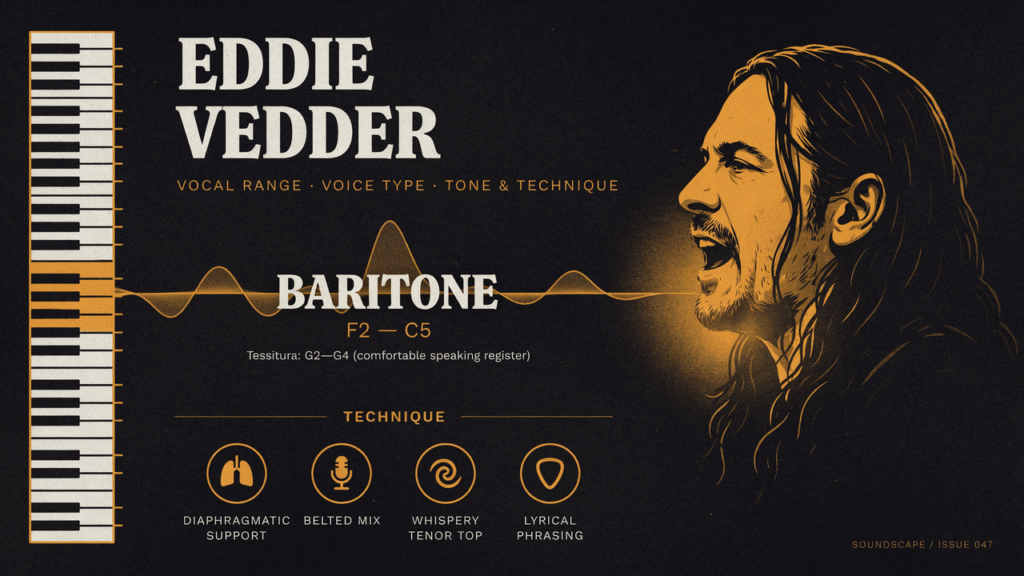
Eddie Vedder’s Vocal Range: A1 – E4
Most professional analyses place Vedder’s functional vocal range at: A1 – E4
(roughly 2 octaves + a few semitones)
This range is typical for a baritone, but Vedder’s tone, placement, and stylistic approach make it uniquely expressive in the rock genre.
Lower Range
- Frequently reaches B1–C2 in songs like “Black” and “Yellow Ledbetter.”
- Occasionally dips to A1 in acoustic performances.
- His low notes are full, resonant, and unusually warm for rock singing.
Middle Range (Primary Tessitura)
- The core of his voice lies between E2–C4.
- This is the range where his tone is most reliable, emotional, and powerful.
- Most Pearl Jam melodies sit in this zone because it matches his natural strengths.
Upper Range
- Vedder’s upper limit typically lands around D4–E4, delivered with chest weight rather than mixed resonance.
- He seldom uses falsetto or head voice; his style is chest-dominant.
Vedder’s influence is rooted not in vocal gymnastics but in emotional expression, tonal identity, and interpretive depth.
To grow your range safely, begin by reviewing the principles in vocal health tips for singers. Once you’ve built stable habits, follow the methods in expand your vocal range safely for gradual improvement. You can reinforce every new skill with proper support using the breathing techniques for singing guide.
Voice Type: A High Baritone With Extraordinary Depth
Eddie Vedder is a high baritone, though many listeners mistake him for a bass-baritone due to the depth and warmth of his tone.
Baritone Characteristics He Exhibits
- Naturally low speaking voice
- Strong depth in the bottom register
- A warm, thick mid-range
- Limited use of high-register resonance
- Chest-focused singing throughout most songs
What Makes His Baritone Unique
- A dark, cavernous resonance unusual even among baritones
- Rounded vowel formation that enriches low frequencies
- Slow, expressive vibrato with emotional weight
- Controlled rasp that never sounds strained
- A vocal posture that emphasizes storytelling
Vedder’s voice is instantly recognizable because of its dark color, emotional rawness, and low-centered resonance.
Why Eddie Vedder’s Voice Sounds So Deep
Vedder’s signature depth isn’t just anatomy—it’s technique and artistry.
Lowered Laryngeal Position
He naturally sings with a slightly lowered larynx, expanding the throat space and producing a deeper resonance.
Chest-Dominant Resonance
He carries chest voice higher than most baritones, which thickens the tone across his range.
Rounded Vowel Modification
Vedder favors rounded vowel shapes (“uh,” “oh,” “ah”), which enrich the low-frequency resonance.
Subtle Vocal Fry
Used strategically at phrase openings, adding texture and emotional gravity.
Controlled Vibrato
Slow, pulsing vibrato enhances the heaviness and introspective quality of his singing.
Together, these elements create a voice that feels powerful, intimate, and unmistakable.
Highest & Lowest Notes: Song Examples
Lowest Notes
- A1–B1 in acoustic performances
- Songs like “Yellow Ledbetter” and “Black” highlight his depth and warmth
Core Middle Range
- Most expressive singing sits between E2–C4
- Heard clearly in “Alive,” “Jeremy,” “Elderly Woman Behind the Counter in a Small Town”
Upper Notes
- He occasionally reaches D4–E4, but always with chest weight
- Examples include “Once,” “Rearviewmirror,” and select live performances
Vedder’s highest notes may not be extreme, but they carry emotional impact precisely because he pushes chest resonance into intensity without abandoning tone quality.
Technical Analysis: What Makes His Voice Powerful
Despite a narrower range relative to some rock singers, Vedder’s technique excels in several areas:
1. Chest-Voice Dominance
His nearly exclusive use of chest voice produces a masculine, grounded tone rarely matched in modern rock.
2. Resonance Control
Vedder’s vocal tract remains open and rounded, giving his voice an almost orchestral fullness.
3. Emotional Interpretation
Few vocalists communicate vulnerability, melancholy, and urgency with Vedder’s subtlety and conviction.
4. Rhythmic Phrasing
His phrasing has a spoken, almost narrative quality that contributes significantly to Pearl Jam’s lyrical identity.
5. Controlled Grit
Vedder uses grit intentionally and safely, blending rock aggression with vocal discipline.
How Eddie Vedder’s Voice Changed Over the Decades
Early 1990s: “Ten,” “Vs,” “Vitalogy” Era
- Most flexible period
- Deepest low notes
- Clean chest resonance with occasional bright overtones
- Strong dynamic range and storytelling clarity
Late 1990s–2000s
- Increased grit and vocal density
- Slight reduction in mid-high agility
- More reliance on warm mid-range phrasing
- Tone became even darker
2010s–2020s
- Natural aging emphasized his baritone depth
- Upper register narrowed slightly
- Stronger focus on acoustic, narrative-style performances
- Live performances rely on emotional weight more than range
Vedder aged as many baritones do: his tone grew richer and deeper, while the upper range compressed slightly.
Eddie Vedder Compared to Other Rock Vocalists
| Singer | Vocal Range | Voice Type | Notable Traits |
|---|---|---|---|
| Eddie Vedder | A1–E4 | High Baritone | Deep, warm, emotional, resonant |
| Chris Cornell | E2–A5 | Tenor | Extreme range, powerful belts |
| Layne Staley | C3–E5 | Tenor | Haunting tone, strong nasal placement |
| Scott Weiland | C3–G5 | Baritenor | Highly flexible with stylistic shifts |
| Dave Gahan | C2–E4 | Baritone | Dark, dramatic, breathy resonance |
Vedder’s range is modest, but his tonal identity and emotional authenticity make him one of rock’s most iconic vocal personalities.
Frequently Asked Questions
What is Eddie Vedder’s vocal range?
Approximately A1–E4, depending on the performance and era.
What voice type is Eddie Vedder?
He is a high baritone with uncommon depth and warmth.
Why does his voice sound so deep?
Because of lowered larynx posture, chest-dominant singing, rounded vowels, and natural anatomical factors.
What is his highest note?
Typically E4, always delivered with chest resonance.
What is his lowest note?
Between A1–B1, especially in acoustic sets.
How has his voice changed with age?
His tone has deepened, his upper range narrowed, and his delivery shifted toward warmer narrative singing.
- To place Eddie Vedder’s baritone-leaning tenor accurately, start with what are the male vocal ranges.
- His gritty mid-range sits in clear contrast to the norms outlined in what is the average vocal range for a male.
- The way he pushes powerful notes is rooted in the science explained in how vocal cords produce different pitches.
- If you want to see how your own notes compare to his, use how to measure vocal range.
- Many of Vedder’s signature sounds rely on register blending detailed in difference between falsetto and head voice.
- Singers aiming to build similar stamina will benefit from daily exercises to increase vocal stamina.
Humanize 123 words
Erika Parker is a vocal analysis and singing education writer at Vocal Range Test. She focuses on vocal range testing, voice type analysis, pitch recognition, and singing tools for vocalists, musicians, choir singers, and beginners.