
Frank Ocean’s voice is one of the most emotionally influential instruments in contemporary R&B. His vocals blend a light lyric tenor foundation, smooth midrange warmth, ethereal falsetto textures, and a conversational phrasing style that feels both intimate and cinematic. While he possesses an impressive vocal range, his true power lies in how he uses tone, space, and emotional restraint to shape his sound.
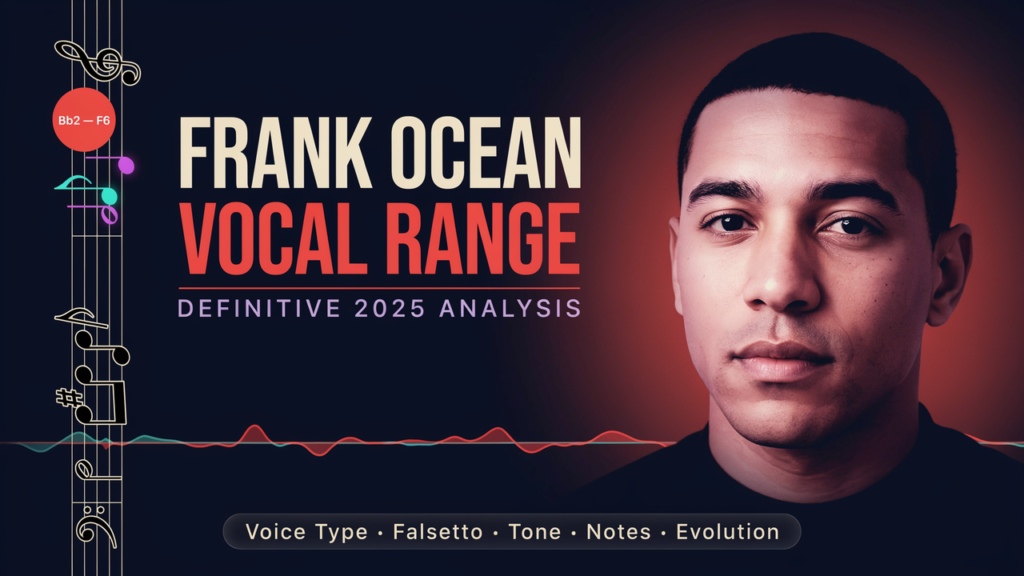
Frank Ocean’s Vocal Range: A2 – C6 (Approx. 3 Octaves)
Frank Ocean’s verified vocal range spans: A2 – C6
(approximately three octaves)
His range is notable for its smooth transitions, dynamic breath control, and expressive falsetto, all of which play crucial roles in shaping his artistic identity.
Lower Register (A2–B2)
His lows are warm, understated, and emotionally resonant.
Key examples:
- “Higgs” — A2 lows, subtle and breath-supported
- “Bad Religion” — deeper B2 phrases with rounded tone
- “White Ferrari” — gentle, whispered lower lines
Frank’s low notes are rarely showpieces; they serve as emotional grounding.
Middle Register (C3–G4): His Primary Tessitura
This is the core of Frank’s sound. Characteristics:
- Warm, creamy timbre
- Conversational, almost spoken phrasing
- Subtle vibrato and micro-slides
- Balanced breath control
Examples:
- “Pink + White”
- “Thinkin Bout You”
- “Self Control”
He uses his midrange as a canvas for emotional storytelling.
Upper Register & Falsetto (A4–C6)
Frank’s falsetto is one of his signature tools:
- Light, airy, dreamlike tone
- Smooth transition points
- Stable pitch despite breath-heavy production
- Creative layering and formant manipulation
High-register examples:
- “Thinkin Bout You” — C5–C6 falsetto harmonies
- “Self Control” — delicate high passages
- “Ivy” — artistic upper-register phrasing
- “Nikes” — falsetto + pitch-shift interplay
Frank’s falsetto isn’t technically “powerful”—it’s emotionally strategic.
Anyone exploring formal coaching can review options in the adult singing lessons guide. To plan financially, check typical prices on the singing lesson cost page. For online alternatives, read the detailed 30-Day Singer review.
Frank Ocean’s Voice Type: Light Lyric Tenor
Frank Ocean is best classified as a light lyric tenor, a tenor subtype known for:
Key Vocal Characteristics
- Light, flexible vocal weight
- Ease in upper-mid range
- Softer dynamic tendencies
- Bright yet gentle tone coloration
- A lyrical, emotional delivery rather than belting strength
Why Not Baritone?
Though Frank’s lows can sound warm or dark, his:
- natural speaking pitch,
- upper-register comfort, and
- falsetto agility
clearly place him in the tenor domain.
Why “Light Lyric”?
Because his voice is:
- not operatically heavy
- not bright or metallic (as with pop tenors)
- not projecting for power
- designed for intimacy, not aggression
He embodies the introspective, intimate tenor voice archetype.
Why Frank Ocean’s Voice Sounds So Emotional
Frank Ocean’s emotional impact comes from interpretive technique, production aesthetics, and vocal choices, not sheer technical force.
1. Airy, Breath-Forward Falsetto
His falsetto carries:
- vulnerability
- longing
- softness
- introspection
This breath-forward style makes his high notes feel fragile and confessional.
2. Conversational Phrasing
Frank often sings as though speaking directly to someone:
- irregular rhythmic delivery
- unexpected pauses
- gentle slide-ins and cut-offs
- minimal vibrato for realism
His voice “talks” more than it “performs,” making listeners feel included.
3. Microtonal and Emotional Bends
Frank intentionally bends pitches slightly below or above center for emotional shading.
4. Harmony Layering
A Frank Ocean hallmark:
- multilayer stacks
- octave blending
- airy choral textures
- harmonically dense reverb
These layers turn his voice into a soundscape.
5. Production as Extension of the Voice
He frequently uses:
- formant shifting
- tape distortion
- spatial reverb
- time-stretched harmonies
Frank’s voice is not just a vocal line—it’s an instrumental element in his production.
Highest & Lowest Notes (Song-Backed Evidence)
Highest Notes: Up to C6 (Falsetto & Studio Stacking)
Frank’s upper-register examples include:
- “Thinkin Bout You” — C5–C6 harmonies in the hook
- “Self Control” — soft upper head tones
- “Nikes” — falsetto + processed layering
- “Ivy” — airy falsetto dips and lifts
These high notes are never belted—they’re atmospheric and emotional.
Lowest Notes: A2
Frank’s lowest verified notes appear in:
- “Higgs” — A2
- “White Ferrari” — tension-filled lower lines
- “Bad Religion” — resonant B2 under compression
His lows are understated yet expressive.
Technical Vocal Characteristics
1. Smooth Falsetto-to-Head Transitions
Frank transitions between registers without obvious breaks, creating a floating effect.
2. Breath-Controlled Airiness
He walks a fine line between breathiness and pitch support. This maintains emotional softness without losing musicality.
3. Minimal Vibrato
Frank uses vibrato sparingly to maintain an introspective, narrative tone.
4. Soft Onsets & Gentle Attacks
He begins many phrases with soft, almost whispered consonants—essential to his intimacy.
5. Controlled Dynamic Range
Frank rarely belts. His power comes from restraint, not force.
6. Harmonic Complexity
His stacked vocals often include:
- extended chords
- cluster harmonies
- octave and unison doubling
- artificial formant blends
These choices make his vocal identity inseparable from his production style.
How Frank Ocean’s Voice Evolved Over Time
Nostalgia, Ultra (2011)
- Youthful tenor brightness
- More traditional R&B phrasing
- Clearer separation between chest and falsetto
Channel Orange (2012)
- Defined falsetto style
- More emotional midrange delivery
- Increased vocal shaping and restraint
- Songs like “Thinkin Bout You” define his modern voice
Endless / Blonde (2016)
A major stylistic transformation:
- Airier tonal palette
- Softer, less defined vibrato
- More conversational delivery
- Experimental production shaping vocal color
This era presents Frank as a vocal architect.
Post-Blonde Singles
Tracks like “Cayendo,” “In My Room,” “DHL” reveal:
- Greater use of close-mic intimacy
- Even softer falsetto textures
- More electronically enhanced vocal identities
- Spanish-language falsetto nuance in “Cayendo”
His voice continues to move inward—more minimalistic, yet more emotionally intricate.
Frank Ocean Compared to Other Modern R&B Vocalists
| Artist | Vocal Range | Voice Type | Distinguishing Features |
|---|---|---|---|
| Frank Ocean | A2–C6 | Light Lyric Tenor | Emotional falsetto, layered harmonies, intimate tone |
| The Weeknd | B2–E6 | Tenor | Powerful belts, bright timbre, pop-R&B projection |
| Miguel | A2–D6 | Lyric Tenor | Classic R&B strength with smooth agility |
| Daniel Caesar | B2–B5 | Tenor | Soft, gospel-infused tone |
| Steve Lacy | A2–G5 | Tenor/Baritone Mix | Indie tone, thinner falsetto, relaxed delivery |
Frank stands apart for emotional subtlety, nuance, and sonic experimentation rather than sheer vocal athleticism.
Frequently Asked Questions
What is Frank Ocean’s vocal range?
Approximately A2–C6, about three octaves.
What is his voice type?
He is a light lyric tenor.
What is Frank Ocean’s highest note?
Around C6, typically in falsetto or layered studio harmonies.
What is his lowest note?
Approximately A2, heard in “Higgs.”
What makes Frank Ocean’s voice sound emotional?
Airy falsetto, conversational phrasing, harmonic stacking, and minimal vibrato.
Does Frank Ocean use autotune?
Yes, but as an artistic effect—not as a corrective tool.
Did Frank Ocean’s voice change since Channel Orange?
Yes. His tone became softer, airier, and more experimental during the Blonde era.
- To place Frank Ocean’s airy tenor correctly, start with what are the male vocal ranges.
- His light, flexible tessitura makes more sense when compared to what is a good vocal range.
- Many of his signature highs live in the register explained in does falsetto count in vocal range.
- You can map your own notes against his by using what is my vocal range.
- The breathy control behind his tone is built on principles in breathing techniques to improve vocal range.
- To see how his span stacks up against elite vocalists, is 3 octaves a good vocal range offers useful perspective.
- For a full technical breakdown of his highs and lows, Frank Ocean’s vocal range provides the complete analysis.
Erika Parker is a vocal analysis and singing education writer at Vocal Range Test. She focuses on vocal range testing, voice type analysis, pitch recognition, and singing tools for vocalists, musicians, choir singers, and beginners.