
Geddy Lee is best understood as a high rock tenor with one of progressive rock’s most recognizable upper-register sounds. His exact vocal range has not been officially published, so note spans such as C3-B5 should be treated as listener-based estimates rather than confirmed measurements. What is clear is that Rush’s early catalog placed Lee in unusually high territory for a male rock singer, with a bright, piercing tone that became part of the band’s identity.
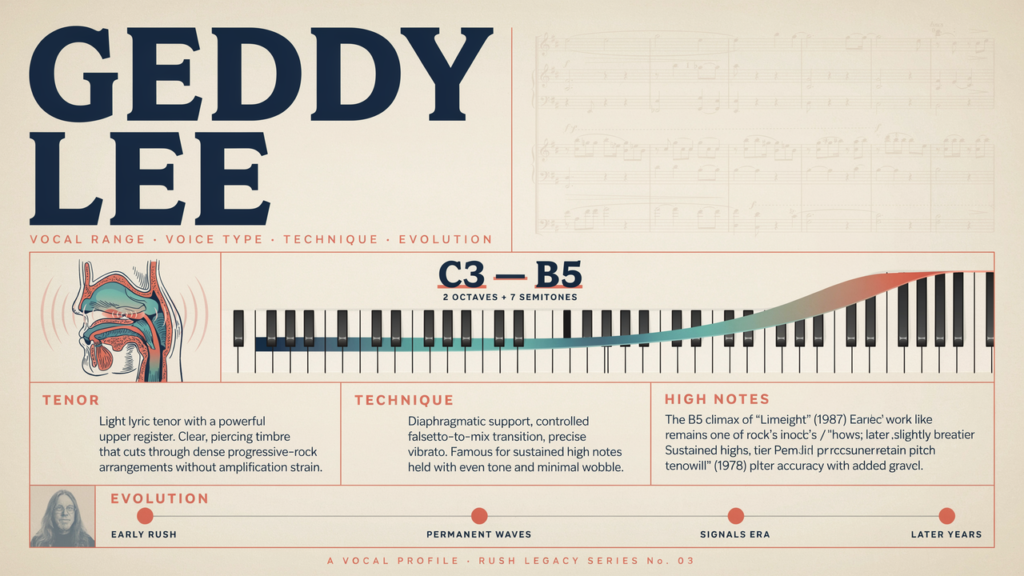
Geddy Lee Vocal Range at a Glance
| Estimated voice type | High rock tenor |
| Commonly cited range | Around C3-B5, but not officially verified |
| Signature era | 1970s and early-1980s Rush recordings |
| Vocal identity | Bright, nasal, high, cutting, dramatic |
| Later-career sound | Lower, warmer, more speech-like, more restrained |
If you are comparing your own voice with his, start with a clear understanding of vocal range and then measure your notes with a vocal range finder. Lee’s voice is not impressive only because of high notes. It is impressive because those notes were part of a complex role: lead vocalist, bassist, keyboardist, and rhythmic center of a progressive rock trio.
What Voice Type Is Geddy Lee?
Geddy Lee is usually described as a high tenor in a rock context. That label is more useful than a strict classical category because his singing was built for amplified progressive rock, not opera. His early tone was bright, narrow, and forward, with a high placement that could cut through bass, guitar, drums, and dense arrangements.
The tenor vocal range guide gives the broad male high-voice framework, but Lee’s sound is more specific: a rock tenor with a sharp upper-register edge. He does not sound like a smooth pop tenor or a classical tenor. His voice is more urgent, metallic, and characterful.
Why Exact Note Claims Need Caution
Many online discussions list Geddy Lee’s range as C3-B5. That may be a useful fan estimate, but it should not be presented as an official measurement. Rock recordings involve studio layering, live key changes, microphone distance, youthful timbre, and different vocal colors that can make note labeling harder than it looks.
A safer statement is that Lee is commonly estimated to have sung from a lower tenor area into very high male rock territory, especially in early Rush songs. The exact top note matters less than the repeatable musical effect: a bright upper register that became instantly identifiable.
Rush Context: Why His Voice Had to Cut Through
Rush’s official site describes Geddy Lee as the band’s lead vocalist, bassist, and keyboardist, and notes that he joined Rush in 1968 at Alex Lifeson’s request (Rush.com). That matters for vocal analysis because Lee was not only singing melodies. He was often singing while playing highly active bass parts and managing keyboard textures in complex arrangements.
That musical role helps explain the sound. His voice needed to occupy a frequency space above the instruments. The high, forward tone that some listeners call shrill is also the reason his voice stayed audible in dense songs like “Tom Sawyer,” “The Spirit of Radio,” “Freewill,” and “The Temples of Syrinx.”
Early Rush: The High, Piercing Era
Lee’s 1970s voice is the version most associated with extreme upper-register singing. The tone is bright, narrow, and intense, especially on albums such as 2112, A Farewell to Kings, and Hemispheres. He often sounds like he is using a very light but focused coordination rather than a heavy chest-dominant belt.
Understanding chest voice vs head voice helps here. Lee’s highest early sounds often feel head-dominant or mix-like, not thick in the way a blues-rock belter might sing. That lighter mechanism helped create height and cut, though it also gave the voice its famously polarizing edge.
Head Voice, Mix, and Falsetto Color
One reason Lee’s high notes are debated is that rock singers do not always fit neat register labels. Some notes may sound like reinforced head voice, some like a bright mix, and some like a stylized high color that sits near falsetto without becoming airy. The difference between head voice vs falsetto is useful when listening to his early catalog.
For singers, the safer takeaway is not “try to sing B5 like Geddy Lee.” It is to build a flexible upper register. The mixed voice guide explains why blending weight and release matters more than simply pushing higher.
How His Voice Changed Over Time
Lee’s voice changed noticeably across Rush’s career. The early sound was higher, sharper, and more urgent. By the 1980s, the tone became slightly rounder and more controlled. In later decades, he used a lower tessitura more often, with warmer phrasing and less reliance on extreme highs.
This is normal for a rock singer with decades of demanding material. Voices age, touring is hard, and the body changes. Lee adapted by leaning more into phrasing, musicianship, and arrangement choices rather than trying to make every era sound like 2112. That evolution is part of what makes his career interesting.
Best Songs for Hearing Geddy Lee’s Range
“The Temples of Syrinx” is the classic example of his most extreme early high sound. “Freewill” shows bright upper-register rock singing with more melodic control. “Tom Sawyer” captures the more polished 1980s version of his voice. “The Garden” shows a later, more reflective approach where the emotional weight comes from phrasing rather than high-note shock.
These songs are better listening references than a single note chart. They show the functional parts of his voice: high placement, rhythmic precision, dramatic delivery, and adaptation over time.
Can You Sing Like Geddy Lee?
You can study his brightness, vowel focus, and fearless upper-register writing, but copying him exactly is risky if your voice is lower or heavier. Start with safe high-note work before attempting Rush material. The guide on how to sing high notes without straining is a better first step than trying to imitate the sharpest early Rush vocals.
Also remember that Rush songs can be difficult because of rhythm and stamina, not just pitch. Warm up carefully, choose keys wisely, and protect your voice. The basics in vocal health for singers matter more than chasing a single extreme note.
FAQs About Geddy Lee’s Vocal Range
What is Geddy Lee’s vocal range?
His exact range has not been officially verified. Many fan estimates place him around C3-B5, but it is safer to describe him as a high rock tenor with an unusually bright and high early-Rush upper register.
Is Geddy Lee a tenor?
Yes, high rock tenor is the most useful description. His early Rush vocals sit much higher than the average male rock voice.
What is Geddy Lee’s highest note?
Some listener-based analyses cite notes near B5 in early Rush material, but those claims should be treated as estimates rather than official documentation.
Why did Geddy Lee’s voice sound so high?
His sound came from high placement, bright resonance, light vocal weight, and progressive rock melodies that often sat above typical male comfort zones.
Did Geddy Lee’s voice change with age?
Yes. His later voice became warmer, lower, and more restrained, with less emphasis on the extreme highs that defined early Rush.
Final Thoughts
Geddy Lee’s vocal range is best described cautiously: a commonly estimated high-tenor rock range, not an official note chart. His real legacy is the way he used that range inside Rush’s music. The bright upper register, unusual tone, rhythmic precision, and long-term adaptation made his voice one of progressive rock’s most unmistakable sounds.
Erika Parker is a vocal analysis and singing education writer at Vocal Range Test. She focuses on vocal range testing, voice type analysis, pitch recognition, and singing tools for vocalists, musicians, choir singers, and beginners.