
Gerard Way’s voice is one of the most defining elements of My Chemical Romance’s identity. His intense emotional delivery, dramatic phrasing, raw vulnerability, and controlled chaos helped shape the emo and alternative rock movements of the 2000s.
This expert analysis breaks down Gerard Way’s vocal range, voice type, highest and lowest notes, distortion technique, and how his voice evolved from My Chemical Romance’s early years through his solo work.
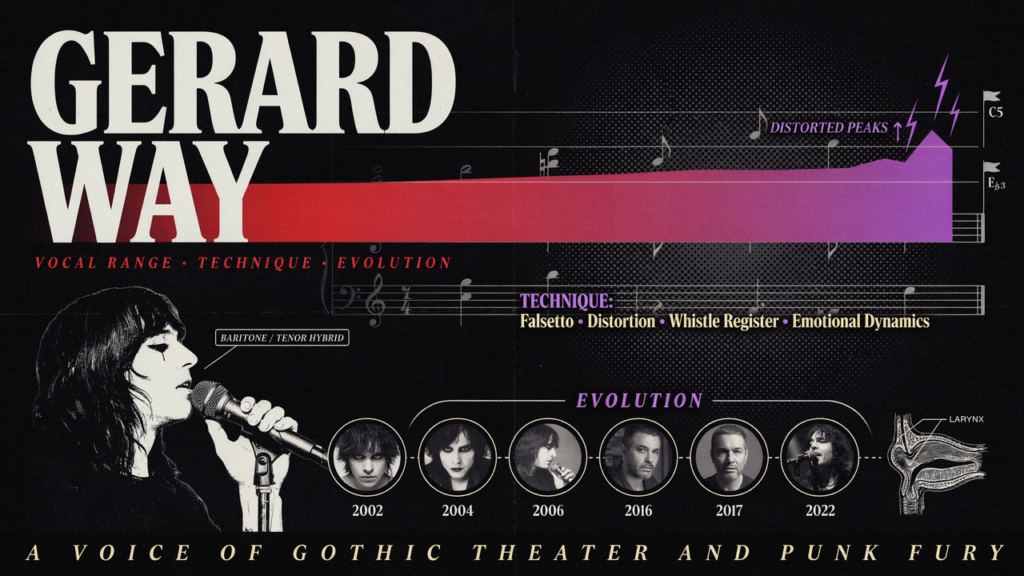
Gerard Way’s Vocal Range
Sustained Singing Range: E♭3 – C5
Extended Distorted Range: Up to E5–G5 (not clean pitch singing; distortion-based)
Total Span: ≈ 2 octaves (clean), with extended highs through controlled screaming
Primary Voice Type: Tenor
Comfort Tessitura: B3 – G4
Gerard Way’s voice is not about extreme note count; it is about emotional impact. His signature sound blends rock tenor belting, theatrical expressiveness, and purposeful vocal distortion.
Is Gerard Way a Tenor? Understanding His Vocal Type
Yes — Gerard Way is a tenor, specifically a rock tenor with a naturally bright speaking voice and upper-leaning tessitura.
Evidence of His Tenor Classification
- His melodies regularly sit above the typical male comfort zone.
- He belts consistently in the A4–C5 region during the Black Parade era.
- His speaking voice aligns with tenor brightness and resonance.
- Even his screams originate from a high-larynx, high-resonance setup typical of high tenors.
Gerard is not a falsetto-driven singer; he primarily uses a mix of chest voice, head voice, and distortion, which is characteristic of a trained—or at least intuitively skilled—rock tenor.
Gerard Way’s Highest Notes: Clean Belts vs. Distorted Screams
Gerard Way produces two types of high notes:
- Clean/melodic mix belts
- Distorted screams that exceed his melodic range
Both are essential to his signature sound.
Highest Clean Notes
B4 – C5
These appear frequently in studio recordings and refined live performances.
Highest Distorted/Screamed Notes
E5–G5 (approx.)
These are not head-voice notes; they are produced using vocal distortion and false fold compression.
High-Note Breakdown by Song
| Song | High Note | Technical Analysis |
|---|---|---|
| Welcome to the Black Parade | A4–B4 | Controlled mix belt with dramatic intensity |
| Famous Last Words | B4–C5 | Emotionally saturated upper mix nearing his limit |
| Helena | B4 | Intense chest-mix note sustained with rasp |
| Mama | Belted highs + screams | Blend of theatrical vibrato and character-driven distortion |
| I’m Not Okay (I Promise) | E5–G5 screams | High-intensity distortion, not melodic singing |
Why His High Register Is Unique
- Uses chest-dominant mix for powerful emotional peaks
- Switches to false fold distortion for expressive screams
- High notes often sound raw and chaotic, yet controlled
- He prioritizes emotional storytelling over technical polish
His high register is one of the most recognizable in alternative rock.
Gerard Way’s Lowest Notes (Rare But Important)
Gerard Way’s low range is not heavily featured in MCR’s early catalog, but becomes more present later.
Lowest Sustained Notes: D3–E♭3
Low Note Examples
| Song | Lowest Note | Description |
|---|---|---|
| Cancer | E♭3 | Fragile, intimate tone with emotional vulnerability |
| Disenchanted | E3 | Warm, softer delivery during storytelling moments |
| Sleep | D3–E♭3 | Dark, controlled lower resonance emphasizing dramatic mood |
In his solo work, Gerard embraces a more grounded, lower vocal timbre consistent with vocal aging and artistic direction.
If you’re unsure where your voice fits, the voice type test gives a quick classification. You can then compare your notes with the baritone vocal range or mezzo-soprano vocal range guides to see which category feels closest.
How Gerard Way’s Voice Evolved Throughout His Career
Gerard Way’s voice changed dramatically across MCR eras and beyond:
1. Early MCR (2002–2004) – Raw, Unrefined, High Emotion
- Reliance on throat-based screaming
- Pitch inconsistency in live settings
- Nasal, bright, chaotic tone
- Lower stamina due to technique and heavy touring
- Emotion-first singing with minimal technical strategy
2. Three Cheers Era (2004–2006) – Controlled Edge
- More consistent pitch
- Improved breath support
- Slightly cleaner tone
- Rasp more controlled
- Emotion still central but delivered with intention
3. Black Parade Era (2006–2008) – Peak Technical Performance
- Strongest belts (A4–C5)
- Solid mix voice
- Controlled theatrical vibrato
- Better breath management
- Cleaner transitions between registers
This is widely considered his technical peak.
4. Danger Days Era (2010–2013) – Lower Tessitura, Warmer Tone
- Reduction in screaming
- Lower overall key choices
- Focus on phrasing and expression
- Healthier resonance and less throat strain
5. Solo Career & Later Work – Mature, Connected Vocalism
- Warmer, rounder sound
- More baritone-like coloration (despite tenor type)
- Artistic phrasing over intensity
- Limited use of distortion
- Greater emotional nuance
Gerard Way evolved from a raw emo vocalist into a controlled, expressive rock singer with improved technique and artistry.
Gerard Way’s Vocal Technique: Expert Analysis
Gerard Way is not a classically trained vocalist, but he has developed effective intuitive techniques that enable emotional intensity without destroying his voice.
Chest Voice
- Strong and forward
- Produces the grit in his early work
- Balanced by greater breath support in later albums
Mix Voice
- Core of his high-range singing
- Used for notes A4–C5
- Blends chest resonance with head voice for power
- More stable in Black Parade era
Head Voice
- Used rarely and mostly for stylistic effect
- Softer and more rounded than his chest-driven belts
Distortion Technique
Gerard Way uses:
- False fold compression (safe, sustainable distortion)
- Twang resonance (brightness and projection)
- Overdrive (rock-style vocal edge)
He DOES NOT yell from the throat when performing properly—his trained distortion explains why he avoided long-term vocal damage.
Vibrato
- Subtle, theatrical, and expressive
- Not technically perfect, but emotionally functional
Breath Support
Improved notably between 2004 and 2006, allowing:
- Better control of long sustained belts
- More reliable pitch
- Healthier screaming technique
Gerard Way Vocal Range Chart
| Register | Note Range | Description |
|---|---|---|
| Low Range | D3 – E♭3 | Warm, dark, used in later works |
| Middle Range | F3 – G4 | Primary emotional storytelling zone |
| Upper Range | A4 – C5 | Powerful mix belts, signature sound |
| Distorted Screams | E5–G5 | High-intensity false fold distortion |
This mapping reflects both studio accuracy and live performance trends.
What Makes Gerard Way’s Voice Iconic
Emotional Intensity
Gerard’s voice communicates pain, hope, defiance, grief, and catharsis better than most rock vocalists.
Controlled Chaos
His success lies in balancing unpredictability with control—raw yet intentional.
Genre-Defining Tone
His raspy tenor sound helped shape the sonic identity of emo and alternative rock in the 2000s.
Theatrical Influence
Broadway-inspired phrasing and dramatic delivery come through strongly in Black Parade.
Evolving Maturity
He improved technically while maintaining expressive authenticity—a rare combination.
Iconic Vocal Performances That Showcase His Range
“Welcome to the Black Parade”
Demonstrates his best mix technique and emotional belting.
“Helena”
Shows powerful upper-chest resonance and emotional strain.
“Famous Last Words”
Features some of his most intense C5 climaxes.
“Mama”
A theatrical vocal performance blending belt, vibrato, and distortion.
“Sleep”
Highlights his lower register and emotional storytelling.
Compare Your Vocal Range to Gerard Way
Use the Vocal Range Test tool to discover your:
- Highest note
- Lowest note
- Voice type
- Total vocal range
- Comparison to Gerard Way’s E♭3–C5 range
This increases user engagement and provides valuable context for fans and vocalists.
Frequently Asked Questions
What is Gerard Way’s vocal range?
E♭3–C5 in sustained singing, with distorted screams reaching E5–G5.
Is Gerard Way a tenor?
Yes, he is a rock tenor with bright upper resonance and emotional belting.
What is Gerard Way’s highest note?
His highest clean notes reach about C5; his highest distorted screams go well above that into E5–G5.
What is his lowest note?
Around D3–E♭3.
Does Gerard Way use falsetto?
Rarely. He relies more on mixed voice and controlled distortion.
Why did Gerard Way’s voice change over time?
Greater technique, vocal maturity, reduced screaming, and improved breath support.
Does Gerard Way scream safely?
In later years, yes—he uses false fold distortion rather than unhealthy throat yelling.
- Gerard Way’s dramatic delivery makes more sense when viewed through vocal range myths every singer should stop believing.
- His E♭3–C5 span fits clearly within the framework outlined in what are the male vocal ranges.
- You can see how your own distorted highs compare to his by using how to check vocal range for free.
- The grit behind his screams is explained in how do the vocal cords work.
- Many of his peaks live in registers detailed in does falsetto count in vocal range.
- To understand how his span stacks up against other rock singers, average vocal range of pop vs classical singers offers context.
Erika Parker is a vocal analysis and singing education writer at Vocal Range Test. She focuses on vocal range testing, voice type analysis, pitch recognition, and singing tools for vocalists, musicians, choir singers, and beginners.