
Jack Black is widely known as a comedic actor, energetic performer, and the charismatic frontman of Tenacious D—but behind the humor lies one of the most unexpectedly skilled and versatile voices in modern rock entertainment. His vocal performances combine theatricality, controlled distortion, metal-influenced screams, and surprisingly strong pitch accuracy. Black’s voice blends baritone warmth with tenor-like high notes, making him a uniquely expressive rock vocalist with a range that often surprises trained singers.
This expert guide explores the vocal range, voice type, technique, and highest and lowest notes of Jack Black, offering a detailed breakdown of how he achieves his powerful and dynamic sound.
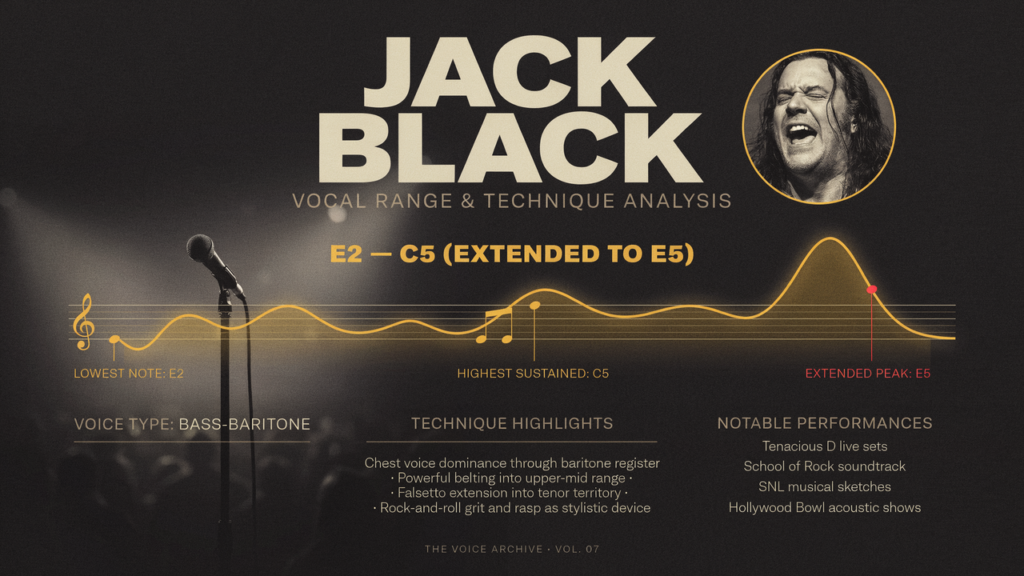
Jack Black’s Vocal Range
Sustained Singing Range: E2 – C5
Extended Range (Falsetto/Fry): Up to E5
Approximate Total Range: Just over 3 octaves
Voice Type: Baritenor (baritone base with tenor extension)
Primary Strengths: Rock-mix belts, metal falsetto, theatrical phrasing, controlled grit
While some of Jack Black’s highest “screams” are exaggerated for comedic effect, the majority of his range is legitimate, supported, and technically consistent across both studio and live performances.
Is Jack Black a Tenor or Baritone? The Baritenor Answer
Jack Black fits the baritenor classification—a hybrid voice between baritone and tenor. This hybrid quality is common among rock singers who possess both low warmth and upper-range flexibility.
Why Jack Black Is Not a Pure Baritone
- He easily reaches G4–C5 in a mixed voice.
- His falsetto extends well beyond standard baritone limits.
- His resonance brightens significantly in the upper midrange.
Why He Is Not a Pure Tenor
- His speaking voice sits low and thick.
- His tessitura (comfortable singing zone) is A2–F4, lower than a tenor’s.
- He possesses a heavy chest-dominant tone that resembles baritone coloration.
Baritenor Traits He Clearly Exhibits
- Rich low notes (E2–G2)
- Agile upper register capable of clean C5s
- Seamless comedic transitions between registers
- Strong head voice and falsetto capability
This flexible baritenor placement is ideal for rock, metal, comedic operatics, and musical storytelling.
If you’re exploring coaching options, the adult singing lessons guide explains how beginners and returning singers can get the most out of private instruction. Budgeting becomes easier once you check the singing lesson cost page for typical price ranges.
Jack Black’s Highest Notes (Song-Verified Analysis)
Jack Black’s upper range is a blend of mix voice, falsetto, fry scream, and controlled false fold distortion. This gives him the ability to hit notes that sound impossibly high, especially in exaggerated Tenacious D performances.
Highest Supported Note (Mix Voice): C5
Consistent in songs like “Tribute,” “Kickapoo,” and “Wonderboy.”
Highest Extended Notes (Falsetto/Fry): D5–E5
Often used for comedic or metal-style screams.
High Note Examples and Technique Breakdown
| Song | Highest Notes | Technique Used |
|---|---|---|
| “Master Exploder” | Up to E5 | Falsetto reinforced with fry scream; partially overdubbed but technique-based |
| “Tribute” | C5 | Strong rock-mix belt with forward placement |
| “Kickapoo” | C5 | Operatic parody using tall vowels and controlled vibrato |
| “Wonderboy” | Bb4–C5 | Clean mix with tonal stability |
| “Beezleboss” | D5+ (screams) | Fry-distortion with metal influence |
Why His High Notes Work
- He doesn’t rely on brute force; he uses efficient resonance.
- His laryngeal tilt helps lighten the upper mix.
- His falsetto is bright, focused, and supported.
- He knows how to control distortion safely, preventing strain.
Even when exaggerated for humor, Jack Black’s high notes demonstrate legitimate vocal technique.
Jack Black’s Lowest Notes (Baritone Foundation)
Jack Black’s low range offers surprising depth and resonance, especially in acoustic performances.
Lowest Sustained Notes: E2–F2
Lowest Recorded Note (Live): D2
Low Note Examples
| Song / Performance | Note | Description |
|---|---|---|
| “Dude (I Totally Miss You)” | E2 | Deep, warm, fully resonant |
| Acoustic Performances | D2/E2 | Relaxed, speech-like but projected |
| Tribute (spoken parts) | E2 range | Demonstrates natural baritone warmth |
Jack Black rarely showcases the full depth of his lower range in Tenacious D recordings, but it becomes more apparent in acoustic sessions and interviews.
How Jack Black Sings: Technical and Stylistic Analysis
Jack Black’s vocal ability is rooted in genuine technique, theatrical intuition, and musical instinct. His comedic delivery often masks the sophistication of his vocal approach.
1. Chest Voice (Rock Core)
Jack Black’s chest voice is powerful, resonant, and surprisingly polished.
He uses:
- Open throat posture
- Efficient airflow
- Strong subglottic pressure
- Forward resonance for clarity
This makes his rock belts sound effortless and energetic.
2. Mixed Voice (Key to His High Notes)
His mix voice allows him to transition into high notes without straining.
Characteristics:
- Balanced chest/head ratio
- Strong mask resonance
- Slight twang for brightness
This is how he reaches G4–C5 cleanly in songs like “Tribute.”
3. Falsetto & Metal Falsetto
Jack Black’s falsetto is unusually strong for a baritone-type singer.
He uses:
- Soft falsetto for comedic effect
- Reinforced metal falsetto for piercing screams
Metal falsetto is heard prominently in “Master Exploder.”
This technique is similar to:
- Rob Halford
- King Diamond
- Some power metal tenors
4. Distortion, Fry Scream, and Grit
Jack Black safely uses:
- Fry scream (low airflow distortion)
- False fold distortion (metal technique)
- Intentional cracks for comedy
- Controlled grit for rock intensity
This gives him the flexibility to shift from melodic singing to aggressive screaming without damaging his voice.
5. Operatic & Theatrical Elements
His exaggerated opera-like singing works because:
- He uses tall vowels
- He lifts the soft palate
- He widens resonance space
- He maintains controlled vibrato
Though often comedic, this technique reflects genuine musical understanding.
Jack Black Vocal Range Chart
| Register | Range | Description |
|---|---|---|
| Low Range | E2 – G2 | Dark, resonant baritone foundation |
| Middle Range | A2 – F4 | Strong expressive zone; storytelling center |
| Upper Range | G4 – C5 | Bright mix belts; signature Tenacious D sound |
| Extended Range | D5 – E5 | Falsetto, fry screams, metal distortion |
Is Jack Black Actually a Good Singer? Absolutely.
Despite his comedic persona, Jack Black is:
- Highly pitch-accurate
- Tonally consistent across registers
- Technically grounded in rock and theatrical mechanics
- Able to maintain stamina across high-energy songs
- Capable of real emotional expression through phrasing
His performances show that he understands the fundamentals of breath support, resonance balancing, and vocal coordination—even when exaggerating for humor.
- Jack Black’s powerful low-end placement is best understood through what are the male vocal ranges.
- His E2–C5 span becomes more impressive when compared to is 3 octaves a good vocal range.
- You can check how your own range stacks up against his using how to test vocal range.
- The dramatic jumps into his upper extension are driven by mechanics explained in how vocal cords produce different pitches.
- His ability to hit E5 without strain relies on support techniques in how to sing high notes without straining.
- To compare his extreme range with other vocal outliers, 5 octave vocal range gives useful context.
Erika Parker is a vocal analysis and singing education writer at Vocal Range Test. She focuses on vocal range testing, voice type analysis, pitch recognition, and singing tools for vocalists, musicians, choir singers, and beginners.