
Jay Chou is one of the most innovative and influential figures in Mandopop. His music reshaped the genre with its fusion of R&B, classical influences, hip-hop, traditional Chinese elements, and cinematic composition. But another defining part of his artistry is his distinctive vocal identity—soft, breathy, intimate, and instantly recognizable.
Despite his global fame, Jay Chou’s vocal range and technique are often misunderstood. Many fans ask: Is Jay Chou a strong singer? Why does he sing so softly? What are his highest and lowest notes? What voice type does he belong to?
This 2025 expert guide answers all of these questions with clarity, accuracy, and detailed vocal science.
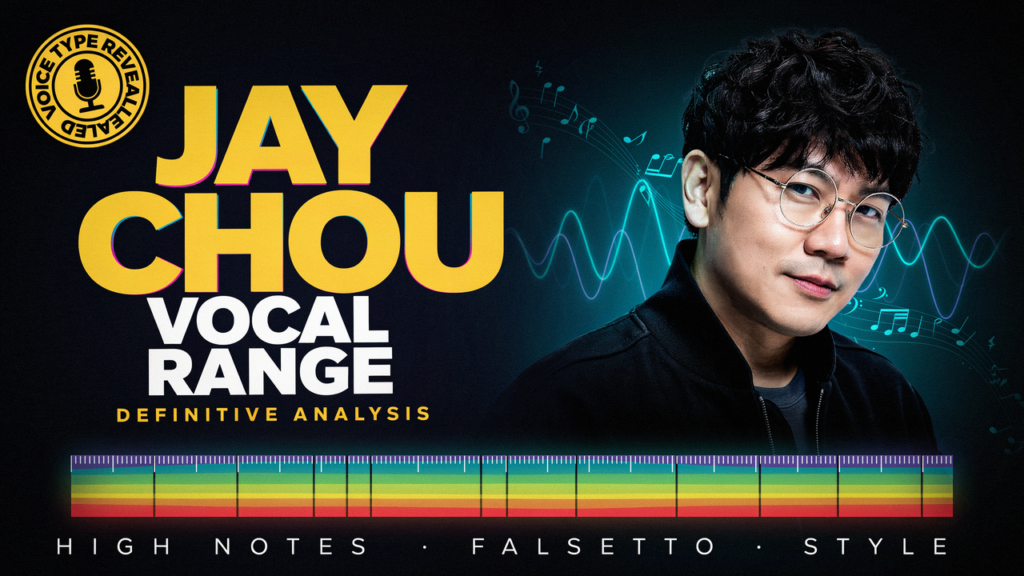
What Is Jay Chou’s Vocal Range?
Jay Chou’s approximate vocal range spans:
A2 – G4 (Chest/Modal Voice)
A2 – B4 (Falsetto / Light Head Voice)
His range is modest compared to powerhouse vocalists, but range alone does not define vocal ability. Jay uses his limited range masterfully through tone shaping, falsetto artistry, phrasing, and emotional expressiveness.
Vocal Range Summary Table
| Era | Range Estimate | Key Characteristics |
|---|---|---|
| Early Career (2000–2005) | A2 – A4 (B4 falsetto) | Bright, youthful tone; nasal quality |
| Mid Career (2006–2015) | A2 – G4 | Most stable vocal technique; improved control |
| Late Career (2016–2025) | A2 – F#4 | Softer tone, less upper extension, more breathiness |
His tessitura (the range he sings comfortably) is typically: B2 – E4
This is where his emotional phrasing and signature tone sound their best.
Jay Chou’s Voice Type Explained
Jay Chou is a light lyric baritone, leaning toward the softer end of the baritone spectrum.
Key Vocal Characteristics
- Naturally low-to-mid male voice
- Strong control at low volume
- Prominent nasal resonance
- Smooth, breathy phonation
- Soft, lightweight timbre
- Frequent use of falsetto
Jay does not rely on chest-power singing. Instead, he crafts songs around mood, texture, and emotion, which is why his vocals pair so well with romantic ballads, R&B grooves, and cinematic arrangements.
Jay Chou’s Highest Notes (With Song Examples)
Jay Chou rarely belts high notes because it does not match his vocal identity. Instead, he achieves upper notes through falsetto, light head voice, and mixed resonance.
Documented High Notes
| Song | Approx. Note | Technique |
|---|---|---|
| “Qing Hua Ci” | G4 | Light mix with airy overtones |
| “Ju Hua Tai” | G4 | Controlled upper chest-mix |
| “Qi Li Xiang” | A4 (falsetto) | Soft, floating falsetto |
| “Dong Feng Po” | G4 | Emotional, heady mix |
| “Fa Ru Xue” | G4 | Balanced head-chest resonance |
Jay’s upper notes are never harsh or forceful. Instead, they are:
- Light
- Floating
- Breath-driven
- Emotion-centered
- Stylistically delicate
This softness is intentional and central to his sound.
Jay Chou’s Lowest Notes
Jay Chou has a stable lower register suitable for his baritone classification.
Notable Low Notes
| Song | Low Note | Description |
|---|---|---|
| “An Jing” | A2 | Gentle and controlled |
| “Ye Qu” | A2 | Intimate, breathy, focused tone |
| “Ge Qian” | A2 | Deep yet soft delivery |
| “Nunchucks” | Bb2 | Spoken-sung low rap |
His lows are quiet by design, supporting his preference for subtlety over power.
Why Jay Chou Sings So Softly
Jay Chou’s signature soft and sometimes “mumbling” vocal tone is a deliberate artistic decision, supported by specific vocal techniques.
1. Breathy, Low-Pressure Phonation
Jay often uses a relaxed glottal closure, allowing excess air to leak through the vocal folds. This produces a whisper-like tone that highlights emotional vulnerability.
2. Nasal Resonance and Front Placement
Instead of projecting from the chest, Jay pushes resonance forward into the nasal cavity and facial mask.
This gives his voice a bright yet mellow timbre that blends well with Mandarin’s tonal characteristics.
3. Minimal Belting or Power Singing
Jay avoids forceful chest voice. This keeps his tone smooth but also limits volume in live settings.
4. Soft Consonant Articulation
Mandarin pronunciation combined with Jay’s personal singing style leads to gentler consonants—part of why some fans say he “mumbles.”
5. Whisper-Pop Technique
A mix of whisper phonation + breathiness + airy tone, widely used in his R&B and pop songs.
These techniques make Jay unique—not technically overpowering, but emotionally resonant.
Jay Chou’s Falsetto Technique
Falsetto is one of Jay Chou’s strongest vocal abilities.
Characteristics of His Falsetto
- Smooth and airy
- Simple transitions from modal to head voice
- Very little vocal weight
- Often used to express softness or vulnerability
Key songs with prominent falsetto include:
- “Qi Li Xiang”
- “Dong Feng Po”
- “Mine Mine”
- “Rainbow”
His falsetto is stylistically intentional, not a vocal limitation.
Jay Chou: Live vs Studio Vocals
Jay Chou’s live vocals have been debated, but the reason is technical, not musical ability.
Studio Advantages
- Controlled acoustics
- Layered harmonies and doubling
- Optimized microphone placement
- Perfect monitoring
Live Challenges
- Whisper-pop loses resonance in large venues
- Soft articulation is harder to project
- Fast rap + singing requires breath efficiency
- Stadium acoustics aren’t ideal for quiet singers
Despite these challenges, Jay’s live performances remain emotionally powerful and musically consistent.
How Your Vocal Range Compares to Jay Chou
Jay Chou’s comfortable singing range (B2–E4) fits many beginner and intermediate male singers.
You can use a vocal range test tool to see whether your voice sits above, below, or within Jay’s tessitura.
Frequently Asked Questions
What is Jay Chou’s vocal range?
Approximately A2–B4, with chest voice up to G4.
What is his highest note?
A4 in falsetto, G4 in chest-mix.
What is his lowest note?
Around A2 in multiple ballads.
What voice type is Jay Chou?
A light lyric baritone.
Why does he sound unclear sometimes?
Because of his relaxed articulation, breathy phonation, and nasal resonance.
Is Jay Chou a strong singer?
He is not a power vocalist, but he is a highly expressive, technically controlled stylist who maximizes his strengths.
- You can explore our vocal-range chart to see how Jay Chou’s range compares to other singers.
- Learn how to test your vocal range and identify notes similar to Jay Chou’s high register.
- Understanding the difference between falsetto and head voice can help you analyze his unique singing style.
- For a deeper dive into voice types, check our voice-type test to see where your range aligns.
- Our how to expand vocal range guide offers techniques that singers use to reach high notes like Jay Chou.
- Discover breathing techniques for singing to support challenging vocal runs.
- Compare his voice with others using the singer comparison tool to see how he stands among top artists.
Erika Parker is a vocal analysis and singing education writer at Vocal Range Test. She focuses on vocal range testing, voice type analysis, pitch recognition, and singing tools for vocalists, musicians, choir singers, and beginners.