
Jennifer Hudson is one of the most powerful and technically gifted vocalists of the 21st century. Her voice—an electrifying fusion of gospel intensity, R&B richness, and theatrical control—has placed her in the lineage of true powerhouse singers like Aretha Franklin, Whitney Houston, Patti LaBelle, and Jennifer Holliday. With her Oscar-winning performance in Dreamgirls and her commanding live vocals across awards shows, tributes, and Broadway stages, Hudson has proven herself a vocalist of rare ability.
But what exactly is Jennifer Hudson’s vocal range? Why does her voice sound so massive? And what makes her technique so extraordinary?
This expert 2025 guide delivers a complete breakdown of Hudson’s range, voice type, highest notes, lowest notes, belting mechanics, and what sets her apart from almost every other contemporary singer.
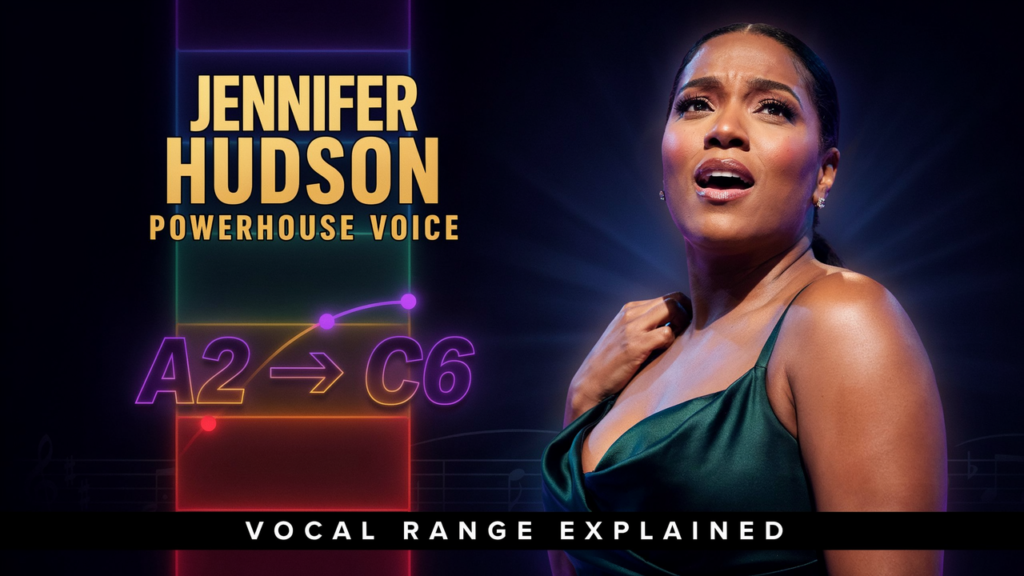
What Is Jennifer Hudson’s Vocal Range?
Jennifer Hudson’s vocal range spans approximately: A2 – C6
(With belts up to A5 and head voice up to C6.)
This covers roughly three octaves, but unlike many singers who have wide but inconsistent ranges, Hudson’s range is fully usable, meaning she can sing with strength, clarity, and control across the majority of it.
Breakdown of Jennifer Hudson’s Vocal Capabilities
| Register | Notes | Characteristics |
|---|---|---|
| Low Register | A2–C3 | Surprisingly rich, warm, and controlled |
| Mid Register | D3–F4 | Her emotional storytelling zone; dark mezzo color |
| Upper Chest / Mix | G4–A5 | Explosive belts that define her vocal identity |
| Head Voice | A5–C6 | Strong, bright, and operatic when required |
Unlike most pop singers who rely on a thin mix, Hudson brings full vocal weight deep into the 5th octave, making her upper register one of the most powerful in modern music.
What Voice Type Is Jennifer Hudson?
Jennifer Hudson is best classified as a Dramatic Mezzo-Soprano.
Why a Dramatic Mezzo-Soprano?
- A naturally darker and heavier timbre
- Stronger lower and mid registers than a soprano
- Exceptional chest voice dominance
- Ability to project huge sound without strain
- A resonant, full-bodied tone that maintains weight even in high belts
Her gospel background further enhances her dramatic resonance—producing a voice that feels physically larger than most contemporary vocalists.
Jennifer Hudson’s Highest Notes (Song Examples & Technical Insight)
Jennifer Hudson has delivered some of the most celebrated high notes in modern vocal performance. These notes are not only high—they are loud, sustained, and tonally rich, which is far more difficult than simply hitting a pitch.
Notable High Notes
| Song / Performance | Highest Note | Technique Used |
|---|---|---|
| And I Am Telling You I’m Not Going (Dreamgirls) | C6 | Operatic head voice with vibrato control |
| Live Whitney Houston Tributes | A5 | Belting with mix reinforcement |
| Spotlight live performances | G5 | Chest-dominant belt |
| Awards show tributes | G5–A5 | Open-throat belting and vowel shaping |
What Makes Her High Belts Extraordinary
- They are chest-heavy, not thin mixed notes.
- They maintain fullness, avoiding the strain or “squeeze” common in high belts.
- She sustains them, often holding a G5 or A5 longer than most singers can hold a mid-range note.
- She maintains vibrato, a sign of excellent breath compression and vocal freedom.
- They cut through orchestras, something only dramatic-voiced singers can do.
Few living singers can match Hudson’s belting strength—she stands on a very short list of elite vocal powerhouses.
Jennifer Hudson’s Lowest Notes
Although known for high-volume belting, Hudson’s lower register is warm, chesty, and surprisingly resonant.
Documented Low Notes
| Song | Low Note | Characteristics |
|---|---|---|
| “Where You At” | A2 | Strong, earthy, and well-supported |
| Gospel live performances | Bb2–B2 | Dark, rounded tone suitable for gospel styles |
| Ballads & R&B works | C3 | Smooth and controlled lower body |
Her lows are not as heavily showcased as her belts, but they reveal her wide range and vocal flexibility.
How Jennifer Hudson Produces Her Legendary Power
Jennifer Hudson’s voice is a masterclass in vocal technique. Her ability to sing loudly and safely at high pitches comes from several advanced skills:
1. Elite Diaphragmatic Support
Hudson’s breath control is exceptional. She uses strong diaphragm engagement and consistent subglottal pressure, allowing her to:
- Sustain long phrases
- Maintain vibrato at high volume
- Hold powerful belts without strain
2. Heavy Chest Voice Dominance
Hudson carries chest resonance into the upper 5th octave, something few singers can do without tension. This is the foundation of her massive sound.
3. Vowel Modification for High Belts
To avoid vocal strain, she subtly modifies vowels—particularly on high sustained notes—opening them toward more resonant shapes that allow airflow and prevent constriction.
4. Forward Mask Resonance
By placing sound forward (teeth, mask, and nasal bones), she projects effortlessly. This forward placement allows her sound to fill large venues without shouting.
5. Gospel-Informed Melisma & Emotional Delivery
Her melisma is:
- Controlled
- Purposeful
- Emotionally connected
It comes from a lineage of church singers who blend storytelling with vocal athleticism.
6. Open Throat Technique
Hudson maintains an expanded pharyngeal space, which allows:
- Huge resonance
- Smooth transitions
- Powerful sound without throat pressure
This is why her voice sounds free even at maximum power.
Live vs. Studio: Where Jennifer Hudson Shines Brightest
Jennifer Hudson is one of the rare singers who is even stronger live than in the studio.
Studio Vocal Traits
- Controlled tone
- Refined vibrato
- Cleaner production
- Subtle emotional shading
Live Vocal Traits
- Louder, bigger resonance
- Higher sustained belts
- More improvisation
- More dynamic power
- Vocal risks that exceed studio recordings
Her awards show performances—Grammys, Oscars, BET Awards, and tributes—are often cited as some of the greatest live vocals of the modern era.
How Your Vocal Range Compares to Jennifer Hudson
Hudson’s comfortable singing zone—or tessitura—is approximately: C4 – G5
This tessitura is far above average. Even trained singers often cannot belt G5 the way Hudson does. You can measure your own vocal range and compare it using a vocal range test tool.
Frequently Asked Questions
What is Jennifer Hudson’s vocal range?
Approximately A2–C6 (three octaves).
What is her voice type?
She is a Dramatic Mezzo-Soprano.
What is her highest note?
C6 in head voice; A5 in powerful mixed and chest-driven belts.
Can Jennifer Hudson sing whistle notes?
No verified examples of whistle register. Her high notes come from head voice and mix.
What makes her voice so powerful?
Gospel training, diaphragmatic mastery, chest dominance, advanced vowel shaping, and resonant placement.
- Explore our vocal-range notes to understand the specific pitches Jennifer Hudson can hit.
- Learn how to find your vocal range and see how your voice compares to her A2–C6 span.
- Understanding breathing techniques to improve vocal range can help you achieve powerful high notes.
- Check out our daily vocal warm-up routines that professional singers use to maintain range.
- Discover the difference between soprano, alto, tenor, and bass to classify her voice type accurately.
- Use the vocal-range improvement plan for structured exercises to expand your vocal capabilities.
- Compare Jennifer Hudson with other artists using our singer comparison tool to see how her range ranks.
Erika Parker is a vocal analysis and singing education writer at Vocal Range Test. She focuses on vocal range testing, voice type analysis, pitch recognition, and singing tools for vocalists, musicians, choir singers, and beginners.