
Josh Turner is one of country music’s most recognizable voices, known for his exceptionally deep tone, rich resonance, and commanding presence. His voice stands out in a genre filled with baritones and low tenors, making him one of the few modern commercial singers whose sound is built on a true bass or bass-baritone foundation. But what exactly is Josh Turner’s vocal range, and how does he achieve the low notes that have become his signature?
This expert analysis breaks down Josh Turner’s vocal range, voice type, lowest notes, vocal mechanics, and the songs that highlight his extraordinary depth.
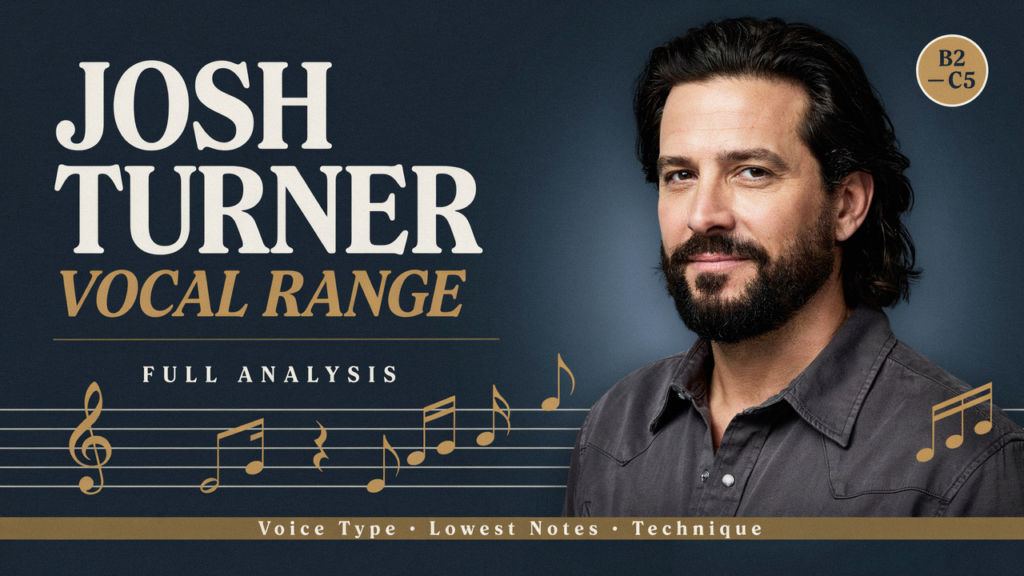
Josh Turner Vocal Range
Josh Turner’s vocal range spans approximately: Ab1 – D4
(About 2.5 octaves)
- Lowest sustained note: Ab1
- Highest chest/mix note: D4
- Primary voice type: Bass-Baritone
- Secondary classification: Commercial Bass
- Comfort range: C2 – G3
Josh Turner is one of the rare mainstream artists capable of producing stable, resonant notes in the Ab1–C2 region, placing him among the lowest male voices in modern popular music.
What Voice Type Is Josh Turner?
Josh Turner is best classified as a bass-baritone, though many vocal experts consider him a true commercial bass due to the depth, color, and consistency of his lower register.
Indicators of a Bass-Baritone or Bass Voice
1. Robust low-frequency resonance
Turner’s tone features strong lower harmonics, creating warmth and fullness even at low volume.
2. Low laryngeal position
His technique allows him to maintain a stable laryngeal posture while accessing extremely low notes.
3. Natural speaking pitch
His speaking voice sits noticeably lower than the average male, signaling deep anatomical resonance.
4. Limited reliance on upper-register belts
Unlike tenors or high baritones, Turner rarely sings above D4, keeping his vocals grounded in the lower register.
5. Strong chest voice dominance
His signature tone is produced primarily through chest resonance rather than mix or falsetto.
Turner’s vocal identity centers on power, warmth, and effortless low-note clarity—traits typical of a true bass within country music.
Josh Turner Vocal Range Chart
| Component | Notes | Approx. Hz | Description |
|---|---|---|---|
| Lowest Note | Ab1 | ~52 Hz | Exceptionally low and rare in commercial music |
| Core Low Register | C2 – F2 | 65–87 Hz | Where his voice is most resonant and recognizable |
| Midrange Comfort | G2 – G3 | 98–196 Hz | Stable tone for narrative and melodic lines |
| Upper Limit | C4 – D4 | 261–293 Hz | Used sparingly; maintains tonal integrity |
| Total Range | ~2.5 octaves | — | Powerful but low-centered |
Before starting any training cycle, it’s useful to measure where your voice currently stands using the vocal range test or the more precise AI voice analysis tool. If you’re unsure how many octaves you cover, the octave range test gives a clear number, and the voice type test classifies your range into standard categories like tenor, alto, or baritone. These tools together give a detailed picture of your vocal profile.
How Josh Turner Produces Such Low Notes
Josh Turner’s ability to produce deep, resonant low notes is rooted in efficient vocal technique, favorable anatomy, and consistent training.
1. Chest-Dominant Resonance
Turner’s tone is grounded in chest voice, producing a full-bodied sound with rich lower harmonics.
2. Low Laryngeal Position
He maintains a relaxed, lowered larynx—similar to classical bass singers—which deepens resonance without strain.
3. Open Pharyngeal Space
His wide pharyngeal shaping contributes to the fullness and warmth of his tone, especially in slower ballads.
4. Controlled Airflow
Deep-voiced singers require stable breath support; Turner’s consistent airflow prevents tonal collapse at extremely low pitches.
5. Efficient Use of Subharmonics (Occasional)
Some of Turner’s lowest notes exhibit characteristics of partial subharmonic engagement, allowing him to produce pitches below typical modal range.
These combined technical elements allow Turner to sustain low notes clearly, without sounding forced or overly darkened.
Songs That Best Showcase Josh Turner’s Vocal Range
Deepest Notes
- “Long Black Train” — showcases strong C2–D2 region
- “Your Man” — iconic low-note phrases demonstrating warmth and depth
- “Would You Go With Me” — blends low phrasing with smooth midrange tone
Midrange Strength
- “Why Don’t We Just Dance” — crisp articulation in G2–B2 region
- “Hometown Girl” — melodic clarity with balanced resonance
Full Vocal Expression
- “I Serve a Savior” — reveals his classical influence and rich chest resonance
- “All Over Me” — smooth transitions between low and mid registers
These songs highlight his remarkable consistency, especially in the C2–G3 range.
Why Josh Turner’s Voice Is Unique
Josh Turner’s voice is notable for several key reasons:
1. One of the deepest voices in modern commercial music
Very few mainstream artists can produce clear Ab1–C2 tones with consistency.
2. Exceptional tonal stability
He maintains clarity at low volume—a sign of advanced breath management.
3. A rare true bass presence in a tenor-dominated industry
Most pop and country singers are baritones or tenors, making Turner’s depth stand out.
4. Timeless genre fit
His voice aligns perfectly with the storytelling and emotional tone of country music.
5. Controlled resonance and diction
Even at extremely low frequencies, his diction remains intelligible—a technical accomplishment.
How Josh Turner’s Range Compares to Other Deep-Voiced Singers
- Lower than: Johnny Cash, Randy Travis
- Comparable to: Trace Adkins, Avi Kaplan
- Higher than: true operatic basses (who can reach F1–A1 but with different vocal production)
Turner occupies a distinct niche: a contemporary commercial bass with exceptional clarity.
Compare Your Vocal Range to Josh Turner
Using our Vocal Range Test tool , you can instantly measure:
- Your lowest and highest notes
- Your voice type
- Your octave range
- Whether your voice sits near Josh Turner’s bass range
Start your vocal range test now.
- To explore how low your voice can go, check out lowest vocal range for reference points.
- Understand different male singing categories with our baritone-vs-bass comparison.
- Learn how proper posture impacts singing in best posture for singing.
- Measure your notes accurately using the how to measure vocal range guide.
- Boost your lower register with practical tips in tips to extend your lower vocal range.
- Train your voice safely by following warm-up exercises for baritone-bass.
- Learn the science behind pitch production in how do the vocal cords work.
Erika Parker is a vocal analysis and singing education writer at Vocal Range Test. She focuses on vocal range testing, voice type analysis, pitch recognition, and singing tools for vocalists, musicians, choir singers, and beginners.