
singers who impress you.
And then there are singers who hit you in the gut — where the voice feels less like sound and more like emotion tearing through a microphone.
Kurt Cobain was that second type.
I still remember the first time I tried singing “Lithium.”
I thought, “Cool, the verse is low. I’ve got this.”
Then the chorus hit — and suddenly I was fighting for breath, my throat tightened, my pitch collapsed, and my voice cracked so badly I had to cough afterward.
That’s when it hit me:
Kurt Cobain’s vocal range isn’t impressive because it’s wide — it’s impressive because it carries raw, violent honesty in every note.
And that honesty relies on surprising vocal control most people underestimate.
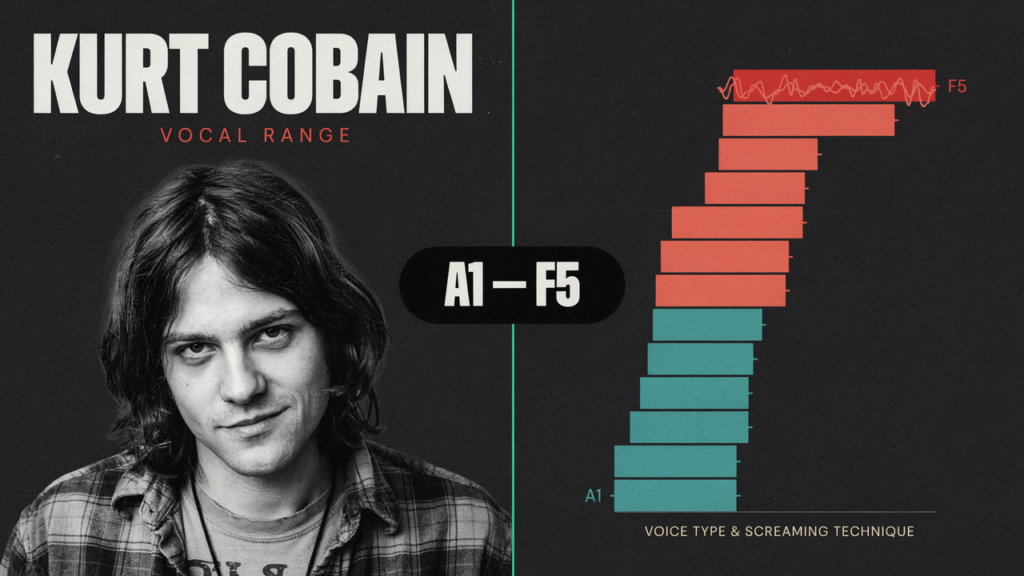
Kurt Cobain’s Vocal Range (Exact Notes)
Most technical analyses place his full range at: A1 – F5
(Over 3 octaves, depending on interpretation.)
But here’s the nuance most websites miss:
His functional range (the range where he expressed emotion comfortably): E2 – E5
This is where the:
- grit
- rasp
- screams
- vulnerability
- ache
…all lived.
Kurt wasn’t chasing high notes — he was chasing truth.
Kurt Cobain Vocal Range Chart
| Register | Notes | Description |
|---|---|---|
| Low Register | A1 – D2 | Surprisingly dark and resonant; rarely highlighted |
| Mid Register | E2 – A3 | His storytelling zone — conversational, raw, intimate |
| Upper Register | Bb4 – E5 | The iconic grunge distortion zone |
| Highest Notes | E5 – F5 | Full-throttle screaming mixed with thick distortion |
Cobain rarely used clean head voice.
He preferred to hold onto chest-dominant mix even when most singers would flip registers.
That’s part of his signature sound — and part of why amateurs blow out their voices trying to imitate him.
Kurt Cobain’s Highest Notes: Where the Emotion Meets the Edge
Cobain’s highest consistent notes were around E5–F5, especially in songs like:
- “Smells Like Teen Spirit” – sustained E5 screams
- “Breed” – aggressive E5 throughout
- “Territorial Pissings” – full-throttle yelling
- “Where Did You Sleep Last Night” – emotional peaks in the MTV Unplugged finale
What makes his highs special is not the pitch, but the texture.
He used:
- controlled distortion
- forward nasal resonance
- compressed breath support
- false fold engagement
- minimal vibrato
When I first tried copying those screams, I felt the back of my throat tighten — a huge red flag.
Cobain had learned to scream with technique, even if it didn’t look like it.
This is important:
If your throat hurts copying Cobain, you’re doing it wrong.
When he did it right, it didn’t hurt him.
Kurt Cobain’s Lowest Notes: The Part No One Talks About
Most fans focus on the screams, but Cobain also had a quiet, haunting low range.
Examples:
- Something in the Way: soft, breathy E2–G2
- Come As You Are: relaxed E2–F#2
- Unplugged performances: multiple dips into D2
His low notes weren’t classical or booming — they were:
- vulnerable
- fragile
- conversational
- intentionally “broken”
And that’s exactly why they hit emotionally.
Kurt Cobain’s Voice Type (Baritone With Tenor Tendencies)
Here’s the truth:
He was a baritone.
But a baritone with the courage (and technique) to push into tenor territory.
Signs he’s a baritone:
- strong low notes down to A1
- darker timbre
- comfortable speech pitch around E2–F2
- thick vocal folds producing weighty tone
Signs he behaved like a tenor:
- frequent singing around E4–E5
- sustained high-intensity choruses
- bright distortion and forward resonance
A natural baritone screaming like a tenor is part of the magic — and tension — in his voice.
How Kurt Cobain Created His Rasp (Not Random, Not “Incorrect”)
This is the most misunderstood part of his range.
Cobain’s rasp wasn’t uncontrolled yelling.
It was created through technique, even if he never studied the science.
Here’s what his rasp came from:
1. False vocal fold distortion
This adds roughness without tearing the true folds.
2. Forward placement (“mask resonance”)
The sound vibrates in the cheekbones and nasal cavities — not the throat.
3. Chest-heavy mix voice
He resisted flipping to head voice, which kept the sound gritty and intense.
4. Breath compression
A controlled, pressurized airflow — not screaming from the throat.
5. No vibrato
A straight, tense tone that amplified emotion.
Trying this without technique is brutal.
The first time I attempted the chorus of “In Bloom,” I pushed too much air and felt scratchiness immediately.
Cobain didn’t push — he compressed.
The truth:
He wasn’t careless.
He knew how to make his voice distort without destroying his cords overnight.
Why Kurt Cobain’s Voice Hits So Hard (Even If His Range Isn’t Giant)
1. He sang like he meant every word
Some singers “perform.”
Cobain confessed.
2. His imperfections were his style
The cracks, breaks, and rawness weren’t mistakes — they were texture.
3. His dynamics were unmatched
Soft, ghost-like verses → explosive choruses.
That contrast creates impact.
4. His screams were emotional, not technical
He wasn’t screaming to impress.
He was screaming because he needed to.
5. He weaponized vulnerability
Few singers can make a whisper sound as powerful as a scream.
How Kurt Cobain’s Range Compares to Other Rock Singers
| Singer | Vocal Range | Voice Type |
|---|---|---|
| Kurt Cobain | A1 – F5 | Baritone w/ Tenor Extension |
| Chris Cornell | E2 – C6 | Tenor |
| Eddie Vedder | B1 – E5 | Baritone |
| Layne Staley | A2 – A5 | Baritone/Tenor mix |
| Dave Grohl | B1 – A5 | High Baritone |
| Chester Bennington | G2 – G5 (C6 scream) | Tenor |
Cobain wasn’t the “highest” or “widest ranged” singer —
but he was one of the most emotionally dangerous.
And that’s what people remember.
My Personal Experience Trying to Sing Kurt Cobain Songs
Struggle #1: The rasp comes at a price
If you don’t use false folds, you’ll burn out fast.
I learned this the painful way.
Struggle #2: The pitch is deceptively high
Many Nirvana choruses sit above E4, pushing most beginners too far.
Struggle #3: The dynamics are exhausting
Switching from whispery verses to explosive choruses requires stamina and breath planning.
Struggle #4: Emotional singing is harder than technical singing
Cobain didn’t hide behind technique — that vulnerability is hard to replicate.
But these struggles also made me a better vocalist:
- My breath control improved
- I understood chest/mix more deeply
- I learned safe distortion
- I discovered emotional phrasing
Cobain teaches you to sing honestly, not perfectly.
Test Your Vocal Range Compared to Kurt Cobain
Curious how your range stacks up?
Use the Vocal Range Test — your audio stays entirely on your device.
It shows:
- your lowest note
- your highest note
- your voice type
- a visual range map
A great way to see if you’re anywhere near Cobain’s E2–E5 expressive zone.
Frequently Asked Questions
What is Kurt Cobain’s vocal range?
Approximately A1 – F5.
Was Kurt Cobain a baritone?
Yes — with a tenor-like upper extension.
What was his highest note?
Around E5–F5 in distorted chest/mix.
Did Kurt Cobain scream incorrectly?
No — he used controlled false-fold distortion.
Did Cobain damage his voice?
Lifestyle affected it more than technique.
Why does his voice sound emotional?
Because he sang with tension, vulnerability, and intentional imperfection.
Is it hard to sing like Kurt Cobain?
Extremely — especially if you don’t understand distortion mechanics.
- Beginners can start building strength with beginner singing lessons designed for all voice types.
- To push your limits safely, follow our how to increase vocal range guide.
- Learn how other rock singers manage extreme notes in the vocal range of famous singers examples and charts.
- Maintain vocal stamina by following vocal health tips for singers to prevent strain.
- For free practical exercises, check out our free singing course that helps improve pitch and control.
- To identify your own limits, use the how to find your vocal range tool and see how your range compares to Kurt Cobain.
Erika Parker is a vocal analysis and singing education writer at Vocal Range Test. She focuses on vocal range testing, voice type analysis, pitch recognition, and singing tools for vocalists, musicians, choir singers, and beginners.