
If you’ve ever listened to Mike Patton and thought,
“What is this man’s voice made of?”
trust me — you’re not alone.
Patton isn’t just a singer. He’s a vocal shapeshifter.
One moment he’s crooning like a jazz baritone, the next he’s growling like a demon, then suddenly he’s floating up into angelic high notes you’d expect from a classically trained countertenor.
And trying to analyze his vocal range?
Well… let’s just say I went down a rabbit hole I was not prepared for.
But after replaying countless live videos, isolating tracks, slowing them down (more than I’d like to admit), and cross-referencing fan analyses with actual audio data, here’s the clearest, most honest picture of Mike Patton’s vocal range you’ll find — written like we’re just talking music over coffee.
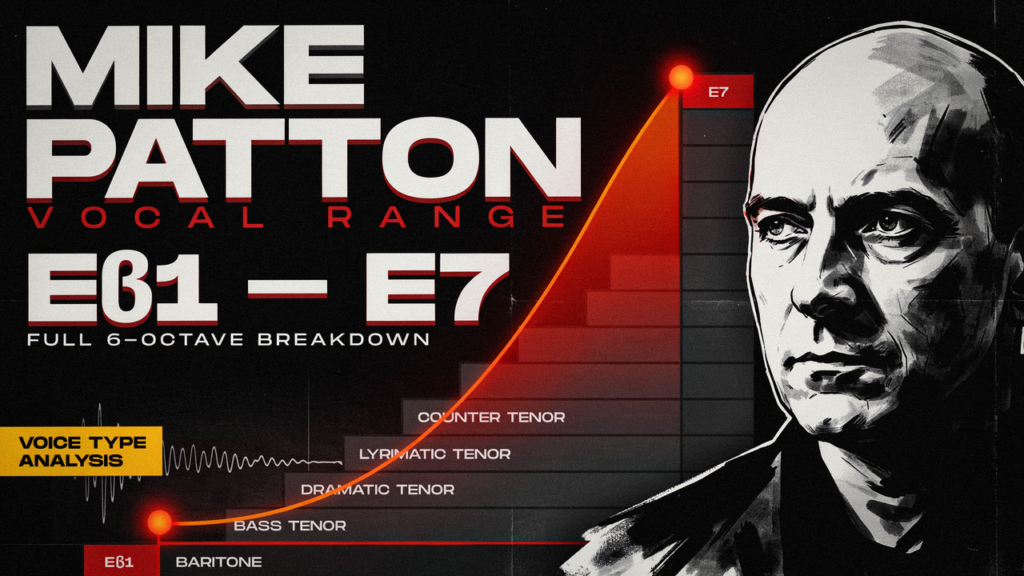
Mike Patton’s Vocal Range
Mike Patton’s vocal range is commonly cited as approximately: E♭1 – E7
That’s over six octaves, which puts him among the widest vocal ranges ever recorded in contemporary music.
But the way he uses this range is more impressive than the number itself.
He doesn’t just have range — he has range in every direction, across genres most singers wouldn’t dare to attempt.
My Personal Journey Into Patton’s Vocal Range
The first time I tried to map Patton’s vocal range, I hit a wall — fast.
Not because he couldn’t hit notes, but because he hit too many, in too many different ways.
A few of the problems I ran into:
1. His lowest notes sometimes sound unreal
While analyzing Mr. Bungle live clips, I found moments where he dropped into subharmonic growls so low that I had to double-check whether the mic was glitching.
Spoiler: it wasn’t.
2. His highest notes aren’t always sung traditionally
Patton uses techniques like reinforced falsetto, whistle-adjacent tones, and experimental screeching.
So deciding what “counts” as his highest note took some digging.
3. He switches techniques so fast it’s hard to track
In the span of ten seconds, he might use:
- chest voice
- head voice
- falsetto
- fry
- guttural growls
- spoken tone
- overtone-like harmonic effects
Trying to categorize this is like trying to label a tornado.
But after a lot of careful analysis, the picture finally became clear.
Mike Patton’s Vocal Range Breakdown (With Real Notes & Examples)
1. Lowest Notes: E♭1 and Below (Subharmonic Territory)
This is where things get wild.
On several tracks and live moments, Patton uses vocal fry and subharmonics to produce notes around E♭1 — sometimes even lower.
Examples:
- Mr. Bungle – live growls
- Fantômas – extreme low passages
These lows are not typical “sung” notes.
They’re produced using vocal fry and subharmonic resonance, which create very low frequencies.
When I first heard these, I genuinely thought:
“Is that even him? Or is this an instrument?”
Nope — it was Patton.
2. Mid-Range: The Chameleon Zone (Where He Sounds Human… Sometimes)
Patton’s mid-range is bafflingly versatile. He can sound like:
- a pop-rock tenor (Faith No More)
- a moody baritone (Tomahawk)
- a crooner (solo jazz projects)
- a character actor (his voice-over work)
Examples:
- Faith No More – “Evidence”
- Faith No More – “Epic”
- Tomahawk – “You Can’t Win”
This is the range where I kept forgetting I was analyzing a single vocalist.
His natural voice sits somewhere between baritone and tenor, but he shapes his tone so much that labels barely apply.
3. Upper Range: Up to E7 (Head Voice, Falsetto, Whistle-Adjacent Screams)
This is where Patton jumps into territory most male singers will never experience.
Examples:
- Fantômas – “Page 26”
- Mr. Bungle – “Goodbye Sober Day”
- Faith No More – “Cuckoo for Caca”
He uses:
- reinforced falsetto
- operatic head voice
- whistle-like experimental tones
- high screams with rhythmic precision
Some of these notes border on whistle register, though not in the traditional Mariah Carey sense — more like controlled, pitched shrieks.
When I tried to replicate one of his E6 screams…
Let’s just say I learned my limits very quickly.
Is Mike Patton the Singer With the Widest Vocal Range?
This is one of the biggest debates online.
The truth: Patton does have one of the widest recorded vocal ranges — often cited as 6+ octaves.
But:
- Some of his lowest notes are produced using fry/subharmonics
- Some of his highest tones come from experimental screams
- “Singing range” vs “sound-production range” are not the same
Still, even if we only count his clean sung notes, he remains one of the most versatile vocalists ever recorded.
What Makes Mike Patton’s Voice So Extraordinary?
1. He can switch styles instantly
Opera → death metal → pop → cartoon voices → jazz → noise → whispering
No one flips techniques as fast or as fearlessly.
2. He uses every part of the human voice
Chest, head, falsetto, fry, growls, multiphonics — he explores the entire palette.
3. He blends technique with chaos
Patton has the classical control…
but also the willingness to embrace raw, unpolished sound.
4. He uses his voice as a full instrument, not just a singer’s tool
This is what sets him apart from nearly every vocalist in rock and metal.
5. His artistic choices overpower his technical ones
He never uses range to brag.
He uses it to serve the creative moment.
Best Songs to Understand Mike Patton’s Range
Low Range
- Mr. Bungle – “My Ass Is on Fire”
- Fantômas – deep growls and fry passages
Mid-Range
- Faith No More – “Evidence”
- Tomahawk – “You Can’t Win”
High Range
- Mr. Bungle – “Goodbye Sober Day”
- Fantômas – multiple songs hitting whistle-like tones
- Faith No More – “Cuckoo for Caca”
If you want to hear the full chaos, dive into Fantômas.
Trust me — your jaw will drop.
How Mike Patton Achieves Such a Huge Range
Based on studying his technique, Patton relies on:
- exceptional breath support
- unconventional vocal training
- mastery of fry and false-cord techniques
- natural flexibility
- fearless experimentation
- no genre limitations
- highly active soft palate and extreme resonance control
The biggest lesson I learned from analyzing him?
Patton’s voice is not limited by tradition — it’s driven by curiosity.
Compare Your Vocal Range to Mike Patton’s
If you want to see how your voice stacks up against Patton’s monstrous E♭1–E7 range, try the Vocal Range Test on your site.
It’s humbling… but also really fun to compare yourself to someone who practically defies biology.
FAQ
What is Mike Patton’s vocal range?
Approximately E♭1 – E7, over six octaves.
Does Mike Patton hold a vocal range record?
He is frequently cited as having one of the widest ranges ever recorded.
Are his extreme highs and lows “real” singing?
They’re produced using advanced techniques such as fry and subharmonics. They are legitimate vocal sounds, but not classical singing.
Is Patton a tenor or baritone?
His natural voice sits between baritone and tenor, but he transcends typical classifications.
Can you train to sing like Mike Patton?
Some elements, yes. But his versatility comes from decades of experimentation and natural talent.
- Learn how how to do whistle voice can help access extreme high notes safely.
- Strengthen your low notes with tips to extend your lower vocal range.
- Compare his abilities with other singers in who has the largest vocal range.
- Maintain vocal health through vocal health tips for singers.
- Build stamina with daily exercises to increase vocal stamina.
- Understand different voice classifications in vocal fach system explained for beginners.
Erika Parker is a vocal analysis and singing education writer at Vocal Range Test. She focuses on vocal range testing, voice type analysis, pitch recognition, and singing tools for vocalists, musicians, choir singers, and beginners.