
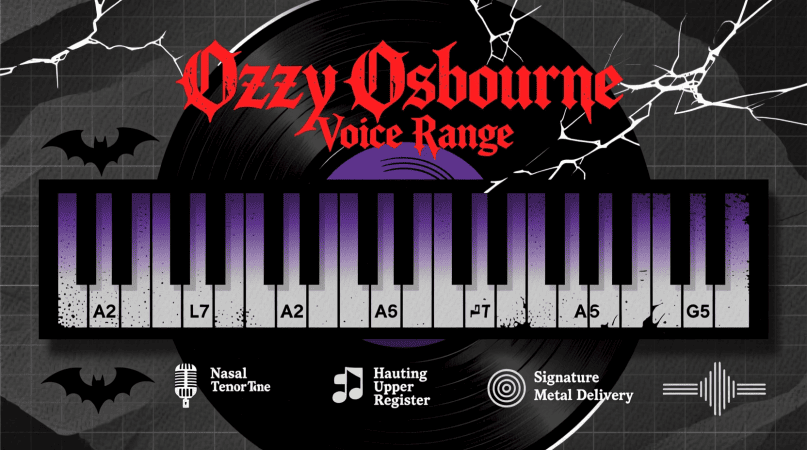
Ozzy Osbourne is best understood as a distinctive metal vocalist with a bright, nasal, haunting tone that cuts through heavy guitars. His exact vocal range has not been officially published in a verified technical source, so specific note claims should be treated as listener-based estimates rather than confirmed measurements.
Ozzy’s voice is not famous because it is the widest or most technically polished in rock. It is famous because it is instantly recognizable. From Black Sabbath’s darker songs to his solo anthems, his tone creates tension, drama, and vulnerability in a way few metal singers can copy.
Quick Answer: What Is Ozzy Osbourne’s Vocal Range?
Online vocal range discussions often describe Ozzy as having a baritone-centered voice with higher, nasal rock extensions. The exact notes vary by source and performance era, so it is safer to focus on his functional style: a midrange-heavy voice with a bright placement that makes notes sound more piercing than their pitch alone suggests.
| Category | Best practical answer |
|---|---|
| Commonly cited range | Often estimated around a multi-octave span, but exact note limits are not officially verified |
| Likely voice type | Baritone / high baritone in rock and metal context |
| Signature sound | Nasal placement, eerie tone, simple melodic shapes, strong identity |
| Best listening examples | “Paranoid,” “War Pigs,” “Iron Man,” “Crazy Train,” and “Mama, I’m Coming Home” |
If you want to compare your voice with his, check your own vocal range first, then use a vocal range finder to separate comfortable notes from one-off extremes.
What Voice Type Is Ozzy Osbourne?
Ozzy is usually best described as a baritone or high baritone in a rock context. His voice has a lower male foundation, but the forward, nasal placement makes it sound brighter and more cutting than a dark traditional baritone.
That is why some listeners may assume he is a tenor. In reality, rock voice type is shaped by tone, microphone use, song keys, and production. A voice type test can help singers learn categories, but Ozzy’s identity is more about timbre than classical classification.
Why Ozzy’s Voice Sounds Nasal
Ozzy’s tone often feels narrow, forward, and metallic. That nasal quality helps his voice sit above heavy guitar riffs without needing operatic volume. It also gives his melodies an eerie quality that became central to Black Sabbath’s sound.
Nasal tone is not automatically bad. In Ozzy’s case, it is part of the character. The danger for singers is forcing the sound by squeezing the throat or pinching the nose. A healthy bright tone should still feel free enough to sing repeatedly.
Chest Voice, Head Voice, and Bright Placement
Ozzy’s singing often stays in a direct, speech-like zone, but his brightness changes how the range feels. He does not usually sound like a dramatic high belter. Instead, he uses a focused tone that makes simple melodies feel intense.
To understand the difference between weight and brightness, compare chest voice vs head voice. If you are a lower male singer, the baritone vs bass guide can also help you understand why a baritone can still sound sharp and cutting in rock.
Best Songs for Hearing Ozzy Osbourne’s Vocal Style
- “Paranoid”: shows his direct, urgent rock delivery over fast, tight riffs.
- “War Pigs”: highlights his eerie tone and long, chant-like melodic lines.
- “Iron Man”: shows how his voice can sound ominous without complex runs.
- “Crazy Train”: captures his solo-era brightness and hook-focused phrasing.
- “Mama, I’m Coming Home”: reveals a softer, more melodic side of his voice.
These songs show that Ozzy’s range is only part of the story. His strongest quality is vocal identity: listeners know it is him almost immediately.
How His Voice Changed Over Time
Ozzy’s voice changed across decades of Black Sabbath, solo albums, touring, and age. Early recordings often sound rawer and more youthful. Later recordings can sound more produced, steadier in some places, and different in tone because of age, arrangement, and studio choices.
This is normal for long careers. Range, stamina, and tone all shift over time. For singers, it is a reminder that vocal health matters more than chasing one old studio take forever.
Can You Sing Like Ozzy Osbourne?
You can study parts of his style: clear melodic shapes, forward tone, dramatic simplicity, and strong identity. But you should not force a nasal sound or try to imitate strain. Start with a clean version of the phrase, then add brightness carefully.
If you want to sing higher rock phrases, learn how to sing high notes without straining. If your throat tightens, reduce volume and simplify the vowel.
Ozzy Compared With Other Metal Singers
Ozzy’s voice is very different from more aggressive metal vocalists. Compared with David Draiman’s vocal range, Ozzy sounds less percussive and more eerie. Compared with Geddy Lee’s vocal range, Ozzy’s tone is darker and less high-tenor focused.
That contrast is useful. Metal vocals do not all need the same kind of range. Sometimes the most memorable voice is the one with the strongest character.
Why Exact Note Claims Can Be Misleading
Ozzy’s pitch can be hard to analyze because nasal placement, production, double-tracking, and live variation can make notes sound higher or lower than they are. Fan charts may include studio effects, backing vocals, or one-off live moments.
A better framework is:
- Core singing zone: the midrange where his tone is most recognizable.
- Upper stylistic moments: brighter rock phrases that cut through the band.
- Estimated extremes: listener-identified notes that are not official measurements.
Vocal Health Note for Ozzy-Style Singing
Ozzy’s tone is distinctive, but forcing nasal pressure or throat tension is not a safe shortcut. Warm up first, keep the sound easy, and stop if you feel pain, scratchiness, or lasting hoarseness.
For sustainable practice, follow basic vocal health for singers habits: hydration, rest, warm-ups, and smart recovery.
Ozzy Osbourne Vocal Range FAQs
What is Ozzy Osbourne’s vocal range?
Ozzy Osbourne’s exact vocal range has not been officially verified. Online estimates often describe a multi-octave range, but those numbers should be treated as listener-based estimates.
What voice type is Ozzy Osbourne?
He is best described as a baritone or high baritone in a rock and metal context. His nasal placement makes the voice sound brighter than many baritones.
Why does Ozzy Osbourne sound so nasal?
His tone uses a very forward placement that helps the voice cut through heavy guitars. That nasal quality is a major part of his signature sound.
Is Ozzy Osbourne a technically perfect singer?
Technical perfection is not the point of his appeal. His strength is identity, mood, phrasing, and the way his voice fits dark heavy music.
Can beginners sing Ozzy songs?
Some Ozzy songs are approachable melodically, but beginners should avoid forcing nasal tone or tension. Start in a comfortable key and keep the sound clean first.
Final Takeaway
Ozzy Osbourne’s vocal range is best understood as a baritone-centered rock voice with a bright, nasal, unforgettable tone. Exact note claims should stay in the estimated category, but his impact is obvious: he proved that a voice does not need to be conventionally polished to become one of heavy metal’s most iconic sounds.
Erika Parker is a vocal analysis and singing education writer at Vocal Range Test. She focuses on vocal range testing, voice type analysis, pitch recognition, and singing tools for vocalists, musicians, choir singers, and beginners.