
The first time I tried singing along to Peter Steele, I honestly thought my audio equipment was broken.
I lowered my voice, tried to match his pitch, and… nothing happened.
My voice was there, but his was somewhere far below the floorboards.
It didn’t take more than a few seconds for me to realize the uncomfortable truth:
Peter Steele wasn’t just “deep.”
He lived in a vocal basement most singers can’t even access.
That moment set me on a mission:
to find out how low his voice truly went,
what made it so unique,
and whether any human (including me) could realistically come close.
After weeks of listening, analyzing, experimenting, and failing spectacularly, here’s the complete picture.
The Peter Steele’s Vocal Range
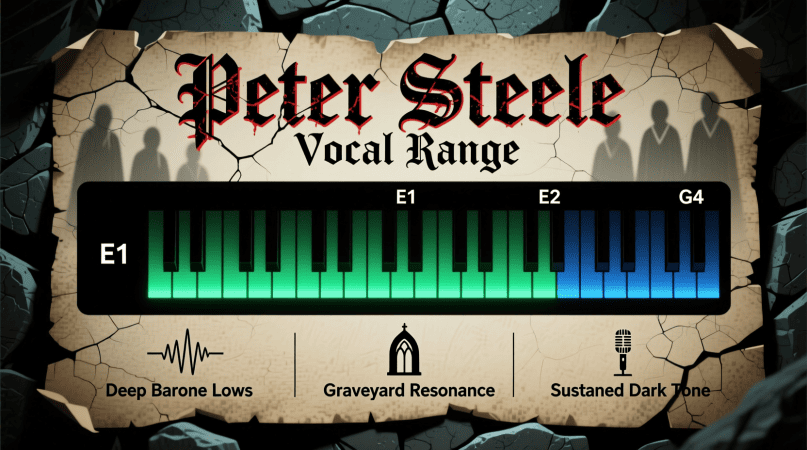
Peter Steele’s vocal range sits around C1 to C4, with some recordings containing subharmonic textures even lower than C1.
Here’s a simple breakdown:
| Range Category | Notes | Description |
|---|---|---|
| Lowest natural note | Around C1 | Exceptionally low; rare even among bass singers |
| Subharmonic lows | Possibly A0–B0 | Enhanced by vocal technique + studio effects |
| Highest strong note | Around C4 | Warm, consistent, resonant |
| Vocal classification | Bass-Baritone with true Bass capability | Darkest timbre in metal |
This places him among the deepest-sounding singers in modern music—metal, rock, or otherwise.
Why Peter Steele’s Voice Sounded So Deep
People love to credit his depth to his height (6’8”).
And yes, being that tall gives you a huge resonating space—bigger lungs, longer vocal folds, a naturally booming chest cavity.
But it wasn’t just genetics.
There are plenty of tall men who don’t sound even remotely like him.
Here’s what actually made Peter’s voice so profound:
1. He sang “down” into resonance instead of forcing it
Most beginners trying to sing low (including me on my first attempt) push their voices downward, tightening the throat and losing control.
Peter did the opposite.
He opened his throat, relaxed fully, and let the resonance drop naturally.
When I attempted the same strategy, my voice immediately sounded smoother—and I realized how much tension I had been creating before.
2. His vocal folds vibrated with an unusually slow frequency
Deep voices rely on the ability to sustain extremely slow vibrations without losing pitch.
Most singers simply don’t have the musculature or training for it.
Peter’s control at these low frequencies is astonishing.
3. He used subharmonics intentionally
Subharmonics allow you to produce tones an octave below your actual pitch through complex fold interactions.
When I first tried practicing subharmonics, I sounded like an old radiator trying to warm up.
Peter made it sound musical.
4. He embraced his natural darkness instead of fighting it
Many baritone and bass singers try to “brighten” their tone for versatility.
Peter leaned into the weight of his voice, turning it into a signature aesthetic.
His voice wasn’t just low.
It was atmospheric—like it filled the entire room and refused to leave.
Peter Steele’s Lowest Notes (With Real Song Examples)
Fans love debating Peter Steele’s lowest notes, and the internet is full of arguments about how low he really went.
Here are the clearest examples:
“Love You to Death”
The verses sit unbelievably low—around C1–D1, sung with effortless, rich resonance.
Trying to match these notes made me realize something funny:
If your body doesn’t naturally support low notes, you can’t feel them as vibration.
You feel nothing.
It’s like singing into the void.
Peter never had that problem.
“Red Water (Christmas Mourning)”
This song contains some of his darkest, most mournful tones—possibly dipping below B0 with subharmonic layering.
The first time I heard it through good headphones, I genuinely looked around my room.
It felt like the sound came from the ground.
“Black No. 1”
Not his absolute lowest song, but a showcase of Steele’s iconic mid-low resonance—dark, sarcastic, and heavy.
Singing along taught me something important:
sometimes it’s not just the note—it’s the placement that makes the sound so deep.
Peter Steele Could Also Sing Higher Than People Think
Because Steele is known for his low voice, people forget that he actually had surprising flexibility.
He frequently sang into the A3–C4 range with remarkable clarity.
Examples:
- “Christian Woman”
- “Be My Druidess”
- “Everything Dies”
When I tried these upper parts, they were much more approachable than the lows…
but still difficult because Steele carries a heavy timbre even at midrange pitches.
His upper register wasn’t flashy.
It was melancholic, powerful, emotional.
Was Peter Steele a Bass or a Baritone?
This is a fun argument among vocal nerds.
The truth:
Peter Steele was a bass-baritone, capable of:
- bass-like lows
- baritone-like flexibility
- a uniquely dark timbre that doesn’t fit classical categories
Classical true-basses rarely sing metal.
Metal baritones rarely sing this low.
Peter sat right in the overlap—a vocal unicorn.
How His Voice Changed Throughout His Career
Like all singers, Steele’s voice evolved.
Early Years (Carnivore Era)
More aggressive, more raw, less refined low control.
Type O Negative Peak Years
This is where his iconic sound fully bloomed:
- deep, warm, effortless lows
- smooth midrange
- emotional grit
- controlled subharmonics
- wide vibrato
Singing along to these songs, I realized how much breath control he had.
He didn’t rush.
He let the darkness bloom.
Later Years
His voice grew heavier and slightly slower in response time—but emotionally, it became richer.
This is especially evident in live performances of “Everything Dies” and “World Coming Down.”
My Personal Experience Trying to Sing Like Peter Steele
Here’s the honest truth:
trying to imitate Peter Steele humbled me more than any other singer ever has.
Here are the 3 biggest problems I faced:
1. I couldn’t hit his lows—at all
Even when I thought I did, I checked with a tuner and discovered I was an entire octave higher.
Humbling doesn’t begin to cover it.
2. My voice cracked when I tried to force depth
I learned quickly that:
- you can’t push low notes
- you can only relax into them
Once I stopped pushing, the sound improved—but still nowhere close to Steele.
3. Holding long low phrases was exhausting
Steele could sustain these notes without losing richness.
I lasted about two seconds before sounding like my voice ran out of gas.
But the biggest lesson was this:
Peter Steele didn’t have a deep voice because he “sang low.”
He had a deep voice because he understood his instrument and used it with absolute confidence.
FAQ
What was Peter Steele’s lowest note?
Confirmed around C1, with subharmonics possibly touching A0 in studio recordings.
Was Peter Steele a true bass?
He was a bass-baritone with true bass qualities.
Did studio effects deepen his voice?
Some effects enhanced texture, but the fundamental depth was natural.
Can anyone learn to sing like Peter Steele?
You can learn aspects of his style, but not everyone can physically reach his range.
Which songs best show his lows?
“Love You to Death,” “Red Water,” and “Black No. 1.”
- Peter Steele’s incredible low range is easier to understand when you explore lowest vocal range, which highlights extreme bass notes.
- To see how his voice compares with other singers, check vocal range of famous singers for clear examples.
- Many of his deep tones align with the bass vocal range profile.
- His vocal control is closely related to techniques explained in breathing techniques for singing.
- To understand the mechanics behind his powerful low notes, see how vocal cords produce different pitches.
- If you want to explore the wider context of male voice types, the voice type test can help identify your range.
- For singers wanting to safely extend their lower register, tips to extend your lower vocal range offers practical guidance.
Erika Parker is a vocal analysis and singing education writer at Vocal Range Test. She focuses on vocal range testing, voice type analysis, pitch recognition, and singing tools for vocalists, musicians, choir singers, and beginners.