
The first time I tried singing a Rachel Zegler song, I completely underestimated her.
I thought, “She’s young, she sings musical theatre… I can follow along.”
So I chose her cover of “Shallow” — the beautiful, stripped-down version she posted online.
I hit the first few lines just fine, but then we got to that soaring chorus.
I went for the high notes, and my voice bailed on me like a friend who remembered they had “plans” at the last minute.
My voice cracked, flipped, and vanished.
Meanwhile, Zegler floated through the line like she was born on a cloud.
That’s when I realized:
Rachel Zegler doesn’t just sing — she flies vocally.
In this article, I’ll break down her vocal range, her highest and lowest notes, and the technical magic behind her voice — with all the tiny humiliations I encountered while trying to imitate her.
Rachel Zegler’s Vocal Range
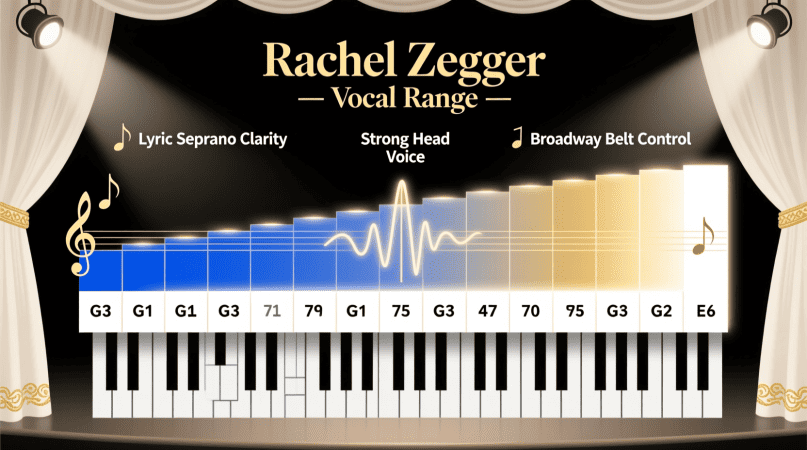
Rachel Zegler’s vocal range spans approximately: A2 – E6
(about 3.5 octaves)
She is best classified as a lyric soprano with legit (classical musical theatre) tendencies and a strong, expressive mix.
Here’s the simplified chart:
| Register | Range | Description |
|---|---|---|
| Lowest notes | A2–B2 | Rare for sopranos, warm and surprisingly stable |
| Chest/mix | C4–G5 | Strong, emotional, Broadway-ready |
| Head voice | A5–E6 | Pure, bell-like clarity |
| Vocal type | Lyric soprano | Flexible, bright, youthful yet powerful |
But the range number alone doesn’t explain why she sounds so extraordinary.
Why Rachel Zegler’s Voice Sounds So Magical
Rachel Zegler isn’t just talented.
She’s trained — and she has that rare combination of natural tone + classical discipline + modern expressiveness.
Here’s what makes her voice so special:
1. Her head voice is unbelievably clean
Most singers her age either:
- have breathy head voices, or
- push too hard to sound powerful
But Rachel?
Her head voice is clear and ringing — almost Julie Andrews-like, but warmer.
When I tried matching her high notes from “Tonight” in West Side Story, I discovered quickly that mine sounded airy and unstable.
Hers stayed focused and shimmering.
2. She transitions between registers without a “break”
Many singers have a noticeable crack between chest and head voice.
Rachel blends them so seamlessly that you barely hear the shift.
I tried singing “I Feel Pretty” along with her film version.
My voice flipped like it hit a pothole.
She sounded like she was gliding on perfectly paved road.
3. She has classical placement but modern emotional delivery
Her vocal placement is very “legit” — lifted soft palate, forward resonance, tall vowels — but she mixes it with modern musical theatre storytelling.
That’s why she can perform:
- delicate head voice
- bright belts
- controlled vibrato
- emotional dynamics
all inside one phrase.
4. Her vibrato is natural, not forced
Some singers vibrate like a sewing machine.
Some have vibrato so wide it sounds like a siren.
Rachel’s is subtle and elegant — the kind that comes from good breath support, not throat tension.
Rachel Zegler’s Highest Notes (With Song Examples)
These are some of her most impressive high-range moments: E6 — “Grown-Up Christmas List” (cover)
A gorgeous, floating E6 in pure head voice — crystal clear.
Trying this note myself was a reminder that humans were not meant to fly unaided.
C6–D6 — “Tonight” (West Side Story)
Her high notes here are shockingly easy and delicate — exactly what Maria requires.
B5–C6 — “The Balcony Scene”
Light, soft, angelic — and technically flawless.
Belting A4–C5 consistently
Her mix is extremely well-supported, never shouty.
When I tried belting along with “Shallow,” I realized how much control she has in her mid-upper range.
Mine felt like it was held together with duct tape.
Click here to start your vocal assessment.
Rachel Zegler’s Lower Register: Warm, Rare, and Underappreciated
Most sopranos struggle with lows.
Rachel does not.
Her A2–C3 range is warm, steady, and expressive.
Examples:
- Her “Shallow” cover (low verses)
- Early YouTube videos (“The Christmas Song,” etc.)
- “What I Was Made For?” cover — beautiful low phrasing
I tried singing those same low lines and learned something embarrassing:
her lows are more stable than mine — and I’m not even a soprano.
How she maintains that warmth at the bottom of her range is genuinely impressive.
How Rachel Zegler Sings in West Side Story (Technique Breakdown)
Spielberg’s West Side Story required Zegler to use:
1. Legit soprano placement
Raised soft palate, bright vowels, lifted larynx — classic musical theatre.
2. Perfect vibrato control
Not too wide, not too fast — pure, clear, emotionally timed.
3. Smooth register blending
Maria’s music requires constant transitions between:
- chest
- mix
- head
Zegler moves between them like she’s shifting gears on a luxury car.
4. Lyric soprano color
Her tone is youthful but not thin.
Full but not heavy.
It has that “Maria innocence” built in.
This is harder than belting pop songs.
It requires micro-level control.
I tried singing her part in “Somewhere,” and my breath control vanished halfway through the phrase.
Her phrasing is long and sustained — you need Olympic-level breath support.
How Her Voice Has Evolved Since Her Early YouTube Days
This is one of the most exciting parts about Rachel Zegler’s voice — it’s still growing.
Early Teen Years
Her voice was bright, sweet, and agile but not yet fully supported.
West Side Story Era (18–20 years old)
Huge leap in control, classical sophistication, and emotional nuance.
Current Voice
Her tone is getting warmer, richer, and more grounded — closer to a mature lyric soprano.
If she continues training (and she is), her voice will likely expand further, especially in the mix and mid-belt range.
Rachel Zegler Compared to Other Singers
| Singer | Type | Strength |
|---|---|---|
| Rachel Zegler | Lyric soprano | Head voice purity + classical placement |
| Julie Andrews | Soprano | Crystal tone + legit technique |
| Lea Salonga | Soprano | Precision + storytelling |
| Ariana Grande | Light lyric soprano | Agility + whistle register |
| Idina Menzel | Mezzo-soprano | Power belting |
Zegler fits closest to Lea Salonga and Julie Andrews — but with a modern edge.
My Honest Experience Trying to Sing Like Rachel Zegler
Here’s what happened during my attempt:
1. My low notes sounded weaker than hers
Zegler’s lows are surprisingly resonant for a soprano.
Mine? Not so much.
2. My chest-to-head transition cracked
She flips registers flawlessly.
I flipped like someone learning to drive manual for the first time.
3. My vibrato was nowhere near as tidy
Her vibrato is controlled.
Mine, when I tried copying her phrasing, wobbled like a loose ceiling fan.
4. Her breath control outclasses almost everyone
Some of her long sustained notes left me breathless — literally.
Trying to sing like Zegler made me appreciate how deceptively hard her technique is.
FAQ
What is Rachel Zegler’s vocal range?
Approximately A2 to E6.
Is Rachel Zegler a soprano?
Yes — she is a lyric soprano with legit musical theatre tendencies.
What is her highest note?
Documented around E6 in head voice.
Can she belt?
Yes — with a controlled, emotional mix.
Does she use whistle register?
No — her highest notes are head voice, not whistle.
- Rachel Zegler’s impressive soprano range is easier to understand when you explore soprano vocal range, which explains typical pitch boundaries for sopranos.
- Her ability to sustain high notes connects closely with the techniques explained in how to sing high notes without straining.
- Many of her mid-to-upper register passages align with the mezzo soprano vocal range profile.
- To compare her vocal flexibility with other famous performers, check vocal range of famous singers.
- Her comfortable singing zone fits the concept described in what is tessitura in singing.
- If you want to choose songs suited to a similar soprano style, how to find songs that fit your vocal range offers practical guidance.
- To understand how she produces precise pitch across her range, see how vocal cords produce different pitches.
Erika Parker is a vocal analysis and singing education writer at Vocal Range Test. She focuses on vocal range testing, voice type analysis, pitch recognition, and singing tools for vocalists, musicians, choir singers, and beginners.