
The first time I tried to sing like Ronnie Radke, I underestimated him.
Badly.
I thought: I can hit some high notes. I can scream a little. I’ve rapped before. I can totally handle a Falling in Reverse song.
So I chose “Losing My Life.”
That was the moment I discovered my lung capacity is about half of what I thought it was, my screams were nowhere near safe, and my vocal cords do not negotiate under pressure.
By the time I hit the first big mixed-note run, my voice cracked like bubble wrap.
And the scream?
Let’s just say it sounded like a wounded squirrel trying to start a motorcycle.
What Ronnie Radke does vocally is not casual, lucky, or purely emotional.
It is technical, controlled, athletic, disciplined, and fueled by an intensity few vocalists possess.
Let’s break down his true vocal range, what makes his singing so distinctive, and the surprising challenges I faced trying to imitate him.
Ronnie Radke’s Vocal Range
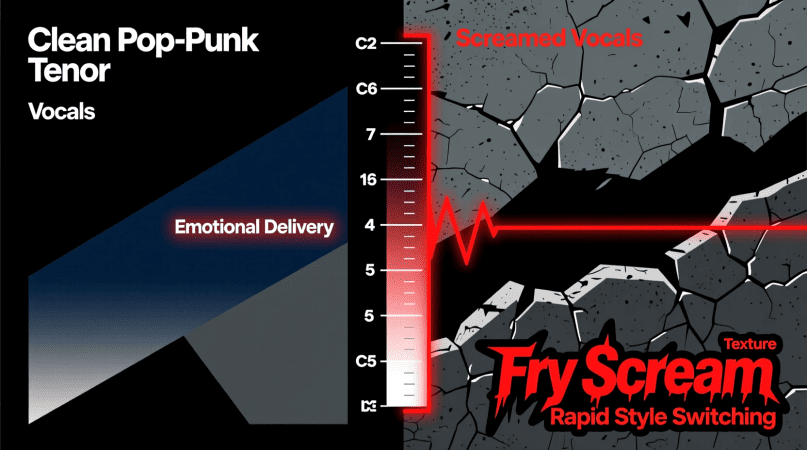
Ronnie Radke’s vocal range spans approximately: C3 – C6 (clean + head voice)
with fry screams extending above C6 into whistle-like distortion territory.
This range covers:
- warm low baritone notes
- emotional tenor-like mids
- piercing mixed belts
- strong falsetto
- high-intensity screams
His Full Range by Register
| Register | Notes | Description |
|---|---|---|
| Low end | C3–F3 | Rich, steady, surprisingly warm |
| Lower mid-range | G3–C4 | Rap phrasing, spoken tones |
| Upper mid-range | C4–G4 | Emotional storytelling zone |
| Mixed voice belts | G4–C5 | Bright, powerful, compressed |
| Head voice/falsetto | C5–C6 | Used for dramatic lifts and haunting lines |
| Screams (fry/false cord) | Above C6 | Distorted upper harmonics |
Ronnie Radke’s range is not just wide — it’s multidimensional.
Identify the key of any song quickly with the Song Key Finder, which helps you stay in tune while practicing. Pair it with the Ear Training Game to improve note recognition, warm up with the Quick Warm-Up Routine, and track vocal ability using the Vocal Range Test.
Why Ronnie Radke’s Voice Is So Unique (The Real Technical Breakdown)
Ronnie Radke’s vocal identity revolves around contrast — between beauty and aggression, softness and rage, melody and chaos.
Here’s what makes his voice stand out:
1. His voice holds emotional tension — even when he’s quiet
Some singers sound emotional because of lyrics.
Ronnie sounds emotional because of tone.
His voice carries:
- strain (intentional)
- pain
- sharp edges
- vulnerability
- urgency
Even his softest lines sound like they were ripped out of a diary written at 3 AM.
Trying to imitate this emotional tension made my voice tighten in the wrong way. Ronnie tightens only where it creates expression — never where it restricts technique.
2. His high belts use advanced mix-voice mechanics
Ronnie’s belts sound raw and powerful, but they’re incredibly controlled.
He uses:
- high laryngeal tilt for brightness
- solid diaphragm compression for power
- mask resonance for cutting edge
- narrowed vowels for stability
- twang to reduce strain
This is the same technique theatrical tenors use — but Radke wraps it in grit and emotion.
When I tried his C5 mixed belt, I pushed too hard from the throat and immediately felt strain.
Radke? He does it while pacing across the stage.
3. His screams are mostly fry-based, not throat-based
This is the biggest misconception about Ronnie.
His screams are:
- airy
- distorted
- pitched
- controlled
This means:
- he’s not shredding his vocal cords
- he’s using proper airflow
- the distortion comes from loose folds, not tight ones
When I attempted fry screaming, I realized how precise the breath control must be.
Ronnie makes chaos sound like art.
4. His rap sections require unreal breath management
Rapping seems easy until you try switching from rap → scream → high belt in the same measure.
Ronnie does this constantly:
- “Losing My Mind”
- “Popular Monster”
- “Voices in My Head”
When I tried, I ran out of breath before finishing even one line cleanly.
He uses micro-breaths — tiny sips of air — without losing flow.
5. His falsetto and head voice carry emotional fragility
Radke uses falsetto as a storytelling tool.
Songs like:
- “The Drug In Me Is Reimagined”
- “Fuck You and All Your Friends”
…showcase soft, vulnerable, tremble-infused falsetto moments that contrast his aggressive screams.
His falsetto isn’t angelic — it’s haunted.
Trying to replicate that tremble without losing pitch? Very hard.
Ronnie Radke’s Highest Notes
C6 — “Losing My Life” (Live ad-libs and head-voice screams)
Clean, piercing, shockingly accurate.
B5–C6 — Fry scream peaks (“Popular Monster,” “Zombified”)
These feel like an explosion detonating perfectly on pitch.
C5 — Mixed vocal belt (“Voices in My Head”)
Sharp, bright, emotionally charged.
G4–A4 — Emotional belts (“The Drug In Me Is Reimagined”)
These sound effortless — they are not.
When I tried these, I felt like I was climbing a cliff with no safety rope.
Radke hits them like he’s jumping between rooftops in parkour videos.
Ronnie Radke’s Lowest Notes (Surprisingly Strong)
Radke’s lows are underrated:
C3 — “Brother” (soft, warm, emotional)
A beautifully resonant low note.
D3–E3 — Spoken sections (“Losing My Mind”)
Smooth, controlled, deep.
Trying to imitate his lows taught me a painful truth:
you can’t force depth — you have to relax into it.
Radke does this instinctively.
How Ronnie Radke Actually Sings (Clean → Mix → Scream → Rap)
Ronnie’s technique is structured like this:
CLEAN SINGING
- forward placement
- slight nasal ring
- breath-managed airflow
- emotional rasp
- strong shaping of vowels
MIXED VOICE
His superpower.
- blends chest + head
- allows C5 belts without shouting
- creates his signature “aggressive high” sound
FALSETTO
- used sparingly
- adds vulnerability
- often appears after emotional lyrics
FRY SCREAM
- low airflow
- relaxed folds
- high distortion
- controlled pitch
FALSE CORD
Used for heavy breakdowns only.
RAP
- rhythmic precision
- strong diction
- breath efficiency
- emotional punch
This combination is why Radke feels like five vocalists at once.
Ronnie Radke’s Vocal Evolution Across His Career
Escape The Fate Era (2005–2008) — Raw and emotional
Potential was huge, but technique was unrefined.
Early Falling In Reverse (2011–2014) — Developing control
He began using a cleaner mix and better scream technique.
Middle Era (2015–2019) — Genre fusion mastery
He blended rap, rock, melody, and metal flawlessly.
Modern Era (2020–2024) — Peak power + peak control
Radke today is vocally stronger than ever:
- higher consistency
- cleaner screams
- more emotional nuance
- better breath control
Very few rock vocalists improve this dramatically over time — Radke is one of them.
Ronnie Radke Compared to Other Modern Vocalists
| Vocalist | Range | Specialty | Difference |
|---|---|---|---|
| Ronnie Radke | C3–C6 | Multi-genre, mix, scream | Most versatile |
| Kellin Quinn | D3–E6 | Angelic high tenor | More melodic, less heavy |
| Oliver Sykes | G2–C6 | Screams | Less clean versatility |
| Andy Biersack | B2–A4 | Baritone power | Less range |
| Corey Taylor | C2–G5 | All-arounder | Deeper lows, fewer rap elements |
Radke stands out because he effortlessly crosses genre boundaries.
Explore your voice type with our online vocal range calculator.
My Personal Experience Trying to Sing Like Ronnie Radke
Let me be brutally honest about how this went:
1. The breathing nearly killed me
Switching between rap → belt → scream is like sprinting, jumping, and lifting all in one move.
2. My screams shredded instantly
Not because screaming is “dangerous,” but because I did it WRONG.
Ronnie does it right — fry scream, relaxed, airflow-based.
3. His belts require more control than volume
I pushed.
Ronnie compresses.
4. The emotion is impossible to fake
His voice carries pain, anger, love, survival, defiance.
I sounded like I was doing a vocal exercise.
5. His stamina humbled me
One chorus wore me out.
He performs full sets like this.
Trying to imitate Ronnie Radke taught me that he’s not “just a screamer” or “just an emo singer.”
He’s a trained athlete of emotion.
FAQ
What is Ronnie Radke’s vocal range?
Approximately C3 – C6, with screams extending higher.
What scream type does he use?
Mainly fry screams, occasionally false cord.
Is Ronnie Radke a tenor?
He is a baritone with an extended tenor-like mixed range.
How does he switch styles so fast?
Exceptional breath control + precise technique + emotional instinct.
Is Ronnie Radke vocally trained?
Self-developed with years of refinement.
- Ronnie Radke’s mix of clean melodies and aggressive screams is easier to evaluate using the vocal range testing platform designed for singers.
- To see how wide your own voice really is, you can map out your singing range with an interactive analyzer.
- His natural placement between tenor and baritone fits the profile explained in the tenor vs baritone breakdown.
- Many of his highest clean notes approach the limits shown on the widest vocal range reference page.
- You can also find out how many octaves you personally span by using the octave span test.
- To understand the pitch accuracy behind his vocals, the voice frequency analyzer reveals the exact note data.
- If his evolution inspires you to expand your own sound, this vocal range improvement plan provides a structured training path.
Erika Parker is a vocal analysis and singing education writer at Vocal Range Test. She focuses on vocal range testing, voice type analysis, pitch recognition, and singing tools for vocalists, musicians, choir singers, and beginners.