
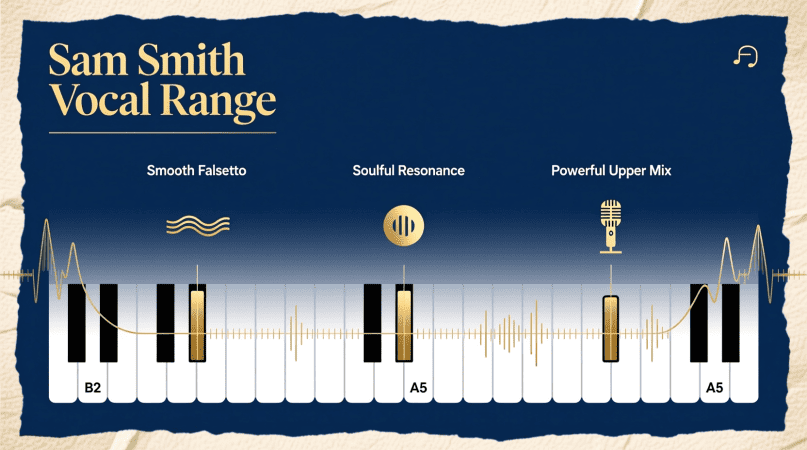
Sam Smith has one of the most emotionally recognizable voices in modern music. Their tone is warm and haunting, their falsetto floats effortlessly, and their phrasing carries a kind of vulnerability that’s rare in pop music. But when people ask about Sam Smith’s vocal range, they usually want more than just numbers—they want to understand how that voice works and why it feels so powerful.
Let’s take a deep look at Sam Smith’s vocal range, voice type, highest and lowest notes, and some personal insights from my own attempts to sing their songs. Because believe me, Sam Smith might sound smooth and calm, but trying to sing like them is a humbling experience.
Sam Smith’s Vocal Range: C3 to B♭5
Sam Smith’s recorded vocal range stretches from C3 at the low end to B♭5 in falsetto. That’s approximately two and a half octaves, which is respectable for a pop tenor. They don’t rely on extreme high belts or unusually low notes; instead, they use the range they have with exceptional control, especially in the upper middle and falsetto registers.
Their comfort zone sits around G4 to C5—right where many of their emotional climaxes happen in songs like “Stay With Me” and “Too Good at Goodbyes.”
Sam Smith’s Voice Type: Lyric Tenor
Sam Smith is best described as a lyric tenor. Their tone is warm, expressive, and smooth, with a bright upper register. They lean toward cleaner high notes rather than heavy, dramatic belts. Their singing style relies more on emotional delivery and breath control than on vocal power.
What stands out is how relaxed their higher notes sound. Even when they reach up to C5, the sound is open, pure, and almost effortless—something far harder than it appears.
The First Time I Tried Singing Sam Smith
The first Sam Smith song I ever tried to sing was “Stay With Me.” I was confident. The melody didn’t seem complicated, and the chorus didn’t appear too high—until I actually tried it. The jump into the upper notes felt like stepping into thin air.
My voice cracked, wobbled, and honestly sounded nothing like the clean, silky tone Sam Smith produces. I realized quickly that Sam’s vocal strength isn’t about hitting huge notes; it’s about how gracefully they get there.
Where I went wrong:
- I pushed too much air, trying to power through the chorus.
- My throat tightened instead of staying relaxed.
- I underestimated how controlled Sam Smith’s soft singing really is.
When I finally eased up and focused on breath flow rather than volume, the notes became more manageable. Not perfect, but at least recognizable. Singing Sam Smith taught me that subtlety is often harder than shouting your way through a note.
Sam Smith’s Vocal Range Breakdown by Register
Here’s a clearer picture of how Sam Smith uses their range:
| Register | Notes | Examples |
|---|---|---|
| Chest Voice | C3 – G4 | “Stay With Me,” “Too Good at Goodbyes” |
| Mixed Voice | G4 – C5 | Live versions of “I’m Not the Only One” |
| Falsetto / Head Voice | C5 – B♭5 | “How Do You Sleep?,” “Diamonds” |
Even though their range isn’t extreme, their transitions between registers are extremely smooth. Their falsetto, especially, carries a controlled warmth that blends well with their chest and mixed tones.
Sam Smith’s Highest Notes
Sam Smith’s highest recorded notes include:
- B♭5 in falsetto during certain live runs
- A5 in select improvisations
- Consistent C5 notes in choruses
What’s interesting is that even at the top of their range, Sam Smith avoids tension. They maintain a soft, floating feeling instead of belting from the throat. That’s part of what makes their voice instantly recognizable.
Sam Smith’s Lowest Notes
Their lower notes don’t appear often, but when they do, they’re clean and warm:
- C3 in harmonies of “Stay With Me”
- D3 in the intro of “Lay Me Down”
Sam Smith is not a low-voiced singer, but their lower range is solid enough to shape emotional contrasts in quieter songs.
Why Sam Smith’s Voice Feels So Emotional
After trying to imitate them dozens of times, I’ve noticed several things that set Sam Smith apart:
- Their breath control is incredibly steady.
- They approach notes gently, avoiding harsh attacks.
- Their vowels are open and clean, which gives the tone a round, resonant quality.
- Their vibrato is subtle and controlled—not too wide, never shaky.
- They switch to falsetto earlier than most singers, preventing strain and adding emotion.
These details are easy to miss until you attempt the songs yourself and realize how hard it is to maintain the same level of calmness and sensitivity.
How Sam Smith’s Range Compares to Other Artists
| Artist | Range | Voice Type |
|---|---|---|
| Sam Smith | C3–B♭5 | Lyric Tenor |
| Adele | C3–C6 | Mezzo-Soprano |
| Bruno Mars | A2–D6 | Tenor |
| Billie Eilish | D3–B♭5 | Light Soprano |
While Sam Smith doesn’t have the widest range on this list, their emotional delivery places them in a league of their own.
Checking Your Own Vocal Range
If you want to see how your vocal range compares to Sam Smith’s, using an online vocal range test can be eye-opening. The first time I tested my own range, I discovered I was singing far below my comfortable limit and straining for notes that weren’t actually out of reach—I was just using the wrong technique.
Knowing your actual range helps you:
- Pick songs that suit your voice
- Understand which notes require technique adjustments
- Track improvements over time
And honestly, it’s satisfying to see your range mapped out clearly.
Tips That Helped Me Improve When Singing Sam Smith Songs
Here are the adjustments that made the biggest difference for me:
- Relax the jaw instead of gripping the notes.
- Use steady airflow, not bursts of air.
- Shift to falsetto earlier rather than pushing chest voice too high.
- Think of singing as speaking emotionally rather than performing loudly.
- Record yourself so you can actually hear what needs fixing.
Sam Smith’s songs are deceptively simple but technically refined. Approaching them with gentleness instead of force is the key.
Erika Parker is a vocal analysis and singing education writer at Vocal Range Test. She focuses on vocal range testing, voice type analysis, pitch recognition, and singing tools for vocalists, musicians, choir singers, and beginners.