
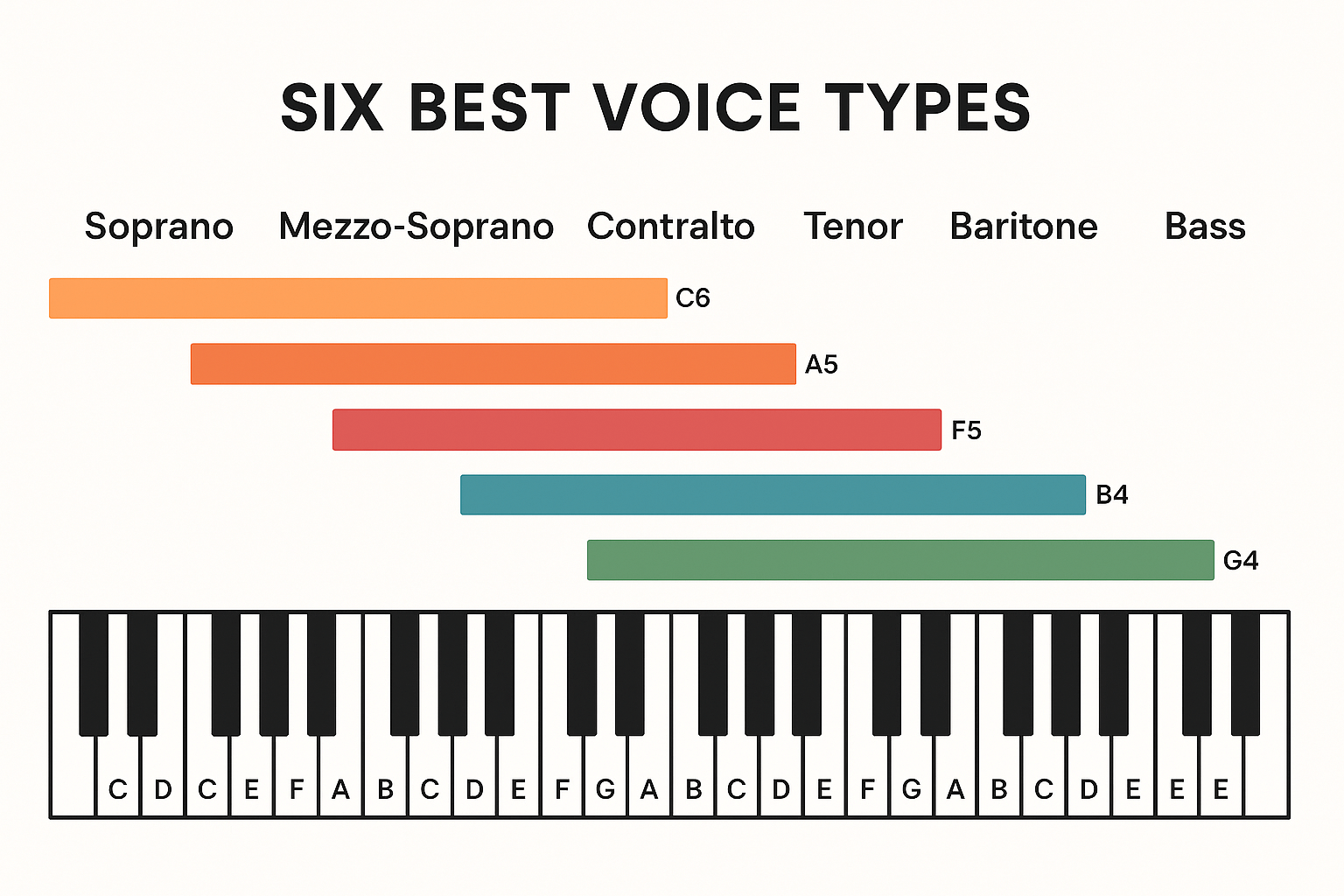
There are 6 standard voice types in classical vocal classification: soprano, mezzo-soprano, contralto, tenor, baritone and bass. Three are female voices and three are male. Every human singing voice fits into one of these categories — or sits in the overlap zone between two adjacent types.
Your voice type is determined by three things: your range (lowest and highest notes you can sing), your tessitura (the zone where your voice sounds best), and your timbre (the natural colour and quality of your tone). Range alone is not enough — tessitura and tone often matter more than your absolute ceiling or floor.
Take the free voice type test — find yours in 2 minutes
Quick Reference: All 6 Voice Types
| Voice Type | Gender | Range | Tessitura | Famous Examples |
|---|---|---|---|---|
| Soprano | Female | C4 – C6 | F4 – A5 | Celine Dion, Carrie Underwood, Ariana Grande |
| Mezzo-Soprano | Female | A3 – A5 | C4 – F5 | Adele, Lana Del Rey, Amy Winehouse |
| Contralto | Female | F3 – F5 | A3 – D5 | Tracy Chapman, Cher, Nina Simone |
| Tenor | Male | C3 – C5 | D4 – A4 | Pavarotti, Justin Timberlake, The Weeknd |
| Baritone | Male | A2 – A4 | G3 – E4 | Elvis Presley, Frank Sinatra, John Legend |
| Bass | Male | E2 – E4 | D3 – B3 | Johnny Cash, Barry White, Josh Turner |
The 3 Female Voice Types
1. Soprano
The soprano is the highest female voice type. It is characterised by a bright, clear tone in the upper register and a natural tessitura that sits above middle C.
Range: C4 – C6 Tessitura: F4 – A5 Timbre: Bright, forward, ringing
Characteristics:
- Most comfortable zone is above middle C (C4)
- High notes above B4 feel natural and powerful
- Lower register below C4 often thins
- Speaking voice tends to be higher than average for women
Types of soprano:
- Lyric soprano — light, agile, warm (Celine Dion, Carrie Underwood, Julie Andrews)
- Dramatic soprano — heavier, more powerful (Maria Callas)
- Coloratura soprano — extremely high and agile (Mariah Carey upper range, Kristin Chenoweth)
Famous sopranos: Celine Dion (B2–E6), Carrie Underwood (D3–C6), Ariana Grande (D3–E7), Kristin Chenoweth (E3–G6)
Soprano vocal range — full guide
2. Mezzo-Soprano
The mezzo-soprano is the most common female voice type — sitting between soprano and contralto. Mezzo means “middle” in Italian. It has a warmer, slightly darker quality than soprano with natural power in the middle of the female range.
Range: A3 – A5 Tessitura: C4 – F5 Timbre: Warm, full, slightly darker than soprano — rich or velvety
Characteristics:
- Most comfortable zone is C4–F5 — straddling middle C
- High notes above G5 require more effort than for a soprano
- Lower register below A3 is fuller than in a soprano
- Speaking voice tends to be lower and warmer than sopranos
Types of mezzo-soprano:
- Lyric mezzo — lighter, more flexible (Adele, Lana Del Rey, Amy Winehouse)
- Dramatic mezzo — heavier, more powerful in the chest register
- Mezzo-coloratura — agile, with extended upper range
Famous mezzo-sopranos: Adele (C3–E5), Amy Winehouse (F3–D6), Lana Del Rey (D3–D5), Dua Lipa (G3–D5), Mitski (A3–A5), Rihanna (C3–E5)
Am I a mezzo-soprano? You are likely a mezzo if your comfortable range centres around D4–F4, your low notes below A3 have real resonance, and soprano repertoire in standard keys feels consistently too high.
Mezzo-soprano vocal range — full guide
3. Contralto
The contralto is the lowest female voice type and the rarest of the three female categories. A true contralto has a deep, rich chest voice extending well below the typical female range, with a distinctive darkness of tone.
Range: F3 – F5 Tessitura: A3 – D5 Timbre: Deep, dark, earthy — chest-dominant and powerful in the lower register
Characteristics:
- Most comfortable zone is A3–C5 — significantly lower than soprano or mezzo
- Lower notes (F3–A3) have full resonant tone rather than thinning
- Upper notes above E5 often feel effortful
- Speaking voice is noticeably lower than most women
Famous contraltos: Tracy Chapman (D3–E5), Nina Simone (D3–A4), Cher (G2–E5), Toni Braxton (E3–G5)
Am I a contralto? You are likely a contralto if your speaking voice is low for a woman, you have full resonant tone below A3, and your voice has a consistently dark, earthy quality.
Alto vs Contralto — what is the difference? In choral music, “alto” is the lower female choral part. In solo classical voice classification, “contralto” is the correct term for the lowest female voice type. The words are used interchangeably in casual contexts but technically contralto = voice type; alto = choral part.
Contralto vocal range — full guide
The 3 Male Voice Types
4. Tenor
The tenor is the highest standard male voice type. Tenors are celebrated for their ability to produce powerful, ringing high notes. The “high C” of operatic tenors is one of the most iconic sounds in classical music.
Range: C3 – C5 Tessitura: D4 – A4 Timbre: Bright, ringing, penetrating — projects easily in the upper register
Characteristics:
- Most comfortable zone is D4–A4
- High notes above G4 feel natural in chest voice
- Lower register below C3 often thins more quickly than baritone or bass
- Speaking voice tends to be higher and lighter than average for men
Types of tenor:
- Lyric tenor — light, flexible, bright (Justin Timberlake, Josh Groban, The Weeknd)
- Dramatic tenor — heavier, more powerful upper range (Rob Halford, Steven Tyler)
Famous tenors: Pavarotti (C3–C6), The Weeknd (A2–D6), Bruno Mars (B1–F5), Brendon Urie (C3–G6), Stevie Wonder (C2–A5)
Am I a tenor? You are likely a tenor if your speaking voice is lighter than most men, notes above G4 feel natural in chest voice, and you struggle more with notes below E3 than above B4.
Tenor vocal range — full guide
5. Baritone
The baritone is the most common male voice type — statistically, the majority of adult men are baritones. The baritone voice has a warm, full, authoritative quality in the mid-range that makes it the defining male voice in most popular music.
Range: A2 – A4 Tessitura: G3 – E4 Timbre: Warm, dark, full — the “classic” male voice sound
Characteristics:
- Most comfortable zone is G3–E4
- Notes above F4–G4 start to require more effort
- Low notes (A2–C3) have real resonance and body
- Speaking voice sits in the lower-middle male range
Types of baritone:
- Lyric baritone — lighter, higher-placed (John Legend, Harry Styles)
- Dramatic baritone — heavier, darker (Elvis Presley, Nick Cave)
- Bass-baritone — extends down into bass territory (Johnny Cash, Leonard Cohen)
Famous baritones: Elvis Presley (G2–C5), Frank Sinatra (F2–G4), John Legend (B2–B4), Harry Styles (B2–G5), Chris Cornell (A2–E5), Eddie Vedder (B1–B4)
Am I a baritone? You are likely a baritone if your speaking voice is in the mid-lower male range, notes around G3–E4 feel most natural, and reaching above G4 in chest voice consistently requires effort.
Baritone vocal range — full guide
6. Bass
The bass is the lowest male voice type and one of the rarest. Bass voices are characterised by a deep, dark, powerful quality in the low register that no other voice type can replicate.
Range: E2 – E4 Tessitura: D3 – B3 Timbre: Deep, dark, resonant — authoritative in the low register
Characteristics:
- Most comfortable zone is D3–B3 — significantly lower than baritone
- Low notes below G2 have full resonance
- Upper notes above E4 often lose characteristic bass quality
- Speaking voice is noticeably deep — often the lowest in any room
Types of bass:
- Lyric bass (basso cantante) — lighter, more flexible (Tim Foust)
- Dramatic bass (basso profondo) — extremely deep, the lowest documented voices (Tim Storms)
- Bass-baritone — between bass and baritone (Johnny Cash)
Famous basses: Johnny Cash (E2–F4), Barry White (D2–G4), Tim Foust (C2–G4), Josh Turner (B1–E4)
Am I a bass? You are likely a bass if your speaking voice is noticeably deep even compared to other men, you can sing G2 or below with full resonant tone, and high notes above E4 are genuinely out of reach in chest voice.
What Are the 4 Vocal Ranges? (SATB)
In choral music, voices are divided into four parts — Soprano, Alto, Tenor, Bass (SATB) — rather than the six classical types:
| Part | Who Sings It | Choral Range |
|---|---|---|
| Soprano (S) | Sopranos + some mezzo-sopranos | C4 – G5 |
| Alto (A) | Mezzo-sopranos + contraltos | G3 – E5 |
| Tenor (T) | Tenors + high baritones | C3 – G4 |
| Bass (B) | Baritones + basses | E2 – C4 |
The SATB system simplifies the six classical types into four choral parts. A mezzo-soprano typically sings the alto part; a baritone typically sings the bass part.
SATB vocal ranges — full guide
What Are the Male Vocal Ranges?
Three standard male voice types: tenor (C3–C5), baritone (A2–A4), bass (E2–E4). The baritone is the most common — the majority of adult men are baritones. Male voices are lower than female voices due to the larger larynx and longer vocal cords that develop during puberty.
What Are the Female Vocal Ranges?
Three standard female voice types: soprano (C4–C6), mezzo-soprano (A3–A5), contralto (F3–F5). The mezzo-soprano is the most common. The contralto is the rarest — true contraltos with a full resonant low register are uncommon.
Difference Between Soprano, Alto, Tenor and Bass
| Voice Part | Range | Description |
|---|---|---|
| Soprano | C4 – G5 | Highest female voice — carries melody in choral writing |
| Alto | G3 – E5 | Lower female voice — harmonic foundation in female section |
| Tenor | C3 – G4 | Highest male voice — secondary melody in choral writing |
| Bass | E2 – C4 | Lowest male voice — harmonic foundation of the choir |
Choral ranges are slightly narrower than solo voice ranges — choir parts are written comfortably for all singers of that type.
How to Find Your Voice Type
Three factors determine your voice type — not just your highest note:
1. Tessitura — Where your voice sounds most resonant and effortless. This matters more than your ceiling. A singer who reaches C5 but sounds best around C4 is likely a baritone, not a tenor.
2. Timbre — The natural colour of your voice. Brighter, more forward voices lean toward soprano/tenor. Darker, fuller-placed voices lean toward contralto/bass.
3. Passaggio location — Where your voice transitions between chest and head voice. This transition point is specific to each voice type and is one of the most reliable classification markers.
FAQs
What are the 6 voice types? The 6 standard voice types are soprano, mezzo-soprano and contralto (female) and tenor, baritone and bass (male). Every human singing voice fits into one of these categories or sits on the border between two adjacent types.
What are the 4 vocal ranges? In choral music, voices are divided into four parts: Soprano (S), Alto (A), Tenor (T) and Bass (B) — known as SATB. Mezzo-sopranos typically sing alto; baritones typically sing bass in SATB settings.
What is the most common voice type? For women, mezzo-soprano is the most common. For men, baritone is the most common. Contralto (female) and basso profondo (male) are the rarest.
What is the difference between soprano and alto? Soprano (C4–C6) is the highest female voice with a bright, clear tone. Alto/contralto (F3–F5) is the lowest female voice with a darker, deeper quality. In choral terms, “alto” is the lower female choral part sung by mezzo-sopranos and contraltos.
What is the difference between tenor and baritone? Tenor (C3–C5, tessitura D4–A4) is the highest standard male voice with a bright, ringing quality. Baritone (A2–A4, tessitura G3–E4) is the most common male voice with a warmer, darker tone. The key practical difference is where the voice sounds best and how high it comfortably reaches in chest voice.
What voice type is the rarest? Contralto is the rarest female voice type. Basso profondo (extremely low bass) is the rarest male voice type.
What voice type is Bruno Mars? Bruno Mars is a tenor with a confirmed range of B1–F5. His natural tessitura sits in the D4–B4 range, characteristic of a lyric tenor.
What voice type is Adele? Adele is a mezzo-soprano with a range of approximately C3–E5. Her tessitura sits around A3–D5 with the warm, darker quality of the mezzo voice type.
What voice type is Laufey? Laufey is a mezzo-soprano. Her voice sits most comfortably around D4–F5, with the warm, jazz-influenced tonal quality typical of a lyric mezzo-soprano.
What voice type is Rihanna? Rihanna is a mezzo-soprano with a range of approximately C3–E5 and a warm, slightly husky mezzo quality.
What voice type is Sabrina Carpenter? Sabrina Carpenter is a soprano, with a range of approximately C3–C6. Her natural tessitura and bright tone quality confirm soprano classification.
What voice type is Shawn Mendes? Shawn Mendes is a lyric tenor with a range of A2–A5. His natural tessitura sits in the D4–B4 zone with the bright, agile quality of a lyric tenor.
Related articles:
- Test your vocal range →
- Soprano vocal range →
- Mezzo-soprano vocal range →
- Contralto vocal range →
- Tenor vocal range →
- Baritone vocal range →
- Bass vocal range →
- SATB vocal ranges →
- Tenor vs baritone →
- Baritone vs bass →
- Alto vs contralto →
- Alto vs mezzo-soprano →
- Vocal fach system explained →
- Average vocal range →
- Compare your voice to famous singers →