
Elvis Presley’s vocal range spanned approximately G2 to Bb4 in full voice — two octaves and a third — with an upward extension in falsetto to at least Db5. That documented span is formally described in a detailed assessment as covering “from the baritone low-G to the tenor high B, with an upward extension in falsetto to at least a D flat.” But the numbers alone don’t capture what was actually unusual about the instrument.
In 1987, Gregory Sandows, a music professor at Columbia University, wrote in the Village Voice that Elvis should be categorized as a “lyric baritone…but with unexpectedly rich low notes…and astounding high notes” — and added: “Elvis was all at once a tenor, a baritone and a bass, the most unusual voice I’ve ever heard.” That assessment has become the canonical description of what made his voice singular, and it’s worth understanding technically rather than simply repeating as a compliment.
He won three Grammy Awards — all for gospel recordings. Placido Domingo said “his was the one voice I wish to have had.” Bryn Terfel called him “very classically orientated with his voice and diction.” Rolling Stone has consistently placed him among the greatest singers in rock history.
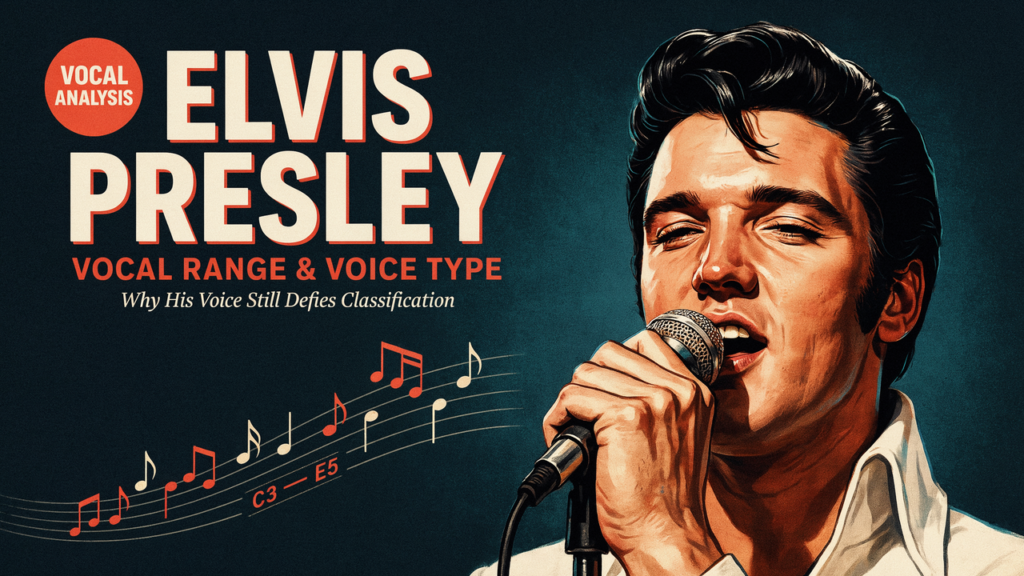
Elvis Presley’s Vocal Range at a Glance
Vocal range: approximately G2 – Bb4 (full voice), Db5 (falsetto extension) Voice type: Lyric baritone (with tenor and bass extensions) Vocal registers in use: Chest voice, mixed voice, falsetto Approximate span: Two octaves and a third in full voice Tessitura (comfortable centre): Roughly Db3 to Db4 (“Presley’s best octave”) Active career: 1954–1977
What Voice Type Was Elvis Presley?
The voice type question around Presley is genuinely contested in a way that reflects something real about his instrument. He has been called a baritone, a tenor, a bass-baritone, and — most accurately — something that doesn’t fit any single label.
The formal technical assessment places him as a high baritone. His low-G extends below the baritone floor; his high-B is solidly in tenor territory. The Village Voice assessment calls the center of gravity “the most unusual voice I’ve ever heard” because it didn’t settle clearly in any one register. The analyst’s description of his “best octave” as Db to Db — right at the baritone-tenor border — is the most useful single piece of information about where his voice actually lived.
What this means practically: Presley could inhabit baritone repertoire with genuine darkness and weight, then ascend into tenor passages without the transition sounding like a gear change. The Conversation analysis notes “the unusual ability to move seamlessly between his tenor and baritone voices” as a hallmark of his vocal approach — not a trick or a range demonstration, but an integrated fluency across registers that most voices don’t possess.
The baritone vocal range page and the human vocal range page together give context for where his documented range sits relative to standard voice type classifications.
His Lower Register: The Baritone and Bass Depths
G2 is the documented effective lower limit, heard in “He’ll Have To Go” (1976). “King Creole” (1958) contains growled low-F’s — below the standard baritone floor. The dark, rich quality in his lower chest voice is part of what generated the bass-baritone label: there’s genuine resonance in the low second octave, not just an approximation.
His preferred register, by several accounts including one from IMDB’s assessment of his career, was “bass-baritone.” The richness of his chest voice in the D2–G3 zone — what The Conversation calls the “richness of his baritone range” — gave even his rock and roll recordings a weight that lighter-voiced performers couldn’t replicate. When he sang gospel and ballads in that lower territory, the resonance had a quality that classical singers like Domingo and Terfel specifically noted.
This lower register wasn’t a departure from his rock-and-roll identity — it was the foundation beneath it. The growling, driving quality of “Jailhouse Rock” exists in tension with the baritone depth below it, and that tension was part of what made him sonically novel in 1956.
The Middle Register: Where His Voice Was Most Itself
The assessment identifying Db to Db as “Presley’s best octave” is the most practically useful statement about his voice. This zone — roughly from middle C downward to Db3 — is where his tone was fullest, most flexible, and most emotionally available.
“Can’t Help Falling in Love” (1961) demonstrates this middle register at its most characteristic — “a gorgeous light baritone in the bridge of the song,” as The Conversation describes it. “It’s Now or Never” (1960) — discussed in studio documentation as presenting challenges because “he basically sang in the baritone range, and the end was in the tenor range” — shows both ends of the instrument: the comfortable middle baritone in the verses, the high tenor A in the climactic ending that required specific technique and multiple takes to achieve.
The studio anecdote about “It’s Now or Never” is revealing. The recording engineer offered to splice a separate take of the ending; Elvis refused, insisting on recording the full song from beginning to end on every attempt. He eventually achieved the ending he wanted. That determination to navigate the full register span within a single continuous performance, rather than stitching together the comfortable parts, reflects both his artistic integrity and the technical difficulty of bridging baritone and tenor registers cleanly.
His Upper Register: The Tenor Peak and Gospel Power
Bb4 in full voice is where his chest/mixed register ceiling sits, with specific documents noting accurate delivery of A’s and high G’s in ballads and country songs — notes that “an opera baritone might envy,” according to the Village Voice analysis. His falsetto extended to at least Db5.
“How Great Thou Art” — the gospel performance that earned him one of his three Grammy wins — is frequently cited as his most impressive vocal document. The song demands dynamic range across the full instrument: intimate and reverent in the lower passages, soaring and powerful in the upper passages. The performance combined the dark, resonant chest voice quality with the ability to ascend into the upper register and maintain the same emotional intensity — which is precisely what the Sandows Columbia University assessment was describing.
Three Grammy Awards, all for gospel recordings — Best Sacred Performance, Best Inspirational Performance, and Best Inspirational Performance again — is a specific kind of recognition: the academy judging his voice by criteria that don’t apply to rock and roll. Gospel singing evaluated by sacred recording standards confirmed that what critics heard in his voice wasn’t simply rock appeal but genuine vocal artistry by any measure.
The Seamless Register Transition: His Most Unusual Quality
The specific technical quality that multiple analysts identify — the ability to “move seamlessly between his tenor and baritone voices” — is worth examining as a distinct skill rather than simply a byproduct of wide range.
Most singers with wide ranges have an audible passaggio — the break or transition zone between registers. A baritone ascending into tenor territory typically produces a perceptible tonal shift: the voice lightens, brightens, and changes character as it crosses from chest to mix to head resonance. Elvis’s transitions were unusually smooth, giving the impression of a single, continuous instrument rather than registers being switched between.
This quality — integrated register use across a span that most voices can’t span without audible breaks — is what Sandows was identifying with “all at once a tenor, a baritone, and a bass.” The center of gravity wasn’t fixed in one register; the voice could authentically inhabit multiple registers without the strain that usually marks a voice operating outside its comfortable zone.
The vocal range and singing techniques page covers the technical principles behind register integration, which is directly relevant to what made Presley’s voice so unusual.
Notable Vocal Performances
That’s All Right (1954): The debut Sun Records recording that launched his career. The voice is in its most raw and natural state — the rock-and-roll high tenor dominant, the baritone depth providing the grounding.
It’s Now or Never (1960): The most technically demanding recording in terms of documented range span — the low baritone verses and the high tenor A in the climax. The studio documentation of multiple attempts and the engineer’s splice offer reveal how genuinely difficult the upper notes were to execute.
Can’t Help Falling in Love (1961): The middle baritone at its most lyrical and emotionally available. Often cited as demonstrating the “light baritone” quality the Village Voice assessment identified.
How Great Thou Art (1967): The Grammy-winning gospel performance. The clearest document of his full dynamic and emotional range in a single performance — and the recording that earned formal recognition beyond pop-music criticism.
FAQs About Elvis Presley’s Vocal Range
What was Elvis Presley’s vocal range?
His documented range spanned from G2 in full voice to Bb4 at the chest/mix ceiling, with falsetto extension to at least Db5 — two octaves and a third in full voice. His most comfortable octave was identified as Db to Db, sitting at the baritone-tenor border.
What voice type was Elvis Presley?
He is most accurately classified as a high baritone — the Village Voice assessment from 1987 used “lyric baritone” as the formal classification while noting “unexpectedly rich low notes and astounding high notes.” The Columbia University music professor Gregory Sandows described him as “all at once a tenor, a baritone, and a bass.”
Why did Elvis win his Grammys for gospel?
He won three Grammy Awards (Best Sacred Performance, Best Inspirational Performance twice), all for gospel recordings. Gospel performance evaluated on sacred recording standards confirmed the musical breadth of his voice beyond rock-and-roll context. He personally described gospel as his favourite music.
What did classical singers say about Elvis Presley’s voice?
Tenor Placido Domingo said “his was the one voice I wish to have had.” Bass-baritone Bryn Terfel called him “very classically orientated with his voice and diction and very sincere.” These assessments from trained classical singers speak to the technical quality of his instrument beyond its pop-cultural context.
Erika Parker is a vocal analysis and singing education writer at Vocal Range Test. She focuses on vocal range testing, voice type analysis, pitch recognition, and singing tools for vocalists, musicians, choir singers, and beginners.