
Judy Garland’s vocal range spanned approximately D3 to G5 — two octaves and three notes — with a contralto instrument that the Diva Devotee analysis described as possessing “a warm, rich, incredibly velvety quality” throughout its full range, with low notes carrying “a darkness that pervades much of the voice.” Born Frances Ethel Gumm on June 10, 1922 in Grand Rapids, Minnesota, and dying on June 22, 1969 at the age of 47, Garland spent her life demonstrating that a relatively modest technical range, wielded with extraordinary emotional intelligence and interpretive precision, could produce performances that contemporaries and audiences for generations afterward called definitive.
Her Carnegie Hall concert of April 23, 1961 — the original cast recording of which won five Grammy Awards, including Album of the Year — has been described as one of the greatest nights in show business history. The voice that produced it was, by technical standards, a good contralto with two octaves of range and a deeply distinctive timbre. By interpretive standards, it was something else entirely.
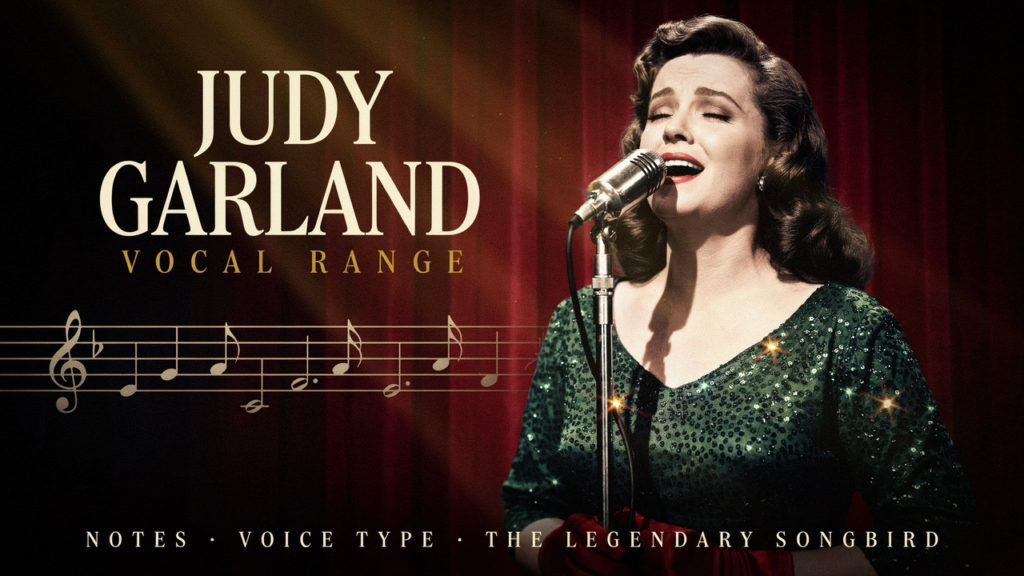
Judy Garland’s Vocal Range at a Glance
Vocal range: approximately D3 – G5 (Diva Devotee documentation) Voice type: Contralto (some analyses: heavy mezzo-soprano) Vocal registers in use: Chest voice, mixed voice, head voice Approximate span: 2 octaves and 3 notes Tessitura (comfortable centre): E3 – Bb4 Active career: 1924–1969
What Voice Type Was Judy Garland?
The Diva Devotee profile classifies her as a “middle-weight contralto” — the lowest standard female voice type, sitting below mezzo-soprano. Some analysts argue for a “heavy lyric mezzo-soprano” classification, based on the brightness of her upper register. The Datalounge forum thread that has circulated widely quotes the Diva Devotee assessment with approval: the “warm, rich, incredibly velvety quality” throughout, with low notes demonstrating “a darkness that pervades much of the voice.”
Her low D3 — documented in “Ol’ Man River” — sits firmly in contralto territory. Her upper G5 appears in the most demanding passages, likely requiring head voice or a strong mix rather than chest production. Her most comfortable and characterful zone — the E3 to Bb4 tessitura — is where her voice is most immediately recognisable: the warm, dark, forward-resonant sound that Connie Francis cited as “a textbook for every female singer.”
The contralto vocal range page covers where this voice type sits relative to the full female voice spectrum.
“Over the Rainbow”: The One Song
The Petersen Voice Studio analysis of Garland’s voice across decades uses “Over the Rainbow” as the lens, and it’s an unusually illuminating document. The song, in its original key of Ab major, spans from G3 (in some analyses) or C4 (Singing Carrots’ document of “Over the Rainbow” at C4–F5 in Garland’s original key) through to the upper register in the climactic high notes.
In the 1938/1939 recording for The Wizard of Oz, Garland sang with “what today we would consider a mix — a balance of head and chest registers, but still favoring the chest,” as the Petersen analysis describes. This production, distinctly different from the pure belt approach she would develop later, gives the song its particular quality of a child’s voice that contains an adult’s yearning — technically, it’s a mix that carries more emotional transparency than a full chest belt would.
By the 1950s, the Petersen analysis notes, the approach had become “chestier still” — the voice thickening into a more robust belt that sacrificed some of the 1939 recording’s vulnerability for greater power. The famous Carnegie Hall version (1961) demonstrates this evolution: the voice is more powerful, more commanding, and the upper Eb4 and Ab4 in the final phrases are “full belt” rather than the earlier mix.
The Emotional Intelligence: What Actually Made the Voice
Garland understood, from a very young age, how to use a voice in service of a lyric. This is a different skill from technical range or tonal quality — it’s the ability to shape a phrase so that the emotional content arrives exactly where the song needs it. The Datalounge description captures it: “She knew just when to emote vocally within her contralto range and unique vibrato like a grand actress.”
Her vibrato — fast, characteristically wide, slightly operatic in its oscillation — was a signature trait that carried emotional urgency in sustained notes. The singingcoach.ai analysis of “Over the Rainbow” notes she “used a shimmering, fast vibrato here” at the climactic high notes, specifically describing how “to achieve this, do not push air” — the vibrato resulting from correct support rather than excess air pressure.
This precision — knowing when to emote, knowing where to place the vibrato, knowing how to sustain a phrase with maximum emotional impact at minimum vocal effort — is what produced performances that lasted. Her voice three months before her death, singing “Over the Rainbow” in the final concert footage that exists, was diminished from the Carnegie Hall peak; but as one source notes, “the amazing talent Judy still was” remained audible even then.
Carnegie Hall 1961: The Greatest Night in Show Business
The April 23, 1961 Carnegie Hall concert has been called “one of the greatest nights in show business history” — a description supported by specific evidence: the recording won five Grammy Awards including Album of the Year; it spent 73 weeks on the Billboard charts; it remains one of the best-selling live concert albums in history.
The performance ran for over two hours and forty minutes — Garland performing more than two dozen songs — and demonstrated the voice at its most powerful and controlled. The belt in the upper range of her contralto, developed through decades of performance, was at its peak; the interpretive authority was absolute.
How Her Voice Changed Across Decades
The Petersen Voice Studio analysis is the most detailed technical account of this evolution. The key points: the 1939 voice used a forward-placed mix favoring chest resonance; the 1950s recordings show increasing chest dominance and a thickening of the belt; the 1960s voice at Carnegie Hall is at its most powerful; the very late recordings show the expected decline of the upper register while the contralto lower-to-mid range retained significant quality.
The how age affects your vocal range over time page covers the physiology that underlies the kind of trajectory the Petersen analysis documents.
FAQs About Judy Garland’s Vocal Range
What was Judy Garland’s vocal range?
Her documented range spanned approximately D3 to G5 — two octaves and three notes — per the Diva Devotee vocal profile. Her comfortable working tessitura sat in the E3–Bb4 zone, with “Over the Rainbow” in its original key spanning C4–F5 per Singing Carrots.
What voice type was Judy Garland?
A contralto — the lowest standard female voice type — per the Diva Devotee analysis, which describes her as a “middle-weight contralto.” Some analysts argue for a “heavy lyric mezzo-soprano,” pointing to the brightness of her upper register, but the lower tessitura and D3 floor are more consistent with contralto classification.
What made Judy Garland’s voice special?
Technical range alone doesn’t explain it. Her contemporaries identified her interpretive precision — knowing exactly when and where to place vocal emphasis for maximum emotional impact — as the primary gift. Connie Francis called her voice “a textbook for every female singer,” which is a statement about the interpretive approach rather than the technical equipment.
What was Judy Garland’s most famous performance?
The Carnegie Hall concert of April 23, 1961, which won five Grammy Awards including Album of the Year and has been called one of the greatest live performances in entertainment history. Among individual songs, “Over the Rainbow” — in its 1939 recording for The Wizard of Oz — is the defining performance of her career.
Why did Judy Garland’s voice change over her career?
Multiple factors: natural vocal aging, the physical toll of decades of intensive performance, personal health challenges, and the deliberate shift toward a more belt-forward approach that sacrificed some of the earlier mix’s vulnerability for power. The Petersen Voice Studio analysis traces this evolution across the same song (“Over the Rainbow”) across 30 years of recordings.
Erika Parker is a vocal analysis and singing education writer at Vocal Range Test. She focuses on vocal range testing, voice type analysis, pitch recognition, and singing tools for vocalists, musicians, choir singers, and beginners.