
The tenor and baritone are the two most common male voice types, and they are also the two that cause the most confusion for singers trying to identify their own voice. Both are middle-to-upper male voices, and the boundary between them is not a sharp line — it is a zone of overlap where many male voices sit without clearly belonging to either category.
This guide explains the differences clearly, gives you the tools to identify your own voice type, and lists famous examples of both.
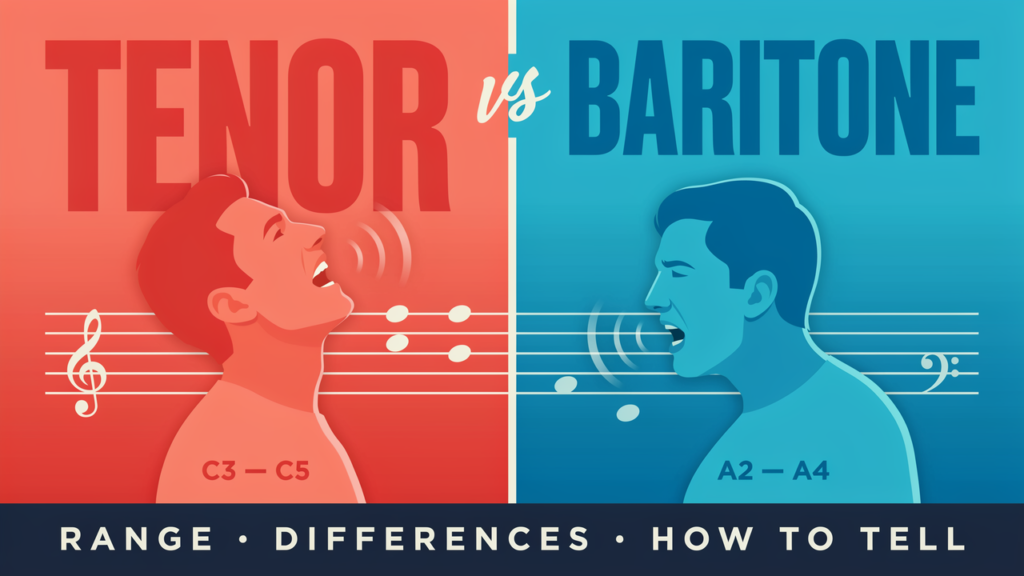
Tenor vs Baritone at a Glance
| Feature | Tenor | Baritone |
|---|---|---|
| Range | C3 – C5 (typical) | A2 – A4 (typical) |
| Tessitura | D4 – A4 | G3 – E4 |
| Speaking voice | Higher, brighter | Lower, darker |
| Chest voice ceiling | Around C5 | Around G4–A4 |
| Timbre | Bright, ringing, forward | Warm, dark, full |
| Most common? | No | Yes — most common male type |
| Classical roles | Lead romantic roles, heroes | Authority figures, villains, mature leads |
| Famous examples | Pavarotti, Justin Timberlake, Freddie Mercury | Elvis Presley, Frank Sinatra, Josh Groban |
What Is a Tenor?
A tenor is the highest standard male voice type. The typical tenor range runs from C3 to C5, with the tessitura — the zone of greatest comfort and resonance — sitting between D4 and A4.
The tenor voice is characterised by brightness and forward placement. It projects easily in the upper register and carries a ringing, penetrating quality that makes it ideal for operatic roles where the voice needs to carry over a full orchestra.
In popular music, tenors are the singers who reach notes in the B4–C5 range with apparent ease, whose high notes feel like a natural expression of excitement rather than a strain.
Types of tenors:
- Lyric tenor — light, agile, bright (Justin Timberlake, Josh Groban)
- Dramatic tenor — heavier, more powerful upper range (Rob Halford, Axl Rose)
- Countertenor — uses falsetto as primary voice, singing above the standard tenor range (different category)
What Is a Baritone?
A baritone is the most common male voice type — statistically, the majority of adult men are baritones. The typical baritone range runs from A2 to A4, with the tessitura between G3 and E4.
The baritone voice is warmer and darker than the tenor. Its resonance centres lower in the chest, giving it a fullness and authority in the mid-range that tenors do not have. The baritone is the voice type of choice for characters who need to convey maturity, power or complex emotion in classical music.
In popular music, baritones are the singers who sound naturally powerful in the E3–E4 range and whose attempts to push consistently into C5 and above begin to feel strained.
Types of baritones:
- Lyric baritone — lighter, higher-placed, can reach into tenor territory (Harry Styles, John Legend)
- Dramatic baritone — heavier, darker, more power in mid-range (Elvis Presley, Nick Cave)
- Bass-baritone — extends into bass territory below A2 (Johnny Cash, Leonard Cohen)
Tenor vs Baritone: Range Comparison
| Voice | Low Limit | High Limit | Comfortable Zone |
|---|---|---|---|
| Bass | E2 | E4 | G2 – E4 |
| Bass-Baritone | F2 | F4 | A2 – F4 |
| Baritone | A2 | A4 | G3 – E4 |
| Baritone-Tenor | B2 | B4 | A3 – F#4 |
| Tenor | C3 | C5 | D4 – A4 |
| Countertenor | G3 | G5 | C4 – A4 (falsetto) |
How to Tell if You Are a Tenor or Baritone
The most reliable way to identify your voice type is to work with a vocal teacher. However, you can get a strong indication on your own by listening carefully to these signals.
Step 1: Check your speaking voice Your speaking voice often reflects your natural range. If strangers frequently comment that you have a deep or rich voice, you are more likely a baritone. If your speaking voice is lighter, brighter and sits higher than most male voices, you are more likely a tenor. This is not definitive — speaking voice and singing voice can diverge — but it is a useful starting point.
Step 2: Find your comfortable singing zone Sing a comfortable melody — something you know well — and notice where it sits without any strain. If it feels most natural between G3 and E4, you are in the baritone tessitura. If it feels most natural between D4 and A4, you are in the tenor tessitura.
Step 3: Test your upper limit with chest voice Sing upward in your chest voice without switching to falsetto. Where does it start to feel tight or require extra effort?
- If it begins to strain around G4–A4 — you are most likely a baritone.
- If it begins to strain around B4–C5 — you are most likely a tenor.
Step 4: Check your lower limit Sing downward from your comfortable range. How low can you go while maintaining full, resonant tone?
- If you begin thinning out around E3 — you are likely a tenor (lower range is less developed).
- If you can descend comfortably to B2–C3 with a full, resonant tone — you are likely a baritone.
Step 5: Listen to timbre This is subjective but important. Record yourself singing a held note around C4 (middle C). Does it sound:
- Bright, forward, slightly ringing? → Tenor
- Warm, round, slightly dark? → Baritone
Famous Tenors vs Famous Baritones
Famous Tenors:
- Pavarotti — the most famous operatic lyric tenor in history
- Justin Timberlake — pop-soul lyric tenor, strong falsetto
- Freddie Mercury — baritone-tenor, natural weight in mid-range
- Josh Groban — lyric dramatic tenor, operatic quality
- Brendon Urie — dramatic tenor with extreme upper extension
- The Weeknd — lyric tenor with falsetto dominance
- Steven Tyler — dramatic tenor
Famous Baritones:
- Elvis Presley — lyric baritone, rich mid-range
- Frank Sinatra — lyric baritone, exceptional tessitura control
- John Legend — high lyric baritone, borders on baritone-tenor
- Harry Styles — lyric baritone, breathy quality
- Nick Cave — dramatic baritone, dark and authoritative
- Johnny Cash — bass-baritone, iconic lower resonance
- Chris Cornell — dramatic baritone-tenor (borderline classification)
The Baritone-Tenor Overlap
A significant number of male singers sit in the space between baritone and tenor and are difficult to classify definitively. This is sometimes called the baritone-tenor or high baritone voice type.
Singers in this zone have:
- A tessitura around A3–F4 (higher than baritone, lower than tenor)
- A chest voice ceiling around A4–B4
- A darker colour than a typical tenor but more upper range than a typical baritone
Chris Cornell, Freddie Mercury, Adam Levine and Barry Gibb are examples of singers who sit in or near this overlap zone. None of them are perfectly classified as either tenor or baritone.
FAQs
What is the difference between a tenor and a baritone? The main difference is range and timbre. Tenors have a higher range (C3–C5) and a brighter, more forward tone. Baritones have a lower range (A2–A4) and a warmer, darker tone. The baritone is the most common male voice type.
Am I a tenor or a baritone? Check where your voice feels most comfortable — your tessitura. If it sits between D4 and A4 with a bright, ringing quality, you are likely a tenor. If it sits between G3 and E4 with a warm, full quality, you are likely a baritone. Take our free voice type test for a more accurate assessment.
Can a baritone become a tenor? No — voice type is determined by the physical size and structure of your vocal cords, which cannot be changed through training. However, baritones can extend their upper range and access notes in the tenor area through technique. The voice type classification stays the same.
Is baritone higher or lower than tenor? Lower. The baritone sits below the tenor in the male voice spectrum. From highest to lowest: countertenor → tenor → baritone → bass.
What is the most common male voice type? Baritone. The majority of adult men are baritones, which is why many popular songs and musical compositions are written with the baritone tessitura in mind.
Which is better, tenor or baritone? Neither is better — they are different instruments with different strengths. Tenors are prized for their ringing upper register and heroic quality. Baritones are prized for warmth, authority and power in the mid-range. Both have led the greatest vocal performances in music history.
Related article:
- Take the free voice type test →
- Find your vocal range →
- Tenor vocal range explained →
- Baritone vocal range explained →
- Bass vocal range →
- Baritone vs bass →
- All voice types explained →
- Josh Groban vocal range →
- Chris Cornell vocal range →
Erika Parker is a vocal analysis and singing education writer at Vocal Range Test. She focuses on vocal range testing, voice type analysis, pitch recognition, and singing tools for vocalists, musicians, choir singers, and beginners.