
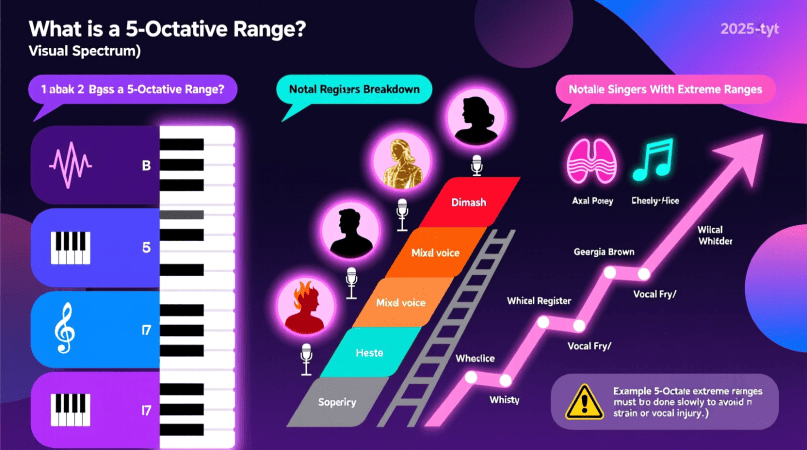
A 5-octave vocal range is one of the rarest measurable abilities in the human voice. While the average untrained singer typically spans 1.5 to 2.5 octaves, and many skilled vocalists reach 3 to 4 octaves, only a very small number of performers can reliably produce pitches across five full octaves.
This guide delivers the most complete explanation available—covering how a 5-octave range works, why it is rare, the registers involved, which singers legitimately demonstrate it, and how to accurately measure your own range.
What Is a 5-Octave Vocal Range?
A 5-octave vocal range means the singer can phonate pitches that span five complete octave intervals. Because each octave doubles in frequency, a 5-octave range represents:
- A 32× increase in pitch from lowest to highest note
- Coverage from very low fry notes to very high whistle-register tones
Example of a 5-Octave Span
C2 → C3 → C4 → C5 → C6 → C7
This is only one example; each singer’s span varies depending on register balance.
A 5-octave vocalist must access multiple advanced registers:
- Vocal fry (subharmonics)
- Chest voice (modal register)
- Mix / reinforced falsetto
- Head voice
- Whistle register (highest frequency register)
Without both the lowest and highest extended registers, achieving five full octaves is nearly impossible.
What Notes Are Included in a 5-Octave Range?
A 5-octave range typically includes:
| Register | Approx. Notes Covered |
|---|---|
| Subharmonic / Fry | C1–B1 (optional for ultra-low singers) |
| Low Chest | C2–B2 |
| Mid / Modal | C3–B3 |
| Head Voice | C4–B5 |
| Whistle Register | C6–C7 or higher |
Every 5-octave singer has a unique combination of high and low extremes.
Before recording vocals or taking online lessons, you can check your setup with the Microphone Tester and ensure your audio is clean. Once your mic is ready, tools like the Voice Frequency Test and the AI Voice Analysis help you evaluate sound quality, while the Voice Type Test shows what category best fits your voice.
How Rare Is a 5-Octave Voice?
A legitimate 5-octave vocal range is exceptionally rare due to four major factors:
1. Physiological Limitations
Most singers cannot thin, stretch, or relax their vocal folds far enough to reach both fry and whistle registers.
2. Register Coordination
Producing low, mid, and extremely high notes requires:
- Precise laryngeal control
- Highly efficient breath support
- Resonance tuning
This level of control is uncommon.
3. Elasticity & Thickness of the Vocal Folds
Only a small percentage of people are genetically predisposed to:
- Extreme fold flexibility
- Vocal fold edge integrity for whistle tones
- Subharmonic production at low pitches
4. Verified vs. Claimed Ranges
Many “5 octave” claims online are:
- Exaggerations
- Based on non-sung noises
- Not technically verified
Only a handful of singers demonstrate sustained, pitch-accurate 5-octave capability.
Singers With Verified 5-Octave (or Wider) Vocal Ranges
While many singers claim wide ranges, these performers are widely recognized for remarkable, documented spans:
1. Dimash Kudaibergen
Known for exceptional control from extreme low notes up to whistle tones, often demonstrating a range exceeding 5 octaves.
2. Mariah Carey
A pioneer of mainstream whistle-tone singing; her highest notes significantly extend her upper range into or beyond five octaves.
3. Georgia Brown
Reported Guinness World Record for vocal range, cited as 8 octaves (though widely debated). Still referenced as a high-range performer.
4. Tim Storms
Holds records for:
- Lowest note produced by a human voice
- Widest vocal range documented
Other Notable Multi-Octave Vocalists
- Axl Rose
- Mike Patton
- Minnie Riperton
- Adam Lopez
- Yma Sumac
Each singer uses a different combination of registers to achieve their span.
How a 5-Octave Vocal Range Is Physically Produced
The human voice creates a wide range through register transitions and biomechanical adjustments:
1. Subharmonic / Fry Register (Low Range)
- Produces very low tones through irregular vocal fold vibration
- Used by bass singers, overtone vocalists, and extreme low-range specialists
2. Chest Voice (Modal Register)
- The primary speaking/singing register
- Occupies roughly the lower-middle of the 5-octave span
3. Mixed & Head Voice
- Enable smooth transitions into higher notes
- Reduce strain while accessing pitches above the speaking range
4. Whistle Register
- Required for most 5-octave ranges
- Created by extreme thinning and stiffening of the vocal fold edges
- Produces the highest pitches the human voice can generate
A 5-octave range requires mastery of all four.
Usable Range vs Total Range
Most singers who demonstrate 5-octave ranges cannot musically use all five octaves in performance.
Total Range
- Every note the voice can produce
- Includes extremes in fry and whistle
- Often used only for demonstrations
Usable Range
- Notes with tone quality, stability, vibrato, and dynamic control
- Typically 2.5–3.5 octaves for most multi-octave singers
Understanding this distinction prevents unrealistic expectations about wide-range performance.
Can You Train to Achieve a 5-Octave Vocal Range?
Training can expand range, but genetics set the ultimate boundary.
Most singers can safely increase range by 1–2 octaves, but reaching five full octaves requires:
- Exceptional vocal fold elasticity
- Precise laryngeal mechanics
- Mastery of whistle register
- Ability to phonate subharmonics
- Advanced breath coordination
What training can reliably do
- Improve upper head voice
- Develop whistle tones (for some singers)
- Strengthen and extend vocal fry
- Increase usable singing range
- Improve register transitions
What training cannot guarantee
- Achieving whistle register
- Unlocking extreme subharmonics
- Developing a true 5-octave span
Most 5-octave singers are a blend of natural predisposition and high-level training
How to Measure Your Vocal Range Properly
Measuring range requires:
- Controlled phonation
- Stable tone (no squeaks or unstable fry)
- Quiet environment
A complete assessment includes:
Lowest Controlled Note
Not breathy fry—actual pitched vibration.
Highest Controlled Note
Not a scream—clean phonation with control.
Register Mapping
Track:
- Fry → chest → mix → head → whistle
Usable vs total range
Both must be evaluated separately.
Tools like the Vocal Range Test measure:
- Note accuracy
- Register transitions
- Tonal stability
- Voice type tendencies
Common Myths About 5-Octave Vocal Ranges
| Myth | Reality |
|---|---|
| Anyone can train to 5 octaves | Extremely rare; genetics play a major role |
| Whistle register = falsetto | They are completely different mechanisms |
| Singers with 5+ octaves can use all notes on stage | Only part of the range is musically usable |
| Hitting one high note means you have 5 octaves | Range is measured from low → high, not by isolated notes |
| More range = better singer | Tone, control, and musicality matter far more |
Frequently Asked Questions
Is a 5-octave vocal range rare?
Yes—very few singers possess this ability.
Can vocal training expand my range?
Yes, by 1–2 octaves in most cases, but 5 octaves requires exceptional biology.
Do whistle notes count toward vocal range?
Yes, they are recognized as the highest register.
What’s the widest range ever recorded?
Tim Storms holds the record for the largest documented range.
Is it safe to try whistle notes?
Only with proper technique. Poor technique may lead to strain or injury.
Conclusion
A 5-octave vocal range is one of the rarest and most impressive vocal abilities. It requires an extraordinary combination of anatomical advantages, disciplined training, and mastery of every vocal register. While few singers achieve it, understanding the mechanics behind extreme ranges can help any singer improve their technique, expand their voice, and explore their full vocal potential.
- Before chasing extreme notes, study how legends like Yma Sumac’s vocal range reached five-octave territory.
- Modern outliers such as Dimash’s vocal range show how classical technique meets contemporary pop.
- The deepest end of the spectrum is represented by Tim Storms’ vocal range, which redefines what low notes are possible.
- To understand how singers access ultra-high notes, learning how to do whistle voice is essential.
- Building a five-octave voice starts with consistent vocal exercises to increase range.
- A solid technical base from beginner singing lessons helps prevent damage when pushing extreme registers.
- For a full training roadmap, the best online singing lessons hub compares programs that specialize in advanced range development.
Erika Parker is a vocal analysis and singing education writer at Vocal Range Test. She focuses on vocal range testing, voice type analysis, pitch recognition, and singing tools for vocalists, musicians, choir singers, and beginners.