
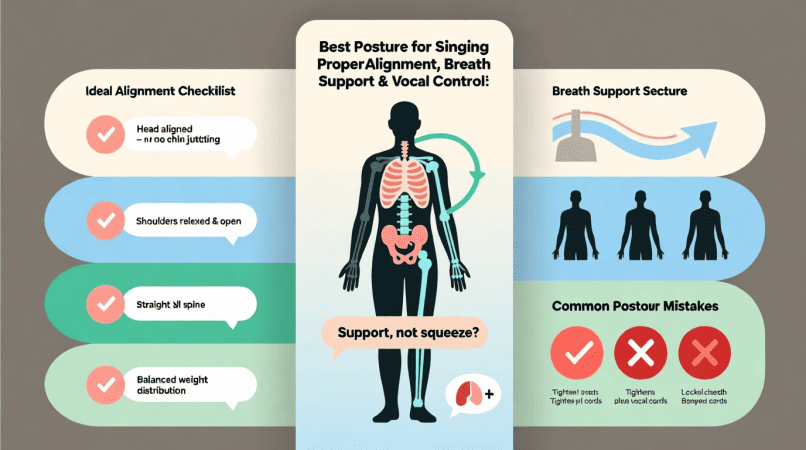
Your posture influences every aspect of your singing technique. It affects breath support, tone quality, resonance, projection, stamina, and even pitch accuracy. Whether you are a beginner or an experienced vocalist, developing proper posture is one of the fastest ways to improve your voice.
This guide explains the best posture for singing using vocal science, biomechanics, and step-by-step practical instruction.
Why Posture Matters for Singing
Good singing posture creates stability, openness, and freedom of movement throughout the body. It supports:
- deeper and more efficient breathing
- stronger resonance and sound vibration
- clearer vocal tone and projection
- reduced muscle tension and fatigue
- improved pitch accuracy
- better overall vocal stamina
Poor alignment restricts airflow, collapses the ribcage, and increases tension, making singing more difficult and less sustainable.
The Best Standing Posture for Singing (Step-by-Step)
Use this as your daily posture alignment reference.
1. Feet Position
Stand with your feet hip-width apart.
Keep equal weight on both feet, with the knees relaxed but not locked.
This creates stability without introducing tension.
2. Pelvis Alignment
The pelvis should remain in a neutral position.
Avoid tilting it too far forward (arched back) or backward (slouched posture).
Cue: Imagine your pelvis as a bowl of water — do not spill it in any direction.
3. Spine Alignment
Maintain a tall, neutral spine.
Avoid slouching or over-arching.
Your chest should be comfortably lifted and your ribcage open without forcing it upward.
Cue: Imagine a string gently lifting you from the crown of your head.
4. Ribcage Position
The ribcage should remain open, flexible, and able to expand easily.
A collapsed ribcage will restrict breath capacity and vocal resonance.
5. Shoulder Alignment
Keep the shoulders relaxed, low, and broad.
Avoid lifting them during inhalation, as this creates unnecessary tension and leads to shallow breathing.
6. Neck and Head Position
The head should sit naturally on top of the spine.
Avoid pushing the chin up or down.
Cue: The ears should line up with the shoulders.
7. Jaw and Facial Relaxation
A relaxed jaw and facial structure allow for clear diction and open vowel formation.
Avoid tension in the jaw, tongue, or lips.
Best Sitting Posture for Singing
Sitting is common in choir rehearsals, recording sessions, and piano-accompanied performances. The same principles apply, but with adjustments.
Correct Sitting Posture
- Sit on the front edge of the chair
- Keep feet flat on the floor
- Align knees with hips
- Maintain a tall spine
- Keep ribcage open
- Relax shoulders
- Ensure the pelvis is neutral, not slouched
If you can slouch easily, you are sitting too far back.
How Posture Affects Breath Support
Efficient breath support starts with proper posture. When the body is aligned:
- the diaphragm moves freely
- the ribcage expands in all directions
- airflow is steady and controlled
- breath lasts longer
- high notes feel easier
Poor posture restricts the diaphragm, collapses the ribcage, and increases throat tension, making breath support inconsistent.
Staying consistent with practice becomes easier when you follow the Daily Vocal Warm-Up and supplement it with more targeted routines such as the Quick Warm-Up Routine. You can track your progress with the Vocal Range Test and maintain vocal health by reviewing the Vocal Health Tips for Singers.
How Posture Affects Vocal Resonance
Proper posture allows sound waves to travel through the chest, throat, mouth, nasal cavity, and head. These spaces act as resonators that amplify and enrich the voice.
A collapsed posture reduces resonance space and limits tonal richness.
A tall, open posture enhances fullness, clarity, and projection.
Common Posture Mistakes Singers Make
- Slouching or collapsing the torso
- Lifting shoulders when breathing
- Locking the knees
- Tilting the chin up during high notes
- Overarching the lower back
- Singing with a tense jaw or neck
Correcting these mistakes improves breath management and sound quality almost immediately.
Posture Exercises to Improve Singing Alignment
1. Wall Alignment Exercise
Stand with the back of your head, shoulders, hips, and heels lightly touching a wall.
Step forward while maintaining the same alignment.
2. Sternum Awareness Exercise
Place a hand on the sternum and lift it gently.
Notice how your breathing becomes deeper and more efficient.
3. Pelvic Neutral Reset
While sitting or standing, tilt the pelvis forward and backward, then settle into the neutral middle position.
4. Shoulder Release Exercise
Roll the shoulders upward, back, and down repeatedly to release tension.
Posture Adjustments for Different Singing Styles
Classical Singing
- Emphasizes lifted sternum
- Requires tall, stable, consistent posture
- Favors maximum ribcage expansion
Pop Singing
- Allows more movement
- Still requires stable spine and relaxed shoulders
Musical Theatre
- Needs dynamic posture with mobility
- Must balance expressive movement and breath control
Choir Singing
- Involves long periods of standing or sitting
- Requires endurance posture and minimal tension
Frequently Asked Questions
1. What is the best posture for singing?
Standing tall with a neutral spine, balanced feet, relaxed shoulders, open ribcage, and aligned head.
2. Can posture improve high notes?
Yes. Proper alignment increases breath control and reduces strain, making high notes easier and clearer.
3. Should singers always stand?
Standing is ideal, but correct sitting posture can also support excellent singing.
4. Does posture affect breath support?
Yes. Posture directly influences diaphragm movement, ribcage expansion, and airflow stability.
5. How can I fix slouching when singing?
Use wall alignment drills and practice maintaining a neutral spine during warm-ups.
6. Should shoulders move during breathing?
No. Breathing should expand the ribs, not lift the shoulders.
7. Does posture affect vocal tone?
Yes. Good posture increases resonance, projection, and tonal richness.
Conclusion
The best posture for singing combines openness, stability, and natural alignment. When your body is properly positioned, breath support becomes easier, tone becomes richer, and vocal control improves significantly.
Good posture is not rigid. It is comfortable, balanced, and flexible. Mastering it is one of the most effective steps in developing a strong, healthy, and expressive singing voice.
- Proper alignment works best when combined with proven Alexander Technique for musicians that reduce tension while singing.
- You can reinforce healthy posture by practicing daily Alexander Method exercises focused on balance and spinal alignment.
- Understanding how the vocal cords work helps explain why posture directly affects tone and control.
- Many singers improve breathing mechanics through structured adult singing lessons that emphasize support and alignment.
- For foundational technique, these beginner singing lessons show how posture and breath should work together.
- You can reinforce upright stability with targeted vocal exercises to increase range that train controlled airflow.
- For a full technical roadmap, the best online singing lessons hub compares programs that integrate posture and breath support.