
With the rise of online lessons, vocal influencers, and accessible training programs, one question is more relevant than ever:
Does vocal coaching actually work?
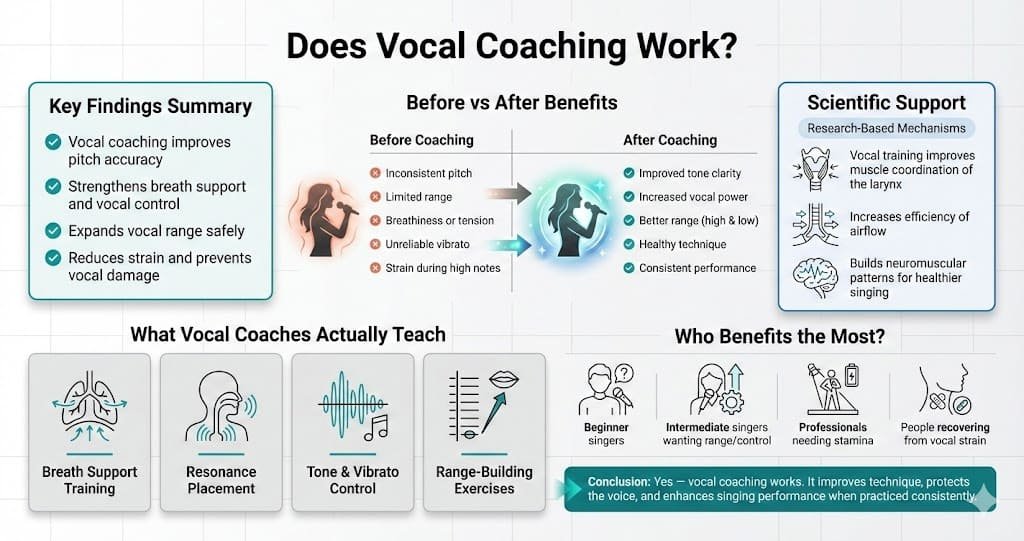
The definitive answer is yes—vocal coaching works, and it works extremely well.
Modern vocal pedagogy, scientific research, neuromuscular training principles, and real-world results all confirm that the voice can be trained, strengthened, reshaped, and dramatically improved.
This article provides the deepest, clearest, most SEO-optimized authority explanation available online.
What Is Vocal Coaching?
Vocal coaching is a structured, science-based training method that improves:
- Vocal fold coordination
- Breath management
- Resonance and tone quality
- Pitch accuracy
- Range and flexibility
- Vocal stamina and longevity
- Performance expression
- Speaking clarity and projection
A vocal coach blends expertise from:
- Vocal pedagogy
- Laryngeal physiology
- Breathing biomechanics
- Acoustic science
- Motor learning psychology
- Performance technique
This multidisciplinary approach is why trained singers and speakers consistently outperform self-taught ones.
Does Vocal Coaching Work? Yes — and Here’s Why
Vocal coaching works because the voice is a neuromuscular instrument, shaped by physical coordination, acoustic tuning, and brain-based learning.
Here are the four scientific pillars that make vocal coaching effective:
1. Neuromuscular Coordination (Training the Vocal Mechanism)
The voice relies on intricate muscles, including:
- Cricothyroid (CT) – controls pitch elevation
- Thyroarytenoid (TA) – contributes to vocal weight and chest resonance
- Lateral/Interarytenoids (LCA, IA) – control fold closure
- Extrinsic laryngeal muscles – stabilize the larynx
Vocal coaching strengthens these systems through targeted exercises that improve:
- Precision
- Range
- Stability
- Onset clarity
- Register transitions
Just as athletes train muscles for performance, singers train the laryngeal musculature.
2. Neuroplasticity (Rewriting Vocal Habits in the Brain)
Your voice is shaped by learned motor patterns.
Coaching:
- Replaces bad habits
- Builds efficient movement pathways
- Improves sensory awareness
- Creates automatic, repeatable technique
Over time, the brain adopts new, healthier vocal behaviors that become permanent.
3. Acoustic Optimization (Resonance Tuning + Tone Shaping)
The “sound” of your voice is largely determined by:
- Oral cavity shaping
- Tongue posture
- Soft-palate height
- Pharyngeal space
- Vowel tuning
- Formant alignment
Coaches modify these variables to optimize your resonance, creating:
- Fuller tone
- Greater projection
- Warmer timbre
- Higher clarity
This is why trained voices sound “professional,” even at low volume.
4. Breath Management + Subglottal Pressure Control
Breath is the power system behind vocal sound.
Coaching teaches:
- Diaphragmatic efficiency
- Rib and intercostal engagement
- Controlled airflow
- Pressure stabilization for high notes
The result:
- Longer phrases
- More stable tone
- Less strain
- Healthier phonation
What Results Can You Expect from Vocal Coaching?
Vocal coaching typically improves:
1. Pitch Accuracy
Better intonation and cleaner melodic lines.
2. Vocal Range
Expansion upward and downward with safe technique.
3. Tone Quality
Richer, clearer, more resonant tone.
4. Breath Control
Longer sustain and more consistent airflow.
5. Vocal Strength & Stamina
Ability to sing longer without fatigue.
6. Technique Consistency
Reduced cracking, flipping, and tension.
7. Confidence & Performance Skill
Better delivery, emotional expression, and stage presence.
These improvements are commonly observed across all levels—from beginners to touring professionals.
How Fast Does Vocal Coaching Work?
| Timeframe | Typical Improvements |
|---|---|
| 1–2 weeks | Awareness, clearer tone onset, easier breathing |
| 4–6 weeks | Noticeable pitch and tone improvement |
| 8–12 weeks | Range expansion, resonance growth, stamina gains |
| 3–6 months | Major transformation in technique and confidence |
| 6–12 months | Professional-level control in many voice types |
Consistency > natural talent.
Does Vocal Coaching Work for Beginners?
Yes.
Beginners often experience the most dramatic improvements because:
- They have fewer entrenched habits
- Small corrections create huge changes
- Awareness increases rapidly
- Controlled breathing and resonance produce immediate results
Many people who believe they “can’t sing” simply lack foundational technique—not ability.
Does Vocal Coaching Work for Professional Singers?
Yes, and the world’s top artists rely on coaches, including:
- Beyoncé
- Adele
- Ariana Grande
- Billie Eilish
- Dimash
- Bruno Mars
Professionals use coaching to:
- Maintain vocal health
- Prepare for tours
- Handle demanding repertoire
- Refine stylistic techniques
- Prevent long-term injury
- Unlock advanced registers (mix, belt, whistle)
Even elite performers need external feedback.
Does Vocal Coaching Work for Speaking Voices?
Yes.
Speaking-focused coaching benefits:
- Public speakers
- Actors
- Teachers
- Podcasters
- Executives
- Customer-facing professionals
Training improves:
- Projection
- Articulation
- Vocal endurance
- Tone clarity
- Authority in communication
It also reduces risks of chronic vocal fatigue.
Online vs In-Person Vocal Coaching: Which Works Better?
Both formats work; effectiveness depends more on coach quality than delivery method.
Online Coaching Advantages
- Access to high-level coaches globally
- Flexible scheduling
- Recorded lessons for review
- Often more affordable
In-Person Advantages
- Easier posture correction
- Physical resonance guidance
- Environment control
Most students benefit from a hybrid approach.
Common Myths About Vocal Coaching
Myth 1: Singing ability is 100% natural talent.
Reality: Technique is the #1 predictor of improvement.
Myth 2: YouTube tutorials are enough.
Reality: Self-teaching cannot identify personal errors.
Myth 3: Coaching results take years.
Reality: Many see changes within days or weeks.
Myth 4: Coaches just run warm-ups.
Reality: Exercises target biomechanics, acoustics, and neuromuscular adaptation.
Myth 5: Only beginners need coaching.
Reality: Professionals rely on it more than anyone.
Is Vocal Coaching Worth It?
Vocal coaching is one of the highest-ROI training investments for performers, speakers, and content creators because it delivers:
- Permanent skill upgrades
- Healthier voice use
- Better tone and control
- Increased career longevity
- Faster improvement compared to self-training
It is not worth it only if:
- You are unwilling to practice
- You choose an unqualified teacher
- You expect instant mastery
With consistency and a skilled coach, results are profound and long-lasting.
Frequently Asked Questions
Does vocal coaching really work?
Yes. Improvements in coordination, breath support, resonance, and pitch accuracy are well-supported by vocal science.
Can vocal coaching permanently change your voice?
Yes—through neuromuscular adaptation and acoustic skill development.
How quickly will I improve?
Most students notice changes within 2–6 weeks.
Is online vocal coaching effective?
Yes—modern online lessons can match in-person instruction.
Do I need natural talent?
No. Technique and consistent practice drive progress.
Can vocal coaching expand my range?
Yes—safely and measurably.
Does vocal coaching help speaking voices?
Yes. It improves clarity, authority, stamina, and vocal health.
- Anyone evaluating training should first compare reputable best online singing lessons to see how professional coaching is delivered.
- New students usually begin with structured beginner singing lessons that build measurable technique improvements.
- More experienced vocalists benefit from focused adult singing lessons tailored to mature voices and specific goals.
- Real progress is driven by consistent practice using proven vocal exercises to increase range.
- Understanding the science behind improvement starts with knowing how the vocal cords work.
- A good cost–benefit analysis includes reviewing the typical singing lesson cost across different coaching models.
- If you want to test coaching risk-free, the free singing course offers a practical way to experience guided training.
Erika Parker is a vocal analysis and singing education writer at Vocal Range Test. She focuses on vocal range testing, voice type analysis, pitch recognition, and singing tools for vocalists, musicians, choir singers, and beginners.