
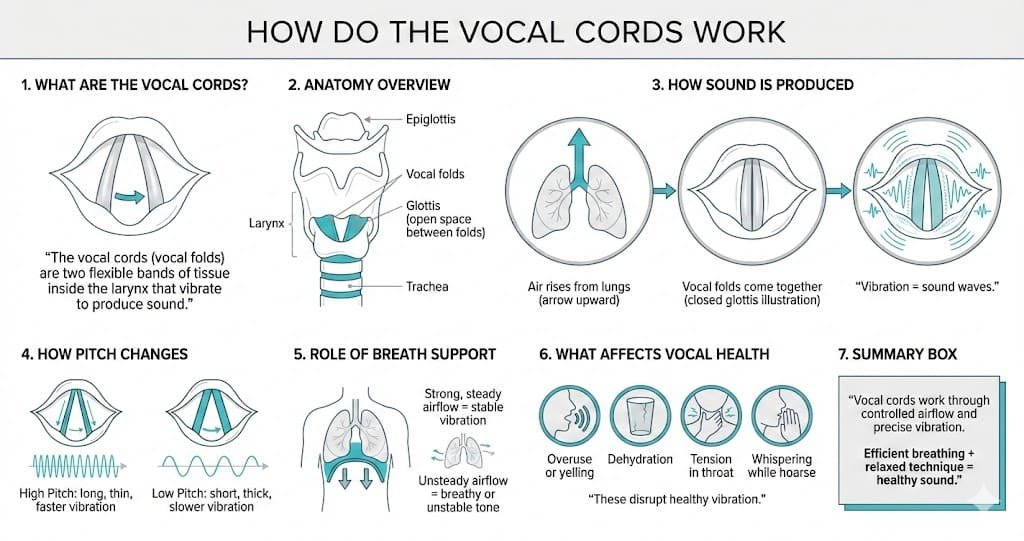
The human voice is produced by one of the most intricate biological mechanisms in the body: the vocal folds (commonly known as the vocal cords). These flexible structures vibrate with remarkable precision, enabling speech, singing, and countless expressive sounds. This guide provides a fully detailed scientific explanation of how the vocal cords work, how sound is formed, and the factors that influence vocal tone, pitch, and health.
What Are the Vocal Cords?
The vocal cords are paired folds of muscle and layered tissue located inside the larynx (voice box). Each fold is composed of:
- Epithelium (outer protective covering)
- Lamina propria (three-layer connective tissue system responsible for vibration)
- Thyroarytenoid muscle (forms the body of the vocal fold)
This multi-layered design allows the cords to withstand rapid vibration while remaining flexible and efficient.
Where Are the Vocal Cords Located?
The vocal cords sit horizontally within the glottis, a space inside the larynx. The larynx is supported by several cartilages:
- Thyroid cartilage
- Cricoid cartilage
- Arytenoid cartilages
These structures adjust the tension, length, and position of the vocal folds to produce different sounds and pitches.
How the Vocal Cords Produce Sound
Phonation is the process by which the vocal cords create sound. It involves several coordinated steps:
1. Breath Pressure Builds Below the Vocal Cords
Air from the lungs is pushed upward when you exhale.
This airflow, known as subglottal pressure, provides the power needed for vocal sound.
2. The Vocal Cords Move Toward Each Other (Adduction)
Muscles bring the cords close together without fully sealing the airway. This prepares them for vibration.
3. Airflow Forces the Cords Into Vibration
When enough air pressure builds, it pushes the folds apart.
They immediately come back together due to:
- Elastic recoil
- The Bernoulli effect
- Muscle tension
This rapid opening and closing cycle can occur hundreds or even thousands of times per second, producing the initial sound wave of the human voice.
4. Resonance Shapes the Sound Into a Recognizable Voice
The raw buzzing sound produced by the folds travels through the vocal tract (throat, mouth, nasal cavities).
These spaces act as resonators that shape tone, clarity, and pitch, giving each person a unique sound.
Beginners often see faster progress when they understand how their voice compares to others, which is why the singer comparison tool is a valuable resource. For those curious about standout performers, the widest vocal range page highlights extraordinary examples. You can evaluate your own recordings through AI voice analysis and confirm pitch stability using the voice frequency test.
How the Vocal Cords Control Pitch
Pitch is controlled by adjustments in the vocal folds’ length, tension, and mass.
1. Length of the Vocal Folds
Longer folds vibrate slower, producing lower pitches.
Shorter folds vibrate faster, producing higher pitches.
2. Tension of the Vocal Folds
Increased tension leads to faster vibration and higher pitch.
Relaxed folds vibrate more slowly, creating lower tones.
3. Thickness (Mass) of the Folds
Thicker folds produce deeper, darker tones.
Thinner folds produce lighter, higher tones.
Differences in fold length and mass explain why adult male voices are typically lower than female voices.
Understanding Vocal Registers: Chest, Head, Mixed, Falsetto, and Fry
Chest Voice
The folds are thick and vibrate fully, producing strong, resonant low to mid pitches.
Head Voice
The folds stretch and thin out. Resonance shifts upward into the head cavities.
Mixed Voice
A balanced blend of chest and head qualities, essential for smooth transitions.
Falsetto
Only the thin edges of the vocal folds vibrate. The sound is light and airy due to reduced contact.
Vocal Fry
The folds vibrate slowly and irregularly, producing a creaky sound. Often used in warm-ups or expressive speech patterns.
Why Every Voice Sounds Different
Several factors contribute to vocal uniqueness:
- Size and shape of the vocal tract
- Thickness and length of the vocal folds
- Muscle coordination patterns
- Habitual speech style
- Hydration and tissue health
- Age and hormonal influences
Because no two vocal tracts are identical, no two voices sound exactly alike.
Common Vocal Cord Problems and Their Causes
Laryngitis
Inflammation from illness, dryness, or irritants.
Vocal Nodules
Callus-like growths caused by chronic strain or misuse.
Polyps and Cysts
Benign lesions often requiring professional treatment.
Muscle Tension Dysphonia
Over-tightening of throat muscles leading to voice fatigue or strain.
Vocal Fatigue
Often from poor breath support or excessive talking or singing.
Acid Reflux (LPR)
Irritates and inflames vocal tissues.
How to Maintain Healthy Vocal Cords
Hydration
Keeps the mucosal layers lubricated and functioning efficiently.
Warm-Up Routines
Essential before extended speaking or singing.
Avoid Shouting or Vocal Over-Compression
Protects tissues from unnecessary collision and trauma.
Rest During Hoarseness
The folds require recovery when inflamed.
Breath Support
Good posture and diaphragmatic breathing reduce throat strain.
Avoid Smoking and Excess Irritants
Prevents drying, swelling, and long-term damage.
Reflux Management
Helps prevent acid-related inflammation.
Frequently Asked Questions About the Vocal Cords
Do the vocal cords touch when speaking?
Yes. During voiced sound, the folds make rapid, brief contact during each vibration cycle.
What causes a voice crack?
Sudden shifts in tension or register transitions cause instability in vibration.
Can vocal training extend your range?
Yes. Proper technique can expand both upper and lower registers safely.
Why do children have higher voices?
Their folds are shorter and thinner than adults’.
Can vocal cords heal?
Yes, but rest is essential. Chronic misuse can lead to lasting issues.
- Understanding voice anatomy becomes easier when you review the structured breakdown in choral voice classifications.
- Many singers develop healthier cord function through guided free vocal training that emphasizes airflow and resonance.
- Tension in the larynx is often reduced using principles from the Alexander Technique for musicians.
- Practical control of the cords improves with consistent adult voice lessons focused on breath management.
- To see how cord vibration creates elite sound, study Freddie Mercury’s singing range.
- Extreme elasticity of the vocal folds is demonstrated in Dimash’s vocal range.
- For applied technique, these targeted range-expansion workouts show how cord coordination develops.
Erika Parker is a vocal analysis and singing education writer at Vocal Range Test. She focuses on vocal range testing, voice type analysis, pitch recognition, and singing tools for vocalists, musicians, choir singers, and beginners.