
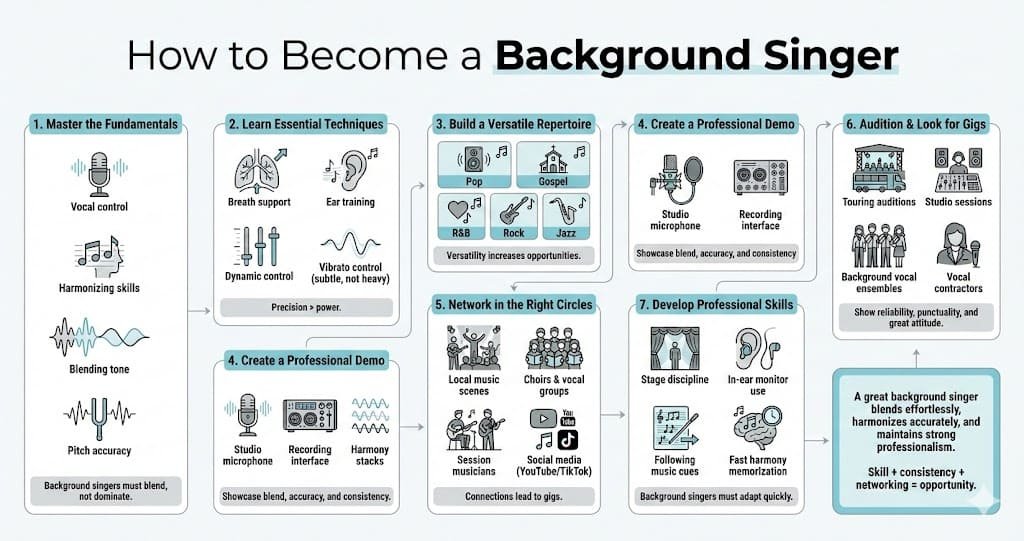
Background singers are the hidden engine of the music industry—the invisible pillars supporting every great live performance and studio recording. They bring depth, emotion, texture, and power to a song. While lead vocalists carry the spotlight, background singers are trusted musicians, relied upon for precision, professionalism, and vocal mastery.
This definitive guide breaks down exactly how to become a successful background singer, from technical vocal skills to industry navigation, networking, auditions, studio workflow, and long-term career growth.
Understand the Real Role of a Background Singer
A background singer is more than “someone who sings behind the lead.” The job is highly skilled, fast-paced, and requires musical intelligence.
Primary Duties
- Provide harmony, doubles, and supportive vocal textures
- Match the lead singer’s tone, phrasing, and dynamics
- Memorize arrangements, choreography, and transitions
- Blend seamlessly with other backup vocalists
- Follow cues from the Music Director (MD)
- Adjust instantly when arrangements change during rehearsals
Types of Background Vocal Work
- Studio Session Work (recording harmonies for songs, commercials, films)
- Live Performance Singing (concerts, awards shows, festivals)
- Touring Background Vocalist (traveling with artists)
- Choir/A Cappella Work
- Corporate and Theater Shows
- Cruise Ship Contracts
Background singers must be reliable, versatile, and fast learners.
Build the Specialized Skills Every Professional Background Singer Needs
Background singing is a technical discipline that requires mastery of skills many lead vocalists don’t develop.
Essential Skills for Background Singers
1. Harmony Mastery
This is the foundation of backup singing. You must be able to:
- Build 3rd, 5th, and 7th intervals by ear
- Hold a harmony against a dominant melody
- Create natural, stylistic harmonies (pop, gospel, R&B, rock)
- Adjust when arrangements change
- Stay locked in despite distractions
2. Exceptional Pitch & Ear Training
Professional background singers can:
- Identify intervals instantly
- Sing perfect thirds, fourths, fifths
- Match pitch even when lead deviates
- Hear internal harmonies in complex arrangements
3. Blend & Tone Matching
Blend separates amateurs from professionals. You must:
- Match vowel shapes
- Match breathiness or brightness
- Match vibrato speed (or suppress vibrato entirely)
- Adjust volume instantly
- Shape tone to match the group or lead
4. Sight-Singing & Music Theory
Not required everywhere, but highly valued for:
- Studio sessions
- Theater and professional productions
- High-level touring gigs
- Church and choir work
Skills include:
- Reading lead sheets
- Reading Nashville Number System charts
- Following conductor cues
5. Microphone Technique
Professional background singers know how to:
- Control dynamics with mic distance
- Avoid plosives
- Use side-angle mic placement for smooth blend
- Sing off-axis when necessary
6. Stamina, Consistency & Vocal Health
Backup singers must sing:
- Repeated choruses
- Multiple runs through arrangements
- Hours of rehearsal
- Nightly performances on tour
Vocal health is non-negotiable.
Singers preparing for more advanced repertoire will benefit from consistent practice using the daily vocal warm-up. After warming up, confirm that your microphone setup is accurate by using the microphone tester. When you’re ready to explore range specifics, the mezzo-soprano vocal range and baritone vocal range guides offer useful reference points.
Train Like a Professional: Daily Training System
A polished background vocalist trains like an athlete.
Sample Daily Routine
- 5 minutes — warm-up (lip trills, sirens, humming)
- 10 minutes — harmony drills (3rds, 5ths, unison blending)
- 5 minutes — ear training (intervals, chord tones)
- 10–20 minutes — repertoire harmonization
- 3 minutes — cool-down
Joining Ensembles Is Critical
- Choirs
- Gospel groups
- A cappella groups
- Vocal ensembles
- Community choirs
These environments sharpen:
- Blend
- Tone matching
- Listening skills
- Following MD direction
- Musical discipline
Choose Your Background Singing Path: Studio, Live, or Touring
Studio Background Singer
Requires:
- Hyper-accurate pitch
- Perfect timing
- Ability to blend instantly
- Fast learning
- Vocal stacking skills
Live Background Singer
Requires:
- Stage presence
- Projection
- Choreography ability (especially in pop)
- Strong memory
- Consistent stamina
Touring Background Singer
Requires:
- Adaptability
- Touring discipline
- Vocal consistency under travel strain
- Professionalism with large crews
Each path offers different earnings, expectations, and opportunities.
Build a Professional Vocal Reel (Your Most Important Tool)
Your vocal reel—not your résumé—is what gets you hired.
A Great Vocal Reel Includes:
- 1 harmony line example
- 1 blend demonstration with doubled parts
- 1 genre versatility clip (pop/R&B/gospel/etc.)
- 1 short lead vocal sample (optional but helpful)
- 1 clean a cappella harmony section
- High-quality audio and simple visuals
Reel Tips
- Keep it under 90–120 seconds
- Showcase precision, not vocal “flexing”
- Use controlled environments (no noisy live clips)
Create a Simple Home Studio for Recording at a Professional Level
You can start with:
- Quality USB mic or XLR mic + audio interface
- Pop filter
- Closed-back headphones
- Basic acoustic treatment (foam, blankets, rugs)
- DAW: Logic Pro, Pro Tools, or GarageBand
High-quality recordings help you:
- Get hired for remote session work
- Build better reels
- Collaborate with producers
Get Real Experience Through Local Opportunities
Practical experience matters more than theory.
Where to Start Working as a Background Singer
- Local venues and bands
- Churches and gospel choirs
- Community choirs
- Open mic nights
- School/college ensembles
- Musical theater productions
- Local recording studios
- Online collaborations (SoundBetter, Fiverr, YouTube creators)
Every performance grows your network and skillset.
Learn How Background Singers Get Hired in the Industry
Who Hires Background Singers
- Music directors (MDs)
- Vocal contractors
- Recording producers
- Touring companies
- Churches
- Venue music coordinators
Where to Find Jobs
- Instagram (biggest discovery hub)
- TikTok (showcase harmonies)
- Facebook musician groups
- BandMix
- SoundBetter (for remote sessions)
- Backstage, StarNow (auditions)
- Local music schools or studios
Networking is critical. One good gig can lead to years of consistent work.
Master the Audition Process for Background Singing
Background auditions are unique. You may be asked to:
- Sing harmony with zero preparation
- Match tone to another singer instantly
- Sight-sing a short passage
- Follow director cues
- Perform choreography (for pop/urban gigs)
- Learn an arrangement in minutes
How to Stand Out
- Demonstrate instant blend
- Stay calm under pressure
- Match vowels precisely
- Keep vibrato subtle unless requested
- Show excellent ear skills
- Be friendly, confident, and professional
Understand Income, Rates & Career Growth
Typical Earnings (Varies by country & production scale)
Local Background Singer
- $100–$400 per show
Studio Session Background Singer
- $150–$600 per session
- High-level sessions pay significantly more
Touring Background Singer
- $700–$3,000+ per week
- Additional per diem, travel, food, housing may be included
Long-Term Growth Opportunities
- Music Director (MD)
- Vocal Contractor
- Vocal Arranger
- Session Specialist
- Songwriter for backing vocals
- Lead vocalist
Career progression is flexible, and many background singers build robust, financially stable careers.
Frequently Asked Questions
Can I become a background singer with no experience?
Yes. Start with choirs, harmony practice, and small local gigs.
Do background singers need to read music?
Not always—but sight-reading greatly increases job opportunities.
How long does it take to become a professional background singer?
6 months to 2 years of consistent training.
Do I need a vocal coach?
Highly recommended for blend, tone control, stamina, and overall professionalism.
Is harmony the most important skill?
Yes. Harmony and blend are the core of the job.
Conclusion
Becoming a background singer is a realistic, achievable career path for anyone with musical discipline, a trained ear, and a passion for harmony. With the right training, vocal reel, network, and professional attitude, you can work in studios, perform live, tour the world, and build a respected, well-paid career behind the scenes.
- Most professional backing vocalists begin by mastering fundamentals through structured beginner singing lessons.
- Reliable studio work depends on refined technique built in focused adult singing lessons.
- Understanding harmony roles is easier when you study standard choral voice ranges.
- Technical control improves with daily vocal range training.
- Before investing heavily, testing a free online singing course lets you experience guided instruction.
- Knowing how sound is produced helps with blending, which is explained in how the vocal cords work.
- To choose professional training, the best online singing lessons hub compares programs used by working vocalists.