
Avi Kaplan’s vocal range spans approximately Eb1 to D5 — around four octaves — with a lyric bass instrument that sits comfortably in the first octave, a register most singers can’t access at all. As the former vocal bass of Pentatonix from 2011 to 2017, and a Grammy-winning a cappella performer, Kaplan built his reputation on a voice that could reach pitches more commonly associated with a pipe organ than a human throat. Since leaving the group, his solo folk career has shown a different dimension of that instrument: warmer, more intimate, and stripped of the a cappella context that once framed it.
What makes Kaplan genuinely unusual isn’t just the depth of his range — it’s the quality he maintains down there. Many singers can force a note into the first octave. Far fewer can sustain tone, resonance, and intonation that deep without the voice collapsing into an indistinct rumble.
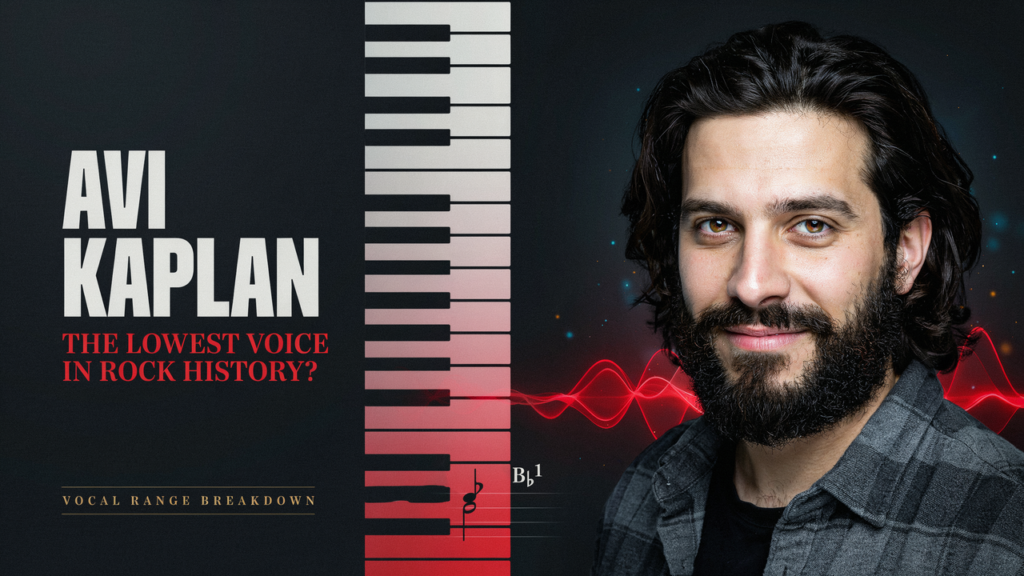
Avi Kaplan’s Vocal Range at a Glance
Vocal range: approximately Eb1 – D5 Voice type: Lyric bass Vocal registers in use: Chest voice (sub-bass to mid-range), mixed voice, head voice/falsetto Approximate span: Around 4 octaves Tessitura (comfortable center): Roughly E2 to C4 Training background: Mt. San Antonio College (choral and opera program); a cappella performance
What Voice Type Is Avi Kaplan?
Kaplan is a lyric bass — specifically the kind of bass voice that sits at the heavier, lower end of the male vocal spectrum while still retaining flexibility and warmth rather than pure darkness. In the classical vocal fach system — the German classification system that categorizes voices by weight, timbre, and range — the lyric bass is distinct from the dramatic bass (built for sheer power and depth) and from the bass-baritone (which overlaps into baritone territory with a heavier quality). The lyric bass has a natural richness in the low register but can ascend into the third and even fourth octave with a mixed voice that sounds controlled rather than strained.
Kaplan’s chest voice floor sits well into the first octave — E1, Eb1 — which is territory only a small percentage of trained bass singers can access cleanly. For context, the lowest note on a standard piano bass register is A0; E1 is three semitones above that. Most listeners can’t even perceive pitches that low without good speakers or headphones, which is why Kaplan famously recommends using quality audio equipment to hear his lowest notes clearly.
For a broader sense of where bass sits in relation to other voice types, the bass vocal range page covers the full classification in detail, and the vocal range chart maps all six categories together.
His Lower Register: Into the First Octave
The first octave — notes below C2 — is what separates a true bass from a baritone who sings low. Most male singers, including many who identify as basses, reach their practical floor around C2 or D2. Kaplan descends significantly below that, with documented notes in the Eb1–G1 range in Pentatonix performances.
What’s important to understand is how a voice produces sound at these extreme lows. At pitches below about C2, the vocal cords are vibrating very slowly — fewer than 65 Hz — and the resonance chambers of the chest and throat have to work hard to amplify a signal that the human ear struggles to register as musical tone. Singers who try to force their way into this territory typically produce a gravelly, uncertain sound; Kaplan sustains actual pitch and tone there, which is a product of both natural physiology and years of trained a cappella technique that demands precise intonation at every register.
His lows are the most commented-on feature of his voice, and for good reason — but they can obscure the fact that his mid-range is equally strong. His chest voice through the second and lower third octave (C2–C3) is where his voice sounds richest and most naturally resonant, which is typical for a well-developed lyric bass instrument.
His Upper Register: Mix and the Fourth Octave
A bass who can only sing low is a one-dimensional instrument. What distinguishes Kaplan is that he ascends reasonably high for the voice type — into the third octave and, in lighter mixed voice, into the lower fourth octave up to around D5.
Vocal analysts who have studied his Pentatonix work note that his mix — the blended chest-head register — is unusually smooth and controlled for a bass. While his belts sit low (C4 and above represent genuine upper-range extension for this voice type), his mixed voice in the upper third octave has a gentle, floating quality that’s described as almost disarming coming from a voice that can also rumble below E1. The contrast between the two ends is part of what made him so useful in a cappella harmony arrangements.
That mix, used in songs like “Standing By” and “Little Drummer Boy” with Pentatonix, demonstrates the kind of register integration that is covered in depth in the piece on chest voice vs head voice — understanding how those two resonance modes blend is key to understanding what makes Kaplan’s upper range work.
Overtone Singing: Kaplan’s Rarest Ability
Separate from his documented pitch range, Kaplan has a skill that places him in a genuinely small group of vocalists globally: the ability to overtone sing, sometimes called throat singing or harmonic singing.
Overtone singing works by selectively amplifying specific harmonic frequencies that exist in any vocal sound. Normally when you sing a note, you produce a fundamental pitch and a series of overtones above it — but those overtones blend into the overall timbre of the voice and aren’t perceived as separate pitches. By shaping the oral cavity, tongue, and lips in precise ways, an overtone singer can isolate and amplify one of those upper harmonics so it sounds like a separate, higher note ringing above the fundamental. The result is audibly singing two pitches simultaneously.
Kaplan has demonstrated this technique at a cappella workshops, including a documented session at the University of Tennessee in 2017, and it’s visible in multiple Pentatonix performances where a high, flute-like tone floats above his deep bass foundation. The technique is most commonly associated with Mongolian and Tuvan musical traditions, and very few Western pop or a cappella singers have developed it to performance level.
This is genuinely a distinct skill from vocal range. It’s not that he’s singing higher — it’s that he’s producing a resonant harmonic overtone above his fundamental pitch. The two things coexist simultaneously rather than replacing each other.
His A Cappella Role in Pentatonix
In a cappella arrangements without instruments, the bass singer’s voice serves the function that a bass guitar and kick drum normally fill — providing rhythmic foundation and harmonic grounding so the upper voices have something to anchor against. In a standard group, that bass role requires someone who can reliably produce notes in the C2–G2 range cleanly and consistently.
Kaplan didn’t just fill that role — he extended it downward by an octave, giving Pentatonix arrangements a sub-bass floor that was unusual even by a cappella standards. When Pentatonix covered songs like “Daft Punk,” “Little Drummer Boy,” or “Bohemian Rhapsody,” Kaplan’s bass provided a textural depth that most a cappella groups simply can’t replicate without electronic processing.
He joined Pentatonix in 2011 after the founding members sought a bass singer for the group’s audition on NBC’s The Sing-Off. His prior work with the a cappella group Fermata Nowhere at Mt. San Antonio College had already established him as a recognized figure in the a cappella community — he was the first vocal bass to win the ICCA’s Best Rhythm Section award, an honor previously given exclusively to beatboxers.
His Solo Folk Career: A Different Use of the Same Voice
Kaplan left Pentatonix in 2017, citing the difficulty of the touring schedule and a desire to spend more time with family. What followed was a deliberate return to folk music — a genre he describes as his actual musical roots, the sound he grew up with and always wrote in privately.
His solo output under his own name (and briefly as Avriel & the Sequoias) — the EPs Sage and Stone (2017), I’ll Get By (2020), and the debut album Floating on a Dream (2022) — uses his bass voice in a radically different context. Without the a cappella group requiring him to anchor harmony stacks at extreme lows, the solo recordings place his voice in a more conversational register: the upper second and lower third octave, where a warm, resonant folk baritone can carry a lyric with emotional weight rather than sonic spectacle.
It’s worth noting how different the same instrument sounds in these two contexts. The Pentatonix bass who rumbles below E1 and the folk singer on “Change on the Rise” or “I’ll Get By” are the same voice — but the solo recordings reveal a warmth and textural intimacy that the a cappella context, by necessity, subordinated to the needs of the arrangement.
How Kaplan’s Range Compares to Other Famous Basses
Among well-known male vocalists with documented low ranges, Kaplan sits in rare company. Tim Storms holds the Guinness World Record for the lowest vocal note ever recorded (G-7, eight octaves below the lowest G on a standard piano), but Storms operates at the extreme experimental end and doesn’t perform in conventional musical contexts. Among working singers, a consistent floor in the Eb1–E1 range puts Kaplan among the deepest bass performers in pop and a cappella.
For a sense of where other deep voices sit, the pages on Tim Storms and Josh Turner offer useful comparisons — both sit at the lower end of the male vocal spectrum, though Kaplan’s first-octave access goes below either.
If you want to find out where your own voice sits — whether you’re in bass, baritone, or tenor territory — the vocal range finder will map your range, and the voice type test will tell you which classification fits your instrument. Fans of Pentatonix may also want to explore the Mitch Grassi vocal range page for the opposite end of the group’s extraordinary spectrum.
FAQs About Avi Kaplan’s Vocal Range
What is Avi Kaplan’s vocal range?
His range spans approximately Eb1 to D5 — around four octaves. His chest voice floor descends well into the first octave, making him one of the deepest-voiced performers in contemporary music, while his mixed voice reaches into the lower fourth octave.
What voice type is Avi Kaplan?
He’s a lyric bass. The lyric bass sits at the low end of the male vocal spectrum, with a rich, warm quality in the low register and enough upper-range flexibility to function in harmony arrangements and folk singing. It’s a rarer voice type than baritone or tenor.
What is overtone singing, and does Avi Kaplan actually do it?
Yes, he does. Overtone singing — also called throat singing or harmonic singing — is the technique of selectively amplifying harmonic frequencies above a fundamental pitch so they’re perceived as a separate, higher note. The result sounds like singing two notes at once. Kaplan has demonstrated and taught the technique publicly, including at university a cappella workshops.
Why did Avi Kaplan leave Pentatonix?
He left in 2017, citing the difficulty of the group’s touring schedule and a desire to spend more time with family. He has spoken about the decision openly in interviews. He went on to pursue a solo folk music career, recording under his own name and briefly as Avriel & the Sequoias.
How does Avi Kaplan’s bass compare to other famous bass singers?
His documented lower range — reaching Eb1 — puts him among the deepest working performers in pop and a cappella. Most bass singers in commercial music operate with a floor around C2 or D2; Kaplan descends a full octave below the standard working bass range.
Erika Parker is a vocal analysis and singing education writer at Vocal Range Test. She focuses on vocal range testing, voice type analysis, pitch recognition, and singing tools for vocalists, musicians, choir singers, and beginners.