
Carrie Underwood’s vocal range spans from D3 to C6, covering just over 3 full octaves. She is classified as a lyric soprano with exceptional chest voice power, an effortless upper register, and one of the most recognisable tones in country music.
What makes Underwood distinctive is not just her ceiling — it is how she sounds at every point across those 3 octaves. Her chest voice is full and muscular well into the fifth octave, and she transitions into head voice and mixed register without the audible break that catches most singers.
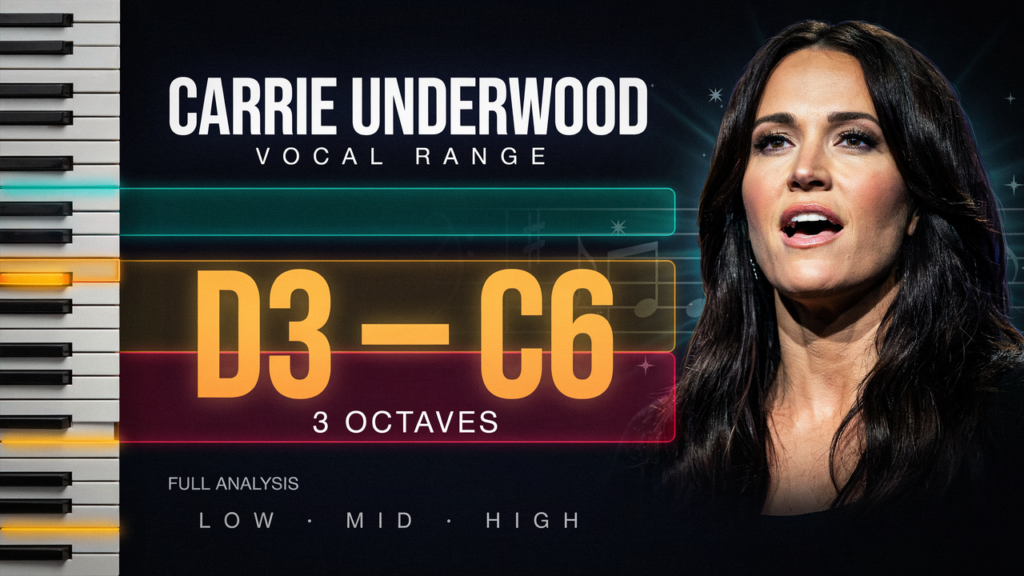
Carrie Underwood Vocal Range at a Glance
| Detail | Information |
|---|---|
| Vocal Range | D3 – C6 |
| Octaves | 3+ octaves |
| Voice Type | Lyric Soprano |
| Tessitura | F4 – G5 |
| Highest Confirmed Note | C6 (Before He Cheats live) |
| Lowest Confirmed Note | D3 |
| Vocal Register | Full chest voice, mixed voice, head voice |
What Voice Type Is Carrie Underwood?
Carrie Underwood is a lyric soprano. In classical vocal classification, this means her voice is lighter and more agile than a dramatic soprano, with a natural brightness that sits comfortably in the F4–G5 range — her tessitura.
In country and pop terms, she is often described simply as a soprano because her voice consistently dominates in the upper fourth and fifth octaves in live performance, without strain or audible effort.
She has the core characteristics of a lyric soprano: a clear, penetrating tone in the upper register, a chest voice that carries significant weight without becoming heavy or dark, and a mixed register that blends both seamlessly on sustained high notes.
Carrie Underwood’s Highest Notes
Underwood regularly performs above C5 in live settings, which already puts her well ahead of the average female singer. Her highest confirmed notes sit in the sixth octave.
C6 — reached in live performances of Before He Cheats and How Great Thou Art. The C6 during her 2011 ACM Awards performance of How Great Thou Art is widely considered one of the most impressive live soprano notes in modern country music.
B5 — a note she hits consistently across stadium tours, including Blown Away and Cry Pretty, using a mix of chest-supported head voice.
A5 — her most frequently used upper note. It appears across multiple studio recordings and is the note most analysts use as her practical performance ceiling for sustained notes.
Her studio recordings often sit slightly lower than her live peaks, as Underwood tends to push harder in live performance, which is the opposite of most pop singers.
Carrie Underwood’s Lowest Notes
Her lower range is less celebrated but real. Underwood can descend to D3 in chest voice, which is solid for a soprano. Most lyric sopranos begin to thin out around E3–F3, so the D3 demonstrates above-average chest extension downward.
In live performances, she typically avoids sustained notes below G3, keeping most of her performances centred in the F4–A5 range where her voice has its most natural power and resonance.
Carrie Underwood’s Vocal Technique
Chest Voice Power Underwood’s defining technical quality is the strength of her chest voice at the top of its range. Most singers begin mixing or switching to head voice around E5. Underwood maintains a strong chest-dominant or thick mixed tone up to A5 and sometimes beyond, which is the source of the raw power audiences hear in her biggest moments.
Passaggio Control The passaggio — the point where a voice transitions between registers — sits around E5–F5 for most sopranos. Underwood manages this transition cleanly, which is why her high notes sound full and powerful rather than thin or heady. She has trained this connection extensively over her career.
Vibrato Her vibrato is natural and consistent, particularly in the upper register. It averages approximately 5–6 oscillations per second, which sits in the classical range for a lyric soprano. In more emotionally intense moments she tightens vibrato for straight-tone emphasis before releasing into a fuller oscillation.
Vocal Agility Underwood is not primarily known as a melismatic singer in the way Whitney Houston or Mariah Carey are, but she deploys runs and ornaments precisely and cleanly. Her melisma is more restrained than flashy, which suits the country-pop format.
Breath Support Her breath management is a major factor in her live consistency. She maintains support over long phrases — particularly in arena settings — without audible breath breaks. This is the result of years of diaphragmatic training that allows her to sustain the kind of high-belt moments that define her biggest songs.
Her Most Vocally Demanding Songs
How Great Thou Art — The 2011 ACM Awards version remains the benchmark for her vocal range in performance. The final sequence climbs through A5 and touches C6, sustained with full chest support. It is the single most-cited example of her upper ceiling.
Blown Away — The climactic vocal builds from a restrained low-register opening through to an exposed A5 in the final chorus. The dynamic contrast makes it one of her most technically complete performances.
Before He Cheats — Her breakthrough hit contains a live-performance C6 in certain versions. Studio-recorded, it sits more modestly around G5, but live she consistently extends the note.
Cry Pretty — Released in 2018, this song was designed specifically to show her upper range, with sustained notes in the B5 area that she handles cleanly both in the studio recording and in live television performances.
Something in the Water — The gospel-influenced bridge requires sustained chest-mix notes in the A5–B5 range while maintaining lyrical clarity. It is one of her more demanding studio recordings in terms of register blend.
How Carrie Underwood’s Range Compares to Other Singers
| Singer | Voice Type | Range | Octaves |
|---|---|---|---|
| Carrie Underwood | Lyric Soprano | D3 – C6 | 3+ |
| Kelly Clarkson | Mezzo-Soprano | B2 – E6 | 3.5 |
| Whitney Houston | Soprano | A2 – G#5 | 3 |
| Celine Dion | Lyric Soprano | B2 – E6 | 3.5 |
| Dolly Parton | Soprano | D3 – A5 | 2.5 |
| Miranda Lambert | Mezzo-Soprano | C3 – G5 | 2.5 |
Underwood’s range is comparable to Whitney Houston in total span, though their voice types differ significantly. She sits below Celine Dion in overall ceiling but surpasses most of her country contemporaries. The comparison with Kelly Clarkson is interesting because Clarkson’s lower floor gives her a wider total range, but Underwood’s chest voice dominance in the upper register gives her more power at the top.
Has Carrie Underwood’s Voice Changed Over Time?
Yes — and in the way that good vocal training produces. Early in her American Idol career (2005), her voice had more raw brightness but less control over the passage between registers. By 2010–2015, she had developed the mixed voice and breath management that characterise her peak performances.
More recently, maturity has added depth to her lower register. The D3 floor is more accessible in her later recordings than it was in early work, which is typical for sopranos in their mid-30s to 40s, when the voice gains weight below without losing the upper ceiling.
There are no credible reports of significant vocal damage or surgery, which is notable given how frequently and intensely she performs live.
What Makes Carrie Underwood’s Voice Stand Out
The combination of a lyric soprano’s upper brightness with a chest voice that stays thick and powerful far higher than typical is relatively rare. Most lyric sopranos thin out significantly above E5. Underwood keeps real mass in the tone through A5, which is why she sounds so commanding in arenas without amplification tricks.
Her consistency is equally notable. Across a 20-year career that includes stadium tours, televised award shows, and Las Vegas residencies, she maintains the same technical standard. Very few artists at her output level — in terms of both performance frequency and emotional intensity — manage this.
FAQs
What is Carrie Underwood’s vocal range? Carrie Underwood’s vocal range spans D3 to C6, covering just over 3 octaves. She is classified as a lyric soprano.
What voice type is Carrie Underwood? Carrie Underwood is a lyric soprano. Her voice sits most naturally between F4 and G5, which is her tessitura — the range where her voice sounds most powerful and effortless.
What is Carrie Underwood’s highest note? Her highest confirmed note is C6, reached during live performances of How Great Thou Art and Before He Cheats. Her most consistently used upper notes in performance sit around A5–B5.
How many octaves can Carrie Underwood sing? Carrie Underwood can sing just over 3 octaves, from D3 to C6.
Is Carrie Underwood a soprano or mezzo-soprano? She is a soprano — specifically a lyric soprano. Her natural voice sits in the upper register, and her tessitura confirms soprano classification. Some of her country contemporaries are mezzo-sopranos, but Underwood is definitively soprano.
How does Carrie Underwood’s vocal range compare to Kelly Clarkson? Kelly Clarkson has a slightly wider range (B2–E6) with a lower floor, while Carrie Underwood’s chest voice dominance in the upper register gives her more power between F4 and A5. Both are elite vocalists in their respective styles.
Erika Parker is a vocal analysis and singing education writer at Vocal Range Test. She focuses on vocal range testing, voice type analysis, pitch recognition, and singing tools for vocalists, musicians, choir singers, and beginners.