
Dolly Parton’s vocal range spans approximately F3 to E5 — just under two octaves in practical performance — with a bright soprano instrument that has become one of the most instantly recognisable voices in the history of country music. Born the fourth of twelve children in Locust Ridge, Tennessee in 1946, raised in a one-room cabin in the Appalachian foothills, Parton grew up hearing “old porch-picking music, old songs brought back from England and Ireland,” as she described to NPR — the Appalachian folk and gospel tradition that shaped both her voice and her approach to songwriting.
She has written more than 3,000 songs, sold over 100 million records, and achieved 25 number one country hits. The day in 1973 when she wrote both “Jolene” and “I Will Always Love You” in a single session — later described simply as “a good writing day” — produced two of the most covered and enduring songs in popular music. The voice that delivered them is the instrument this article examines.
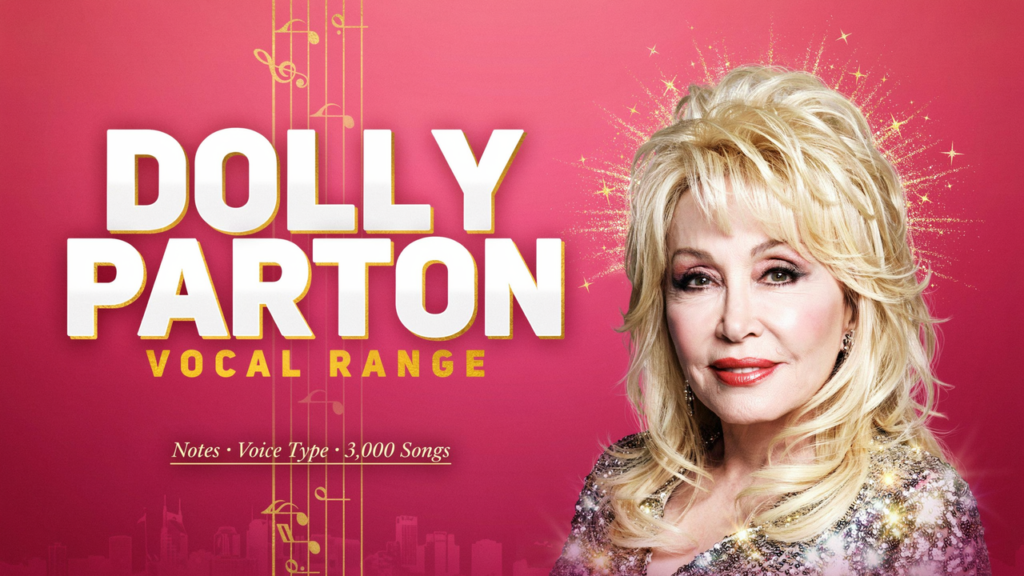
Dolly Parton’s Vocal Range at a Glance
Vocal range: approximately F3 – E5 Voice type: Soprano (spinto-leaning) Vocal registers in use: Chest voice, mixed voice, head voice Approximate span: Just under 2 octaves in practical performance Tessitura (comfortable centre): Roughly B3 to C5 Active career: 1956–present
What Voice Type Is Dolly Parton?
Parton is a soprano — specifically described by vocal analysts as a spinto-leaning soprano in the country tradition. “Spinto” in classical terminology means a lyric voice with enough weight and power to sustain in dramatic contexts; applied to country music, it describes the quality that lets Parton’s bright upper register cut through a full band arrangement without losing its characteristic clarity.
The brightness of her soprano is tied directly to her Appalachian roots. The Appalachian singing tradition — shaped by English and Irish folk music, shaped further by gospel — favours a forward, bright vocal placement rather than the darker, rounder resonance of European classical singing. That brightness became Parton’s tonal signature: crystalline in the upper register, warm and narrative in the mid-range, always with the precision of someone who understands that in country music, the lyric is as important as the note.
For a fuller sense of where her soprano sits relative to the female voice type spectrum, the soprano vocal range page covers the full range of subtypes.
Her Lower Register: F3 and Storytelling Chest Voice
F3 — the F just below middle C — is the lower edge of Parton’s practical range. She doesn’t descend there often in her most widely-heard recordings; the majority of her verse material sits in the A3–C4 zone, which is comfortable mid-range for a soprano. But when the material needs it, the chest voice in the lower third octave carries real warmth and narrative weight.
“Coat of Many Colors” (1971), one of her most autobiographical songs, demonstrates the lower chest register’s storytelling function. The song sits in the G3–D5 range and uses the verse passages in the lower third octave to create intimacy and vulnerability — the voice of a child remembering. The melodic range is modest; the emotional range is vast. That combination — a small note range used with large emotional precision — is one of the defining qualities of Parton as a vocalist.
Her Appalachian background trained this register not through formal technique but through the practical demands of singing folk ballads at home. In that tradition, the voice serves the story; nothing else matters.
Her Upper Register: The Bright Soprano Ceiling
E5 is the documented upper limit in her most demanding recordings. “Nine to Five” reaches C#5; “Jolene” is documented by Singing Carrots as spanning A3–A5 — the A5 being her upper extension in certain performance contexts. “I Wasted My Tears” has been cited as containing an E5 by vocal analysts tracking her range.
The characteristic quality of her upper register is brightness without shrillness — the soprano cutting edge that allows her voice to be identified instantly even in a full band mix. This brightness is partly physiological (the specific resonance of her vocal instrument) and partly stylistic (the country twang that is both a regional trait and a trained technique).
Vocal coaches describe the twang as narrowing the pharyngeal space in a way that produces a sharp, bright resonance — “often felt in the nose or mask of the face,” as one coaching analysis puts it. It serves multiple functions simultaneously: it creates the country tonal character, it increases projection efficiency (more sound per unit of effort), and it provides the characteristic brightness that makes her upper notes sit so clearly in a mix.
The how to sing high notes without straining page covers the technical principles that underlie the twang technique, which is directly relevant to how Parton’s upper register works.
The Vibrato: Fast, Shimmer, and Signature
One of the most immediately distinctive features of Parton’s voice is her vibrato — fast, tight, and characteristically country. Where classical soprano vibrato tends to be slower and wider in oscillation, Parton’s has what vocal coaches describe as a “shimmering” quality: rapid, bright, and applied selectively at the end of sustained notes rather than throughout a phrase.
This is a stylistic choice as much as a physiological one. Country vibrato in the Appalachian tradition uses a lighter, faster oscillation than operatic vibrato, which aligns with the overall aesthetic preference for forward placement and brightness over dark resonance. Parton has had this vibrato since her earliest recordings in the 1950s and 1960s, which suggests it developed naturally from her folk and gospel background rather than being trained in the classical sense.
The Songwriter’s Voice: Melody Serves the Word
What makes Parton’s voice particularly interesting to analyse is how completely it serves the melodic and lyrical architecture of her songwriting. She has described her approach to writing as starting with emotion — “I write what I feel” — and the vocal delivery is always in service of communicating that emotion through the specific words of a lyric rather than through vocal display.
“Jolene” is the clearest example. The song’s vocal range (A3–A5 across its full span) is not especially wide. The melody is simple and repetitive. What makes it emotionally devastating is how Parton shapes the word “Jolene” itself — the pleading quality of the phrasing, the slight sharp catch at the start of the name, the sense of urgency that the repeated melodic figure creates. None of that is range. All of it is craft.
The same principle applies to “I Will Always Love You” — written as a farewell to her business partner Porter Wagoner when she left his show to pursue a solo career. Parton wrote the song as a love letter and a breakup note simultaneously, and the restrained soprano delivery she gave it was deliberately unlike the belting that the sentiment might invite. The emotional power comes from the withholding, not from the release. Whitney Houston’s later version turned it into a power ballad showcase; Parton’s original is a quiet goodbye. Both are great; they’re doing opposite things.
Notable Vocal Performances
Jolene (1973): The defining single in terms of vocal immediacy. The chorus hook — the name itself, repeated with increasing urgency — demonstrates how a soprano can use rhythm and phrasing rather than range to create intensity.
I Will Always Love You (1974): Written the same day as “Jolene.” The original recording demonstrates Parton’s restraint as a vocalist — choosing delicacy over power in material that could support either.
Coat of Many Colors (1971): Her most personal and autobiographical song; the storytelling soprano in its most characteristic form. A restricted melodic range made emotionally vast through diction and phrasing.
Nine to Five (1980): Hit number one on both the country and pop charts, earning Grammy Awards for Best Country Vocal Performance and Best Country Song. The vocal sits in the G3–E5 range; the song demonstrates how the twang technique cuts through a denser, more pop-oriented arrangement than her country ballads.
Career and Legacy Context
Parton is the most decorated female country performer of all time. Her 25 number one country singles span six decades. “Nine to Five” hit the top of both the country and pop charts simultaneously and won her two Grammys. She has built Dollywood into one of the most visited theme parks in the American Southeast, and the Dolly Parton’s Imagination Library programme — which mails books to children from birth — has distributed over 300 million books worldwide.
“I Will Always Love You” has been recorded more than 400 times by other artists, earning Parton substantial songwriting royalties each time — including from Whitney Houston’s version for The Bodyguard (1992), which is among the best-selling singles in history.
If you want to test whether your voice sits in soprano range or somewhere else, the voice type test will classify your instrument, and the vocal range finder will map your specific notes for direct comparison.
FAQs About Dolly Parton’s Vocal Range
What is Dolly Parton’s vocal range?
Her practical range spans approximately F3 to E5 — just under two octaves. Her Singing Carrots repertoire data documents “Jolene” spanning A3–A5 in certain performance contexts, and “Nine to Five” sitting in the G3–E5 range.
What voice type is Dolly Parton?
She’s a soprano — specifically described by vocal analysts as a spinto-leaning soprano. Her timbre is bright and forward-placed, with the Appalachian folk-derived tonal quality that gives her voice its characteristic crystalline clarity.
What is the twang technique in Dolly Parton’s singing?
Twang is a resonance adjustment that narrows the pharyngeal space, creating a bright, forward sound associated with country and Appalachian singing. It gives Parton’s voice its cutting quality — the ability to be heard clearly over a full band — and contributes directly to the characteristic country brightness of her upper register.
Did Dolly Parton really write “Jolene” and “I Will Always Love You” on the same day?
Yes — she has confirmed in multiple interviews, including one with Bobby Bones in 2017, that both songs were written in the same period in 1973. She described it simply as “a good writing day.” Both became number one country singles.
How many songs has Dolly Parton written?
More than 3,000 songs, across a career spanning over six decades. Of these, 25 reached number one on the country charts — a record for female country artists.
Erika Parker is a vocal analysis and singing education writer at Vocal Range Test. She focuses on vocal range testing, voice type analysis, pitch recognition, and singing tools for vocalists, musicians, choir singers, and beginners.