
Jordan Fisher’s vocal range spans approximately A2 to A4, with a natural baritone instrument that has been stretched and developed across one of the most varied Broadway careers of his generation. Playbill’s coverage of his Dear Evan Hansen casting was explicit: he is “a natural baritone” who “worked intensely with the production’s vocal consultant Liz Caplan to find his way into the Benj Pasek-Justin Paul score and stretch his vocal limits.” Born March 25, 1994 in Birmingham, Alabama, Fisher has played John Laurens/Philip Hamilton in Hamilton, Evan Hansen in Dear Evan Hansen (becoming the first Black actor to play the title role full-time), Anthony Hope in the Sweeney Todd revival, Orpheus in Hadestown, and Christian in Moulin Rouge! — a span of five leading Broadway roles across four years that represents remarkable vocal versatility for an instrument that began as a baritone.
He was also Season 25 champion of Dancing with the Stars, which is a useful reminder that the voice exists in a performer who brings considerable additional skills to every role.
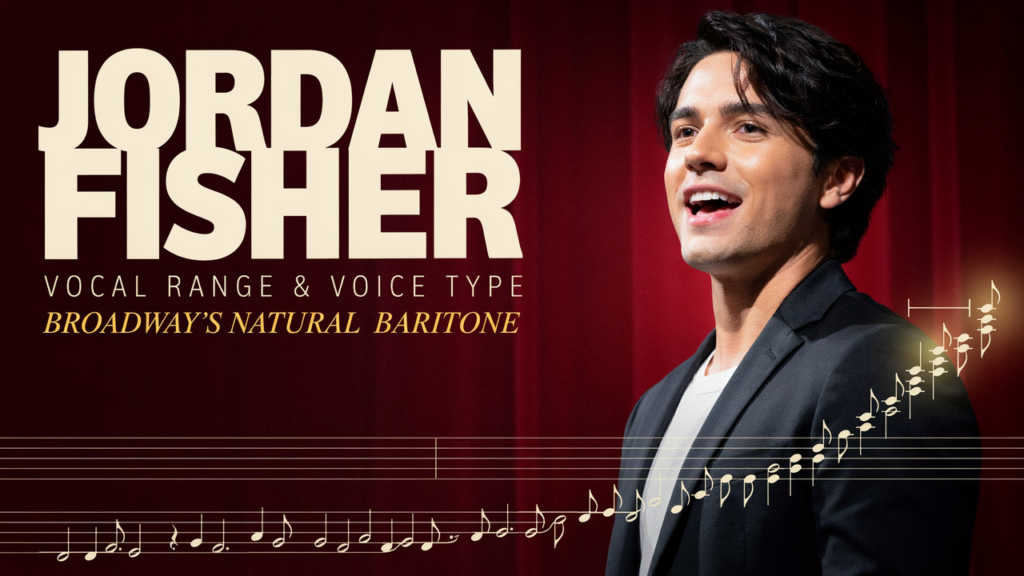
Jordan Fisher’s Vocal Range at a Glance
Vocal range: approximately A2 – A4 (natural baritone), with upper extensions developed for specific roles Voice type: Baritone (with developed tenor upper register) Vocal registers in use: Chest voice, mixed voice, head voice/falsetto Approximate span: Around 2 octaves natural; wider with developed upper register Tessitura (comfortable centre): Roughly C3 to F4 Active career: 2013–present
What Voice Type Is Jordan Fisher?
Fisher is a baritone by his own and Playbill’s explicit acknowledgment. This places him in an interesting category: a natural baritone taking on roles written for voices in the tenor zone. Evan Hansen’s material sits primarily in the upper baritone-lower tenor range — demanding for a baritone but not impossible for one with developed upper register technique and the right vocal coaching.
The vocal consultant Liz Caplan (who has worked with many Broadway leads including original Dear Evan Hansen cast members) worked specifically with Fisher to prepare his voice for the score’s demands. The result, Playbill noted, paid off — he completed the engagement successfully and received positive critical notices for the performance.
His subsequent casting as Orpheus in Hadestown — another role that requires a baritone with tenor-adjacent upper range facility — and Christian in Moulin Rouge! reflect a pattern: roles written at the upper end of the baritone range, suited to an instrument with Fisher’s natural depth and developed upper reach.
The baritone vocal range page covers the full classification and where his voice sits within it.
His Lower Register: Natural Baritone Depth
Fisher’s natural chest voice in the lower-to-mid third octave is where his baritone identity is most present. Roles like Anthony Hope in Sweeney Todd — a young, romantic tenor role in the original conception, but one that lies comfortably in the upper baritone range for a voice like Fisher’s — showcase this lower warmth. The Anthony Hope material in Sondheim’s score includes some of the score’s most lyrically exposed passages, and a voice with genuine lower chest resonance gives them more gravity than a lighter tenor instrument would.
His Philip Hamilton material in Hamilton — the brief but emotionally intense role that includes the duel scene — also sits in this baritone zone, where his natural instrument needs no stretching and the emotional weight is fully supported by the chest voice.
The Upper Register: Baritone Stretch Into Tenor Territory
The Dear Evan Hansen score — particularly “Waving Through a Window” and “For Forever” — requires the voice to sustain upper notes in the Bb4–C5 range repeatedly across a full performance. For a natural baritone, this is the territory where deliberate technique development makes the difference between a voice that can get there and one that sustains there night after night.
Fisher described the preparation as “the hardest time getting off book” in his career — which speaks to both the technical demands and the complexity of Evan Hansen’s musical phrasing. The vocal work with Liz Caplan specifically targeted the upper range development needed to sustain the score’s demands.
His work as Orpheus in Hadestown — another role that requires baritone warmth in the lower register and access to the upper fourth octave in the climactic passages — demonstrates that this upper register development has become a consistent part of his technical toolkit rather than a one-time stretch.
Broadway Career: Five Major Roles
Fisher’s Broadway career spans an unusual breadth of repertoire for a single voice type:
Hamilton (2016): John Laurens/Philip Hamilton — baritone-comfortable hip-hop musical theatre.
Dear Evan Hansen (2020): Evan Hansen — first Black actor to play the role full-time; baritone stretching into upper register for Pasek and Paul’s demanding score.
Sweeney Todd revival (2023): Anthony Hope — Sondheim’s romantic tenor role handled in baritone range.
Hadestown (2024–2025): Orpheus — mythological tenor role requiring the full upper register.
Moulin Rouge! (2025): Christian — romantic lead requiring belt and emotional power across a pop/rock score.
This range of roles — from Hamilton to Sondheim to Anaïs Mitchell — demonstrates how far the same baritone instrument can travel with the right technical development and coaching support.
If you want to find out where your own voice sits — whether you share Fisher’s baritone foundation or fall somewhere else — the vocal range finder will map your range, and the voice type test will give you a classification.
FAQs About Jordan Fisher’s Vocal Range
What is Jordan Fisher’s vocal range?
His natural baritone range spans approximately A2 to A4, with upper register extensions developed through vocal coaching to reach into tenor territory for roles like Evan Hansen and Orpheus.
What voice type is Jordan Fisher?
He is a natural baritone — explicitly confirmed in Playbill’s coverage of his Dear Evan Hansen casting. His career has involved deliberate vocal development to access the upper baritone-lower tenor range required by the roles he has taken on.
Was Jordan Fisher the first Black actor to play Evan Hansen?
Yes — he became the first Black actor to play the title role full-time when he joined the Broadway production in January 2020.
What other Broadway shows has Jordan Fisher appeared in?
His Broadway credits include Hamilton (John Laurens/Philip Hamilton), Dear Evan Hansen (Evan), Sweeney Todd revival (Anthony Hope), Hadestown (Orpheus), Moulin Rouge! (Christian), and Freestyle Love Supreme as a guest performer.
Did Jordan Fisher win Dancing with the Stars?
Yes — he won Season 25 in 2017, partnered with Lindsay Arnold. He is also a Disney Channel alumnus (Teen Beach Movie, High School Musical: The Musical: The Series) and appeared in the Fox live television musicals Grease Live (as Doody) and Rent Live (as Mark Cohen).
Erika Parker is a vocal analysis and singing education writer at Vocal Range Test. She focuses on vocal range testing, voice type analysis, pitch recognition, and singing tools for vocalists, musicians, choir singers, and beginners.