
Tim Waurick’s vocal range is documented by Wikipedia as spanning “nine octaves” — an extraordinary claim that warrants careful contextualisation — with an ability to sustain single notes for over 30 seconds that has become one of the most discussed features of his performances with the barbershop quartet Vocal Spectrum. Born in Levittown, Pennsylvania, where he began singing barbershop at around age 12, Waurick has turned what he describes as a “hobby” into a profession: his company TimTracks produces learning tracks for the Barbershop Harmony Society, Sweet Adelines International, and barbershop ensembles worldwide.
He won the International Barbershop Quartet Contest in 2006 as part of Vocal Spectrum — one of the most competitive achievements in the barbershop world — and has been a member of Ambassadors of Harmony, four-time International Chorus Champions (2004, 2009, 2012, 2016). The Vocal Spectrum Wikipedia entry describes its “distinctive sound” as centring on “the incredibly high vocal range of tenor Tim Waurick and lead Eric Dalbey.”
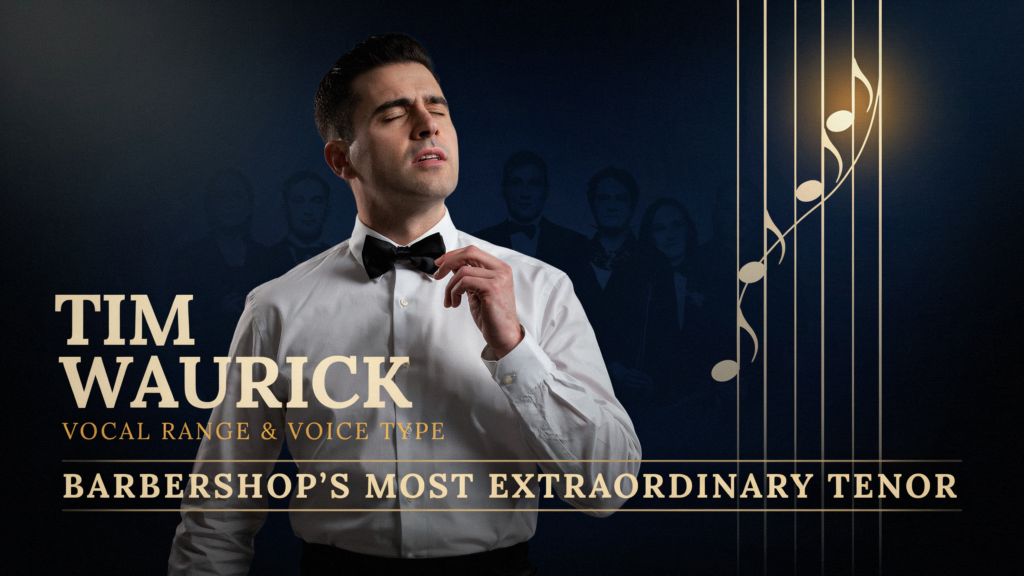
Tim Waurick’s Vocal Range at a Glance
Documented range: “nine octaves” (Wikipedia — includes all extended vocal techniques) Voice type: Barbershop tenor (highest of the four barbershop parts) Special technique: Can sustain single notes for 30+ seconds Active career: approximately 2003–present
Understanding the “Nine-Octave” Claim
Nine octaves is a figure that requires context. The standard human piano spans about 7 octaves; the full range of human pitch perception encompasses roughly 10 octaves; most singers span 2 to 3 octaves of practical singing range. A “nine-octave” documented vocal range almost certainly includes every extended vocal technique available to the human voice — vocal fry at the sub-bass extreme, modal singing across chest and head registers, and the whistle register or extreme falsetto at the top.
The Wikipedia documentation of this range places Waurick in the company of similarly extreme range claims: Dimash Kudaibergen’s six-octave documented range, Mitch Grassi’s six-octave documented range, and Tim Storms’ Guinness World Record for the lowest note. These extreme ranges are real in the sense that the notes are produced — but they involve register extensions that are acoustically distinct from the modal singing that most listeners associate with “vocal range.”
What is undisputed and more musically significant is his “incredibly high vocal range” — the specific quality that makes him stand out in the barbershop tenor role, and the sustained note capability documented at over 30 seconds, which is a measure of breath control and cord stability rather than pitch range.
The average vocal range and widest vocal range pages give context for how extreme range claims fit within the broader landscape of documented vocal capability.
The Barbershop Tenor: What the Role Requires
In barbershop harmony, the four parts are tenor (highest), lead (melody), baritone (fills harmony), and bass (lowest). The tenor sings above the melody, typically in falsetto or the high head voice, creating the characteristic “ring” overtone series that defines barbershop’s acoustic signature.
This means the barbershop tenor’s technical requirements are fundamentally different from a classical or pop tenor: the focus is not on chest-voice power or dramatic projection but on accessing and sustaining the highest notes of the male voice with stability, blend, and the specific acoustic quality that produces the harmonic overtone ring. A barbershop quartet resonates at a frequency above any of the four parts when the harmonics align correctly — the “fifth voice” that barbershop singers and coaches consistently reference.
Waurick’s “incredibly high vocal range” within the barbershop tenor framework means access to notes above what most barbershop tenors can comfortably sustain — which is already the highest part in an ensemble of trained male singers.
Vocal Spectrum: 2006 International Champions
The Barbershop Harmony Society’s International Quartet Contest is the premier competitive event in the barbershop world. Vocal Spectrum’s 2006 championship — preceded by their 2004 collegiate championship — represents the highest competitive achievement in the genre. The quartet’s members are all graduates of Lindenwood University in St. Charles, Missouri, and all members of Ambassadors of Harmony.
The American Harmony documentary (2009) features Vocal Spectrum’s competitive journey — providing public documentation of what their performance level looks like and what Waurick’s tenor contributes to it.
The Sustained Note: 30 Seconds
The ability to hold a single note for over 30 seconds is a measure of breath management, cord stability, and physical control that goes significantly beyond what most singers can demonstrate. A 30-second sustained note requires: enough breath support to sustain the air column for the full duration; the cord control to maintain consistent vibration without allowing pitch to drift or the note to break; and the physical stamina to resist the body’s natural impulse to breathe.
This technical accomplishment — documented by the Vocal Spectrum Wikipedia page — is distinct from the nine-octave range claim and more directly observable and verifiable.
The vocal range and singing techniques page covers how breath control and cord stability interact in producing sustained vocal performance.
TimTracks: Turning Expertise Into a Profession
His company TimTracks.com produces learning tracks for barbershop organisations worldwide. Learning tracks — recordings where one voice part is prominent while the others are soft in the background — are how barbershop singers learn their individual parts before ensemble rehearsal. The scale of demand for these recordings across the Barbershop Harmony Society, Sweet Adelines International, and independent quartets and choruses has allowed Waurick to build a professional career around what began as a community music hobby.
FAQs About Tim Waurick’s Vocal Range
What is Tim Waurick’s vocal range?
Wikipedia documents his range as “nine octaves” — a figure that includes all extended vocal techniques across the full span of producible sound. His practical singing range within barbershop performance is not separately quantified, but his “incredibly high vocal range” in the tenor part is the defining feature of Vocal Spectrum’s sound.
What voice type is Tim Waurick?
He is a barbershop tenor — the highest of the four barbershop parts, typically accessed in falsetto or high head voice to produce the characteristic overtone ring above the melody line.
How long can Tim Waurick hold a note?
The Vocal Spectrum Wikipedia entry documents his ability to sustain notes for “upwards of 30 seconds” — a measure of breath control and cord stability rather than range.
What is Vocal Spectrum?
A barbershop quartet from St. Charles, Missouri, whose members all graduated from Lindenwood University. They won the Barbershop Harmony Society’s International Collegiate Quartet Contest in 2004 and the International Quartet Contest in 2006 — the highest competitive achievement in the barbershop world.
What is TimTracks?
Tim Waurick’s professional learning track company, which produces recordings for the Barbershop Harmony Society, Sweet Adelines International, and barbershop ensembles worldwide. It represents his transition from competitive barbershop singer to full-time music professional.
Erika Parker is a vocal analysis and singing education writer at Vocal Range Test. She focuses on vocal range testing, voice type analysis, pitch recognition, and singing tools for vocalists, musicians, choir singers, and beginners.